
Identifying Animals Worksheets for 8-Year-Olds
4 filtered results
Difficulty Level
Grade
Age
-
From - To
Subject
Activity
Standards
Discover our engaging "Identifying Animals Worksheets for 8-Year-Olds," designed to enhance learning through fun and interactive activities! Tailored for children at this crucial developmental stage, these worksheets help kids sharpen their observation skills while exploring various animal species. Young learners will enjoy activities that promote identification, classification, and understanding of different habitats. Ideal for classroom use or at-home enrichment, our worksheets incorporate vibrant illustrations and captivating facts to ignite curiosity. By making learning enjoyable, we ensure that children not only retain knowledge but also develop a lasting appreciation for the animal kingdom. Download our worksheets today for an exciting educational experience!
Favorites
With answer key
Interactive
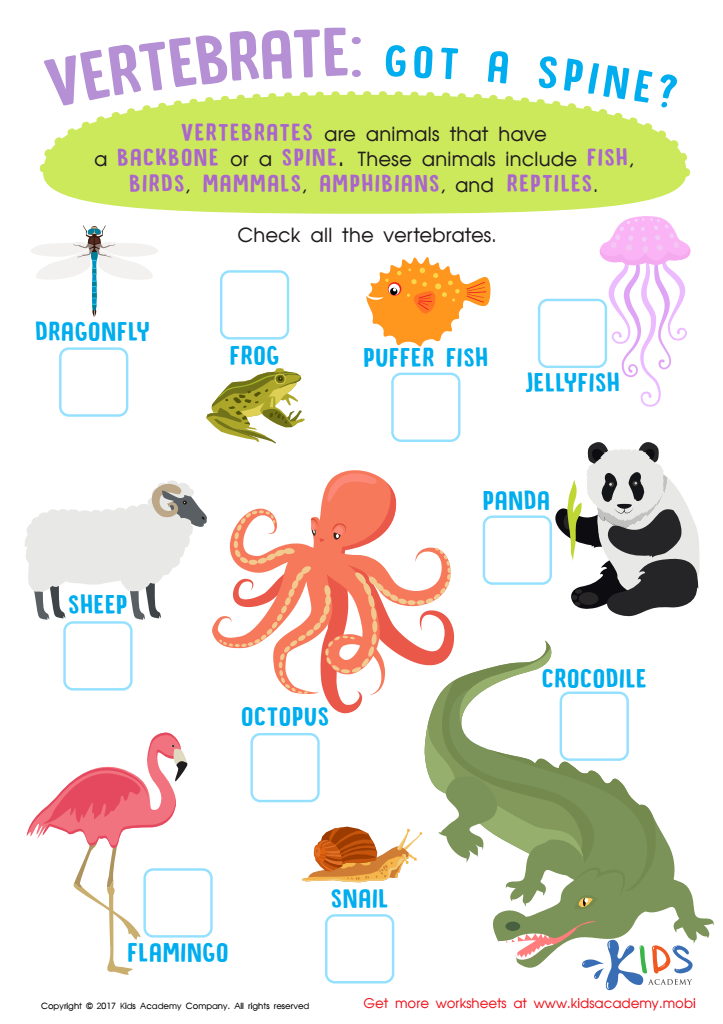
Vertebrates Animals Worksheet for 3rd Grade
This 3rd grade worksheet introduces your child to the wonders of vertebrate animals. They will have fun sorting them from those without a spine, while learning more about the animal kingdom!
 Assign to My Students
Vertebrates Animals Worksheet for 3rd Grade
Worksheet
Join Kids Academy for Free
Who is primarily going to use this learning content?




.jpg)


Identifying animals is an important skill for 8-year-olds, and both parents and teachers should prioritize it for several reasons. First, it enhances children's observational skills and critical thinking. When kids learn to identify different animals, they begin to notice details about their habitats, behaviors, and lifestyles, nurturing a sense of curiosity and exploration about the world around them.
Second, knowledge of animals promotes environmental awareness. Understanding various species helps children recognize the rich biodiversity in their surroundings and the importance of conservation. This groundwork fosters a sense of responsibility towards nature, encouraging them to protect endangered species and their habitats.
Additionally, studying animals connects to literacy and numeracy. Engaging projects about animal classifications, habitats, and diets introduce reading, writing, and basic math concepts in a fun and interactive way. This multi-disciplinary approach enriches their learning experience.
Moreover, social skills can be developed through collaborative animal research projects or field trips to local zoos or parks. Encouraging cooperative learning during these activities helps children build teamwork and communication skills.
In essence, identifying animals cultivates a variety of skills and attitudes in children that are foundational for their overall educational development and environmental stewardship.








