Enhancing problem-solving abilities Adding up to 100 Worksheets for 8-Year-Olds
3 filtered results
-
From - To
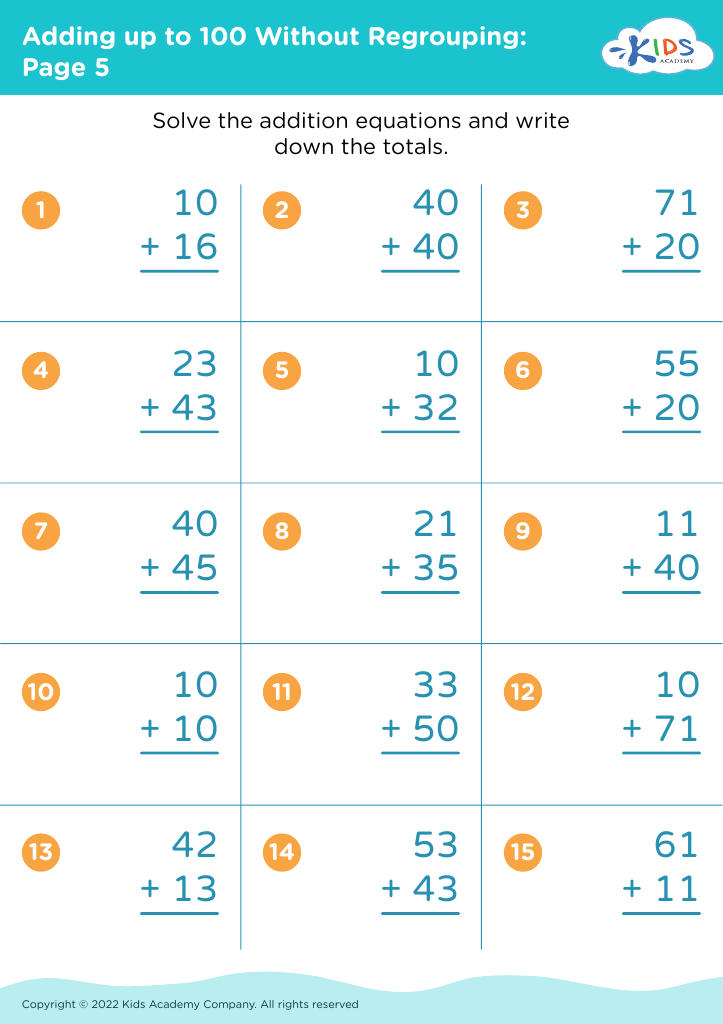
Enhancing problem-solving abilities in 8-year-olds is crucial for their cognitive development. Our "Adding up to 100 Worksheets" are designed specifically to boost these skills, offering engaging and educational exercises that challenge young minds. Perfect for building both confidence and competence in math, these worksheets present a variety of problems that encourage logical thinking and numerical fluency. Each sheet is crafted to make learning fun, helping kids to seamlessly integrate problem-solving into their daily lives. Whether in the classroom or at home, our resources ensure that your child develops vital math skills to set a solid foundation for future learning.








%20(1).jpg)
Enhancing problem-solving abilities and the skill of adding up to 100 in 8-year-olds is foundational for several critical reasons. These skills lie at the heart of mathematical understanding and cognitive development during early education. When parents and teachers focus on these areas, they foster a child's analytical thinking and ability to tackle complex problems, both of which are essential for academic success across subjects.
First, solidifying addition skills up to 100 equips children with the numerical fluency they need to approach more advanced mathematics with confidence. Such fluency promotes a deeper understanding of arithmetic operations, fractions, and eventually, algebra. Moreover, problem-solving strengthens critical thinking and turns abstract mathematical concepts into logical, comprehensible steps, which reinforces their overall intellectual development.
Second, problem-solving and basic arithmetic skills are closely tied to real-life situations, from handling money to time management, thereby enhancing practical life skills. Early mastery of these can improve a child's autonomy and self-efficacy, building the foundation for a positive relationship with learning.
Overall, emphasizing these skills nurtures a growth mindset, teaches perseverance, and enhances a child's ability to think independently. By investing in these fundamental skills, parents and teachers set children on a path that opens doors to a wide array of future opportunities.








