
Understanding area Math Worksheets for 8-Year-Olds
3 filtered results
Difficulty Level
Grade
Age
-
From - To
Subject
Activity
Standards
Unlock the world of mathematical measurements with our "Understanding Area" math worksheets designed specifically for 8-year-olds. Perfectly crafted to blend fun with education, these worksheets enable young learners to grasp the concept of area through engaging exercises and vibrant visuals. From counting unit squares to comparing areas, each activity leads children on a journey to discover how space is quantified. With step-by-step explanations and practical challenges, your child will gain confidence and improve their problem-solving skills. Ideal for parents and teachers, our worksheets ensure a solid foundation in math fundamentals while keeping learning enjoyable.
Favorites
With answer key
Interactive
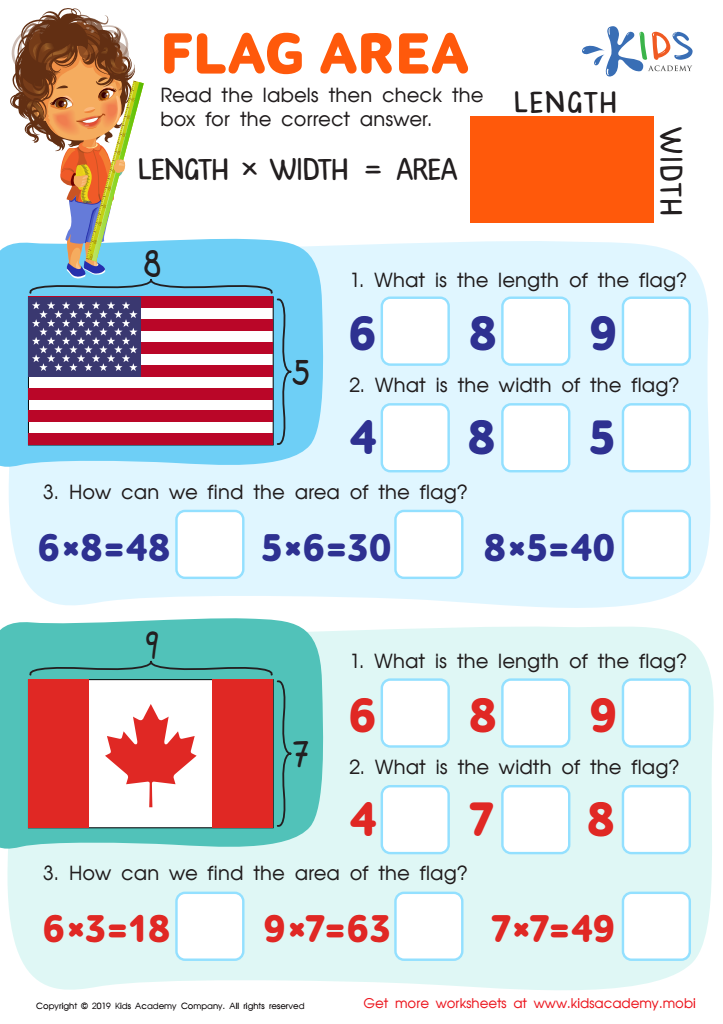
Flag Area Worksheet
Test your child's knowledge of flags by asking which ones they can identify in the image. Then, study the worksheet together. There are 6 questions with labels. Have them read each label and check the box for the correct answer.
 Assign to My Students
Flag Area Worksheet
Worksheet
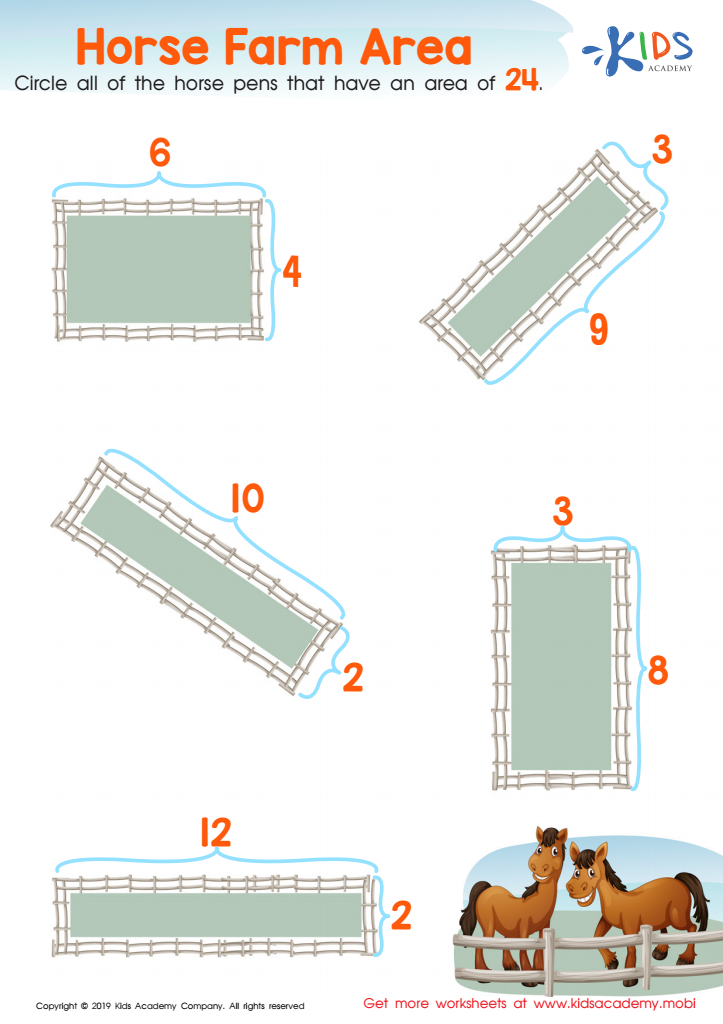
Horse Farm Area Worksheet
Take your kids to a horse farm! They'll love it – there's lots to explore, plus they can ride horses. Then challenge them with a geometry worksheet: help them calculate the area of all the horse pens, then circle the ones with an area of 24.
Horse Farm Area Worksheet
Worksheet
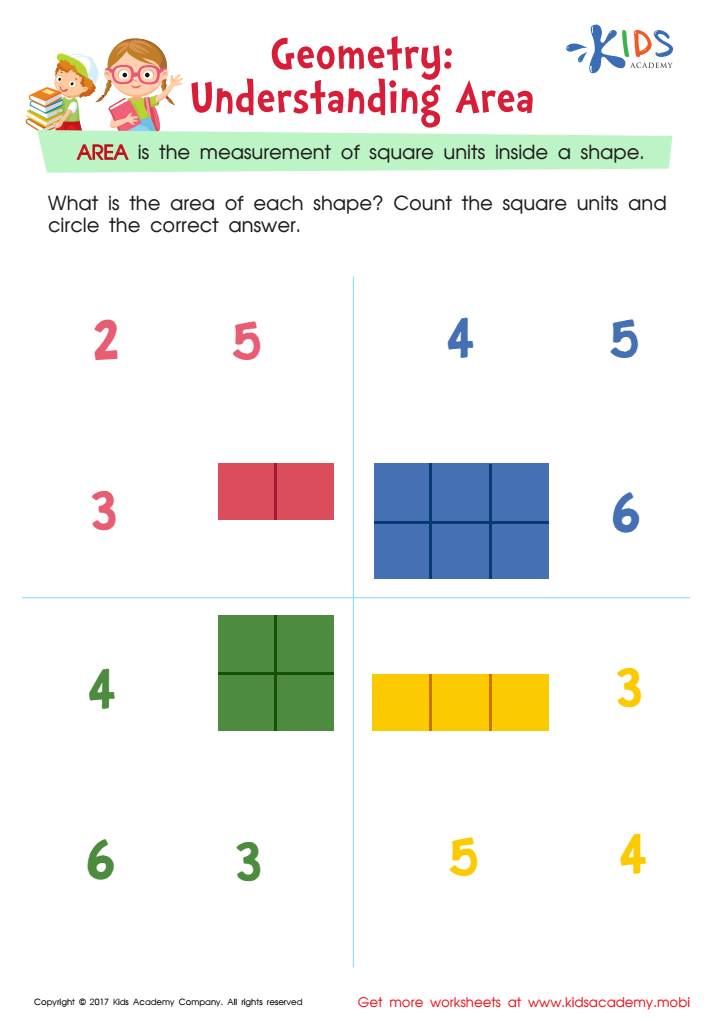
Understanding Area Worksheet
This helps them develop a better understanding and an easier way to learn instead of memorizing a formula.
Understanding Area Worksheet
Worksheet
Join Kids Academy for Free
Who is primarily going to use this learning content?








Understanding area is a crucial math concept that benefits 8-year-olds in numerous ways, which is why parents and teachers should give it ample attention. At this age, children are in a developmental stage where they begin to grasp more complex mathematical ideas, and learning about area lays the foundation for future math skills. Comprehending area involves spatial reasoning and problem-solving, both of which are essential cognitive skills.
When children understand area, they can better visualize and understand the space around them. This knowledge isn't just crucial for math classes; it enhances their ability to make sense of the world. For instance, they can figure out how much room they have to play, how to set up their toys precisely, or how to help with gardening by determining how much soil a plot might need.
Moreover, a grounding in area concepts paves the way for understanding more advanced topics they'll encounter later, such as geometry and algebra. It develops their ability to reason logically and think in abstract terms. Also, early familiarity with area and measurements can foment an interest and confidence in STEM (Science, Technology, Engineering, Mathematics) fields, fostering lifelong skills and career prospects. Therefore, emphasizing the learning of area at this stage builds critical mathematical fluency and practical life skills that will benefit children immensely as they grow.








