
Counting skills Governance and Civics Worksheets for 8-Year-Olds
3 filtered results
Difficulty Level
Grade
Age
-
From - To
Subject
Activity
Standards
Enhance your 8-year-old's understanding of governance and civics with our engaging Counting Skills Worksheets! Designed specifically for young learners, these worksheets combine essential civic concepts with fun counting exercises. Children will explore basic government principles while practicing their counting skills, promoting both numeracy and civic awareness. With colorful, age-appropriate activities, our resources keep kids motivated and excited to learn. From counting representatives to recognizing numbers in civic situations, these worksheets serve as a practical tool to bridge the gap between math and social studies. Perfect for classroom use or at-home practice, these worksheets are a valuable addition to any young learner's educational journey.
Favorites
With answer key
Interactive
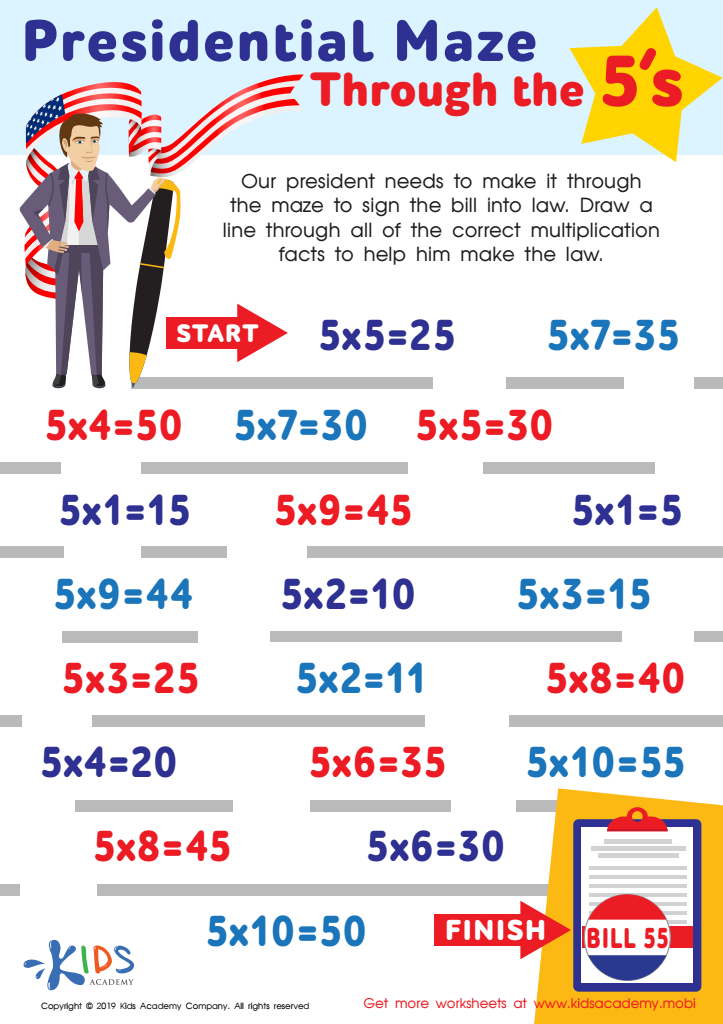
Presidential Maze Through the 5’s Worksheet
Help your kids draw a line through the right multiplication facts to guide the state's President to sign the bill into law. This is a big responsibility - the President has been elected to make decisions on behalf of the people and has the power to make laws and sign them.
 Assign to My Students
Presidential Maze Through the 5’s Worksheet
Worksheet
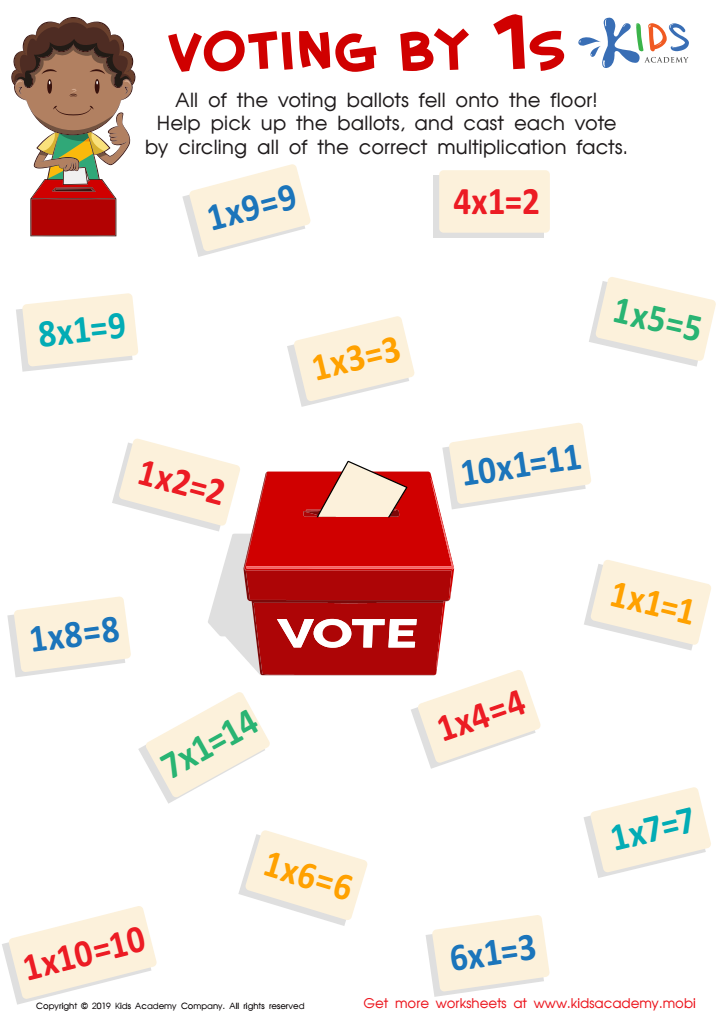
Voting by 1s Worksheet
Ask your child if they can list duties of a good citizen. These include voting, to elect right leaders. With this worksheet, the voting ballots have fallen to the floor! Help your kids pick them up and cast each vote by circling the correct multiplication facts.
Voting by 1s Worksheet
Worksheet
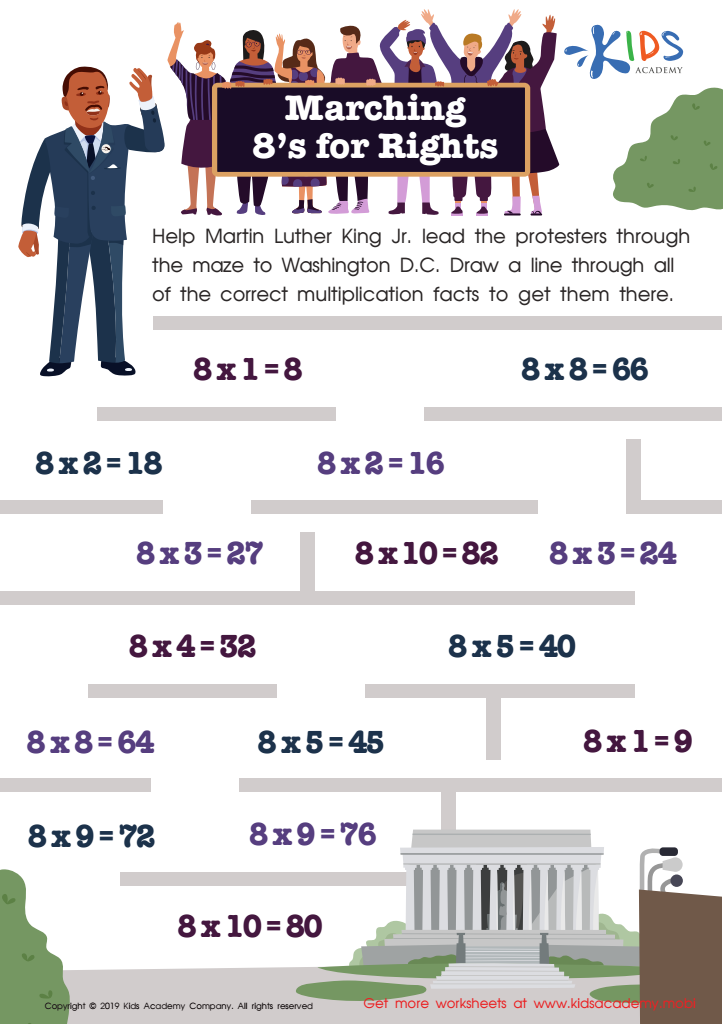
Marching 8’s for Rights Worksheet
Encourage your students to explore MLK's history! This worksheet provides the perfect opportunity. Help them understand his contributions by having them "march" MLK from the starting point to Washington D.C. Have them draw a line through the correct multiplication facts to get there. It's an enjoyable way for kindergartners to learn about a key part of history.
Marching 8’s for Rights Worksheet
Worksheet
Join Kids Academy for Free
Who is primarily going to use this learning content?


Counting skills, alongside an understanding of governance and civics, are essential for 8-year-olds as they form the foundation for both academic and social development. Firstly, counting skills are vital for developing mathematical understanding, critical for everyday tasks and future learning. Mastery of these skills fosters logical thinking, problem-solving, and laying the groundwork for more complex mathematical concepts.
Moreover, introducing governance and civics at an early age encourages children to grasp their roles in society. By understanding basic democratic principles, rights, and responsibilities, children learn to appreciate the importance of participation, community engagement, and decision-making. This knowledge empowers them to become informed citizens who can advocate for themselves and others.
Parents and teachers play a crucial role in nurturing these skills. By integrating counting exercises with civic education, they can create engaging learning experiences that highlight the connection between mathematics and real-world applications, such as budgeting, voting, and community organization. Encouraging discussions about local governance, community roles, and civic duties in tandem with counting activities will help children see the relevance of their education. This holistic approach ensures that children become both numerically literate and socially responsible individuals, equipped for the complexities of the world.








