Normal Building Vocabulary Worksheets Activities With Answers for 8-Year-Olds
1 filtered results
-
From - To
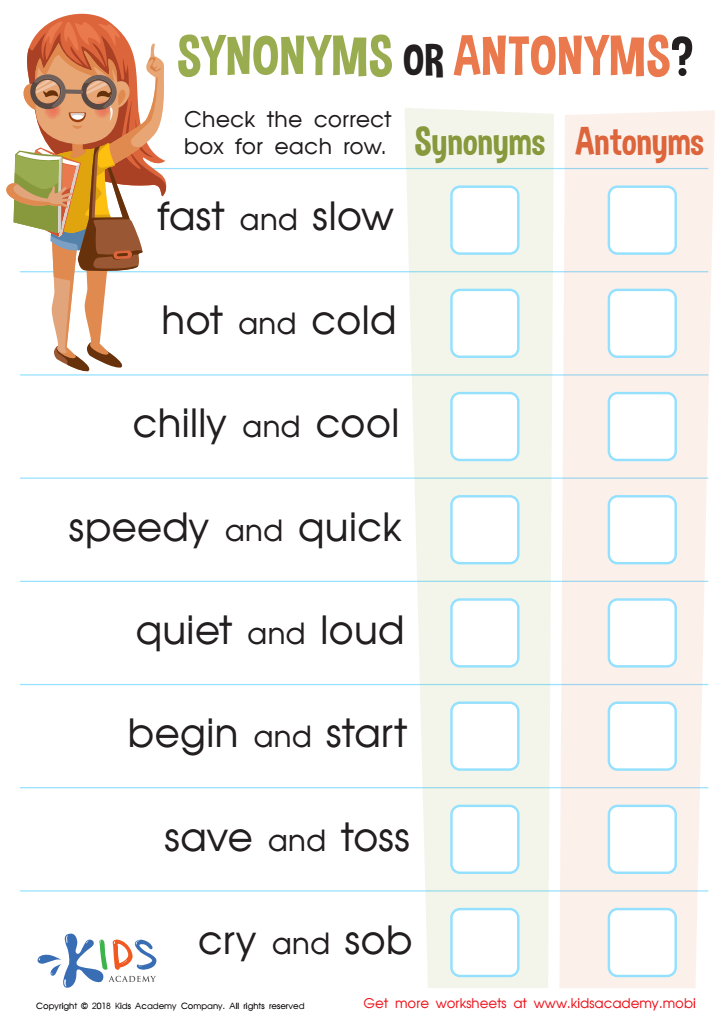
Synonyms or Antonyms: Assessment Worksheet
 Assign to My Students







Normal Building Vocabulary Worksheets Activities With Answers are an essential tool in the journey of language learning and development. These activities are designed with the intention to expand the learner’s vocabulary in a structured and meaningful way, making them an indispensable resource in both classroom settings and self-study routines.
One of the primary reasons these worksheets are so useful is that they provide a systematic approach to learning new words. Through various exercises such as matching words to their definitions, filling in the blanks with appropriate words, and using new vocabulary in sentences, students are able to understand and retain words more effectively. This methodical exposure ensures that learners can gradually build their vocabulary foundation, adding layers of complexity as they progress.
Moreover, Normal Building Vocabulary Worksheets Activities come with answers, offering immediate feedback to learners. This feature is particularly beneficial as it allows students to self-correct and understand their mistakes in real-time. The inclusion of answers not only aids in reinforcing the correct use of new vocabulary but also boosts learners’ confidence as they can verify their understanding instantly.
These worksheets are also versatile in nature, catering to a wide range of learning styles. Whether a learner prefers visual aids, context clues, or direct definitions, vocabulary worksheets can be adapted to meet these various needs, making vocabulary acquisition more accessible and engaging for all types of learners.
Furthermore, consistent practice with these worksheets can significantly improve reading comprehension and writing skills. As learners expand their vocabulary, they become more adept at understanding complex texts and expressing their thoughts more precisely and eloquently in writing.
In conclusion, Normal Building Vocabulary Worksheets Activities With Answers are a valuable asset for anyone looking to enhance their language skills. Through structured learning, immediate feedback, versatility in learning approaches, and the positive impact on reading and writing, these worksheets play a crucial role in the effective acquisition and application of new vocabulary.








