Subtraction Worksheets for Ages 4-8 - Page 5
97 filtered results
-
From - To
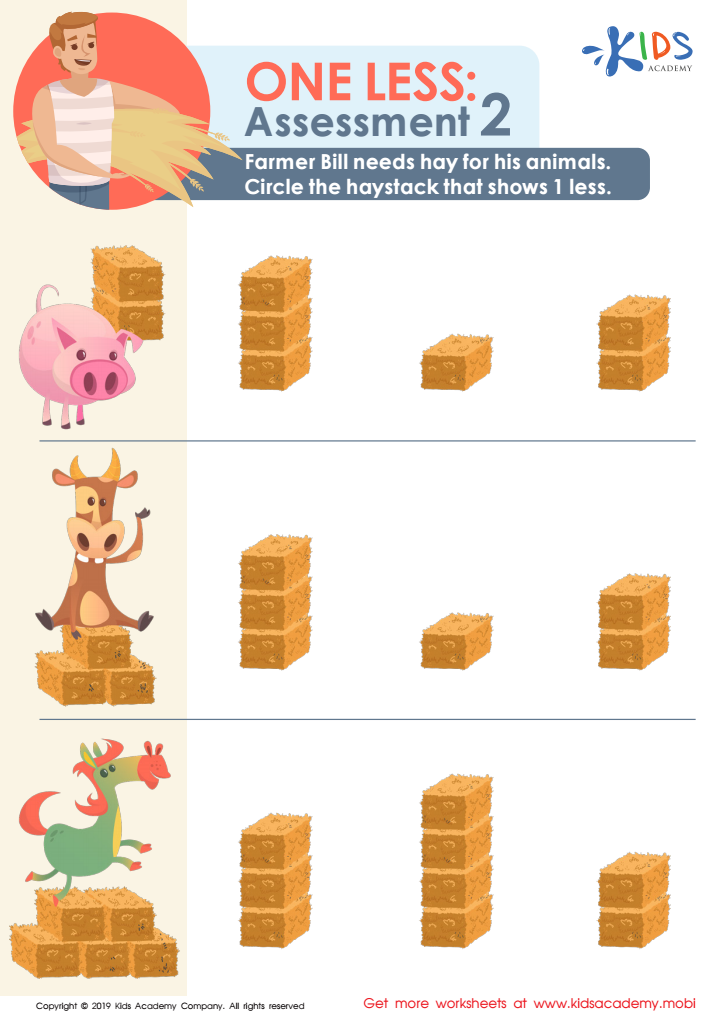
One Less: Assessment 2 Worksheet
 Assign to My Students








Subtraction is a fundamental math skill that lays the groundwork for children's future mathematical understanding and problem-solving abilities. For children ages 4-8, mastering subtraction promotes numerical literacy and critical thinking. Early exposure to this concept not only enhances their ability to perform simple calculations but also fosters a deeper understanding of quantity and relationship between numbers.
Parents and teachers should prioritize subtraction because it helps develop crucial cognitive skills, such as reasoning and logic. When children learn to subtract, they discover how numbers interact, paving the way for more complex mathematical concepts like addition and multiplication. Engaging with subtraction through games and real-life scenarios can make learning enjoyable while reinforcing these critical skills.
Additionally, a solid understanding of subtraction contributes to children's confidence in their abilities. It provides them with tools to tackle everyday situations, from sharing snacks to managing their allowances. This empowers them to start thinking independently. Finally, by focusing on subtraction early on, parents and teachers bridge the gap between basic math skills and advanced learning, ensuring children are well-prepared for future academic challenges. This foundational knowledge fosters a love for learning and equips children for lifelong success in mathematics and beyond.








