
K.NBT.A Number and Operations in Base Ten worksheets With Answers for Kindergarten - Page 2
26 filtered results
Difficulty Level
Grade
Age
-
From - To
Subject
Activity
Standards
Favorites
With answer key
Interactive
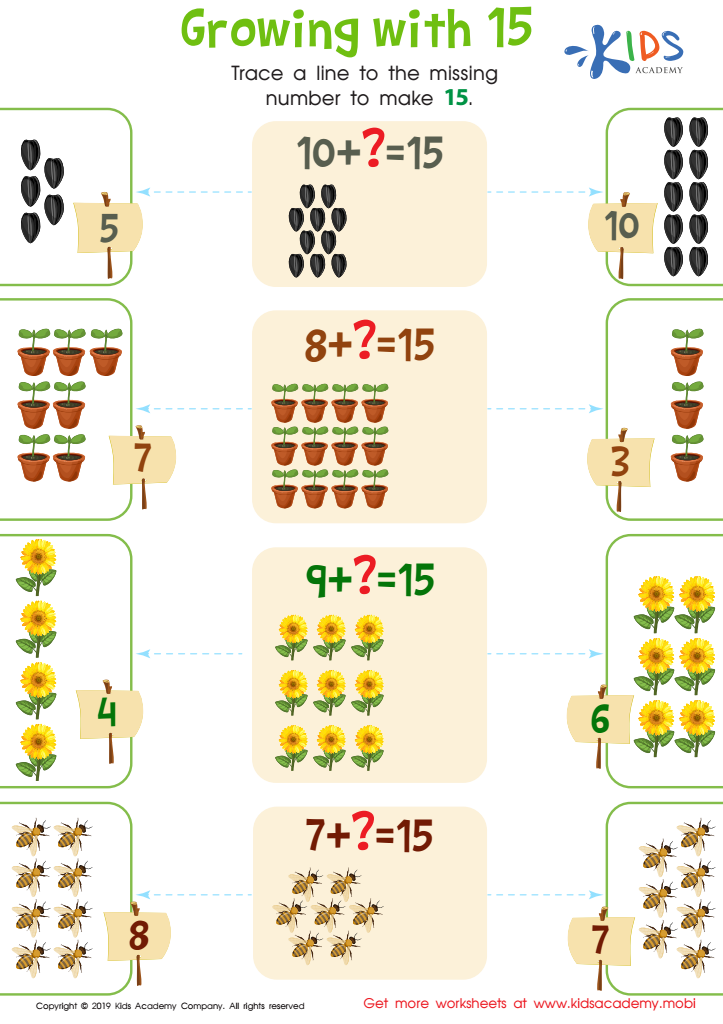
Growing with 15 Worksheet
Remind your kids that adding different sets of numbers can give the same total (e.g. 2+3=5, 4+1=5). Test their understanding by asking them for more examples. Move onto the worksheet: count objects, then trace the line to the number making a total of 15.
 Assign to My Students
Growing with 15 Worksheet
Worksheet
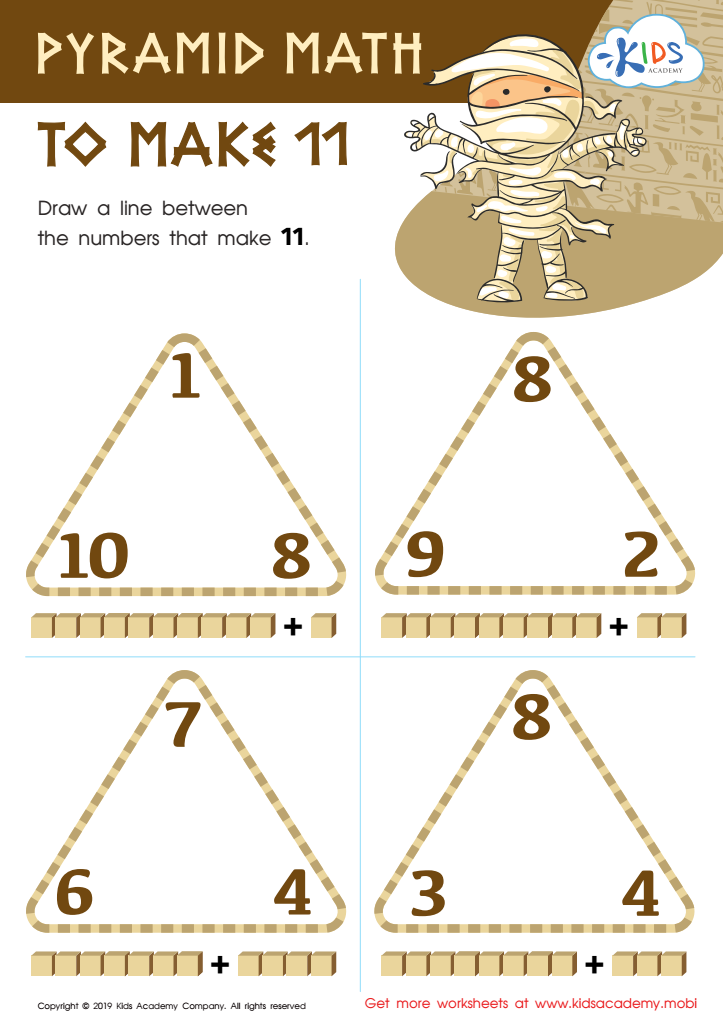
Pyramid Math to Make 11 Worksheet
Have your kids look at the picture of the Egyptian pyramids and tell you what they see. Then, help them do simple math by adding up the numbers in the pyramids and connecting those that make 11. This worksheet is perfect for teaching your kids about history, mathematics, and problem-solving.
Pyramid Math to Make 11 Worksheet
Worksheet
Join Kids Academy for Free
Who is primarily going to use this learning content?








K.NBT.A (Know numbers and operations in base ten) is crucial in kindergarten because it forms the foundation for a child's understanding of mathematics. At this early stage, students begin recognizing numbers and their values, which is key for all subsequent math learning.
Understanding base ten concepts allows children to grasp place value, making sense of how numbers are built and operated upon. This awareness leads to better problem-solving skills and number manipulation, empowering students to add, subtract, and eventually tackle more complex mathematical operations.
Parents and teachers should care about K.NBT.A because knowledge of place value sets the groundwork for future success in math. Children who develop strong numerical understanding in kindergarten are more likely to excel in later grades, reducing the risk of learning gaps that can hinder their academic achievement.
Furthermore, involving parents in reinforcing these skills at home fosters a love for math and builds confidence in their children's abilitlackies. By emphasizing K.NBT.A early on, we cultivate critical thinkers and proficient mathematicians, equipping them for a bright academic future. Recognizing its significance encourages a collaborative effort to provide enriching experiences both at school and home.








