Extra Challenge Tracing Shapes Worksheets for Ages 3-5
4 filtered results
Difficulty Level
Grade
Age
-
From - To
Subject
Activity
Standards
Give young learners an exciting way to develop crucial fine motor skills with our Extra Challenge Tracing Shapes Worksheets for Ages 3-5. Tailored for curious minds, these worksheets feature intricate shapes that help kids improve hand-eye coordination and geometric comprehension. Perfect for preschool through early kindergarten, they offer an engaging approach to mastering foundational skills. Each page invites children to carefully trace a variety of complex shapes, enhancing their dexterity and pre-writing abilities. Created by experts in early childhood education, these worksheets are a fun and educational resource to support your child’s growth and readiness for higher learning.
Favorites
With answer key
Interactive
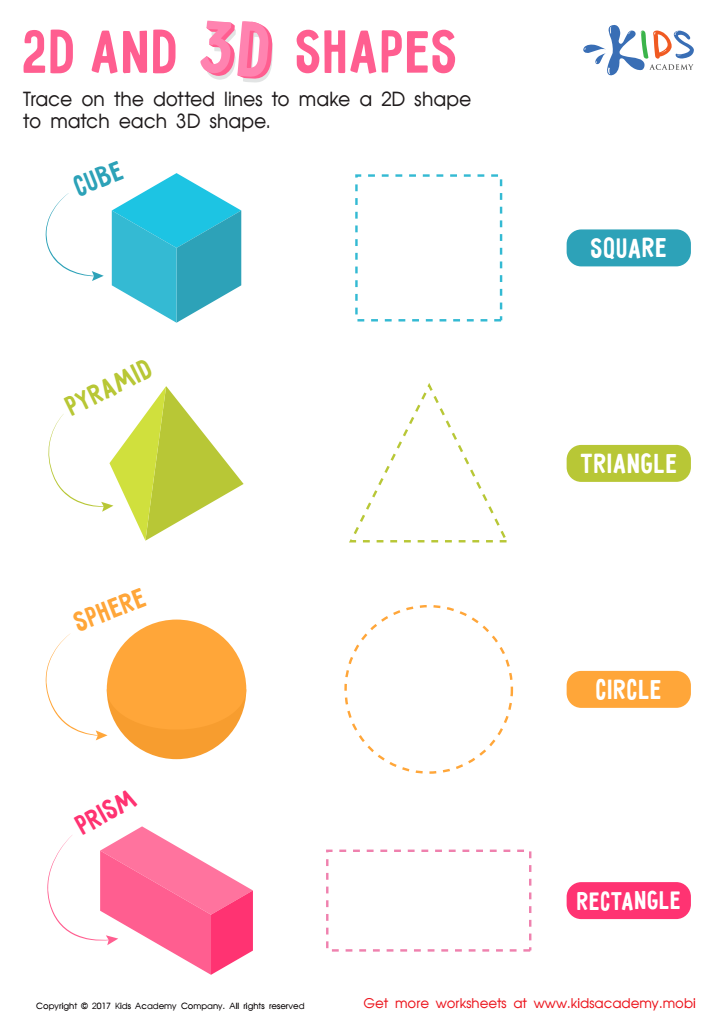
2D and 3D Shapes Worksheet
Introduce your child to 3D and 2D with this traceable worksheet. With dotted lines, help them trace and make a 2D shape for each 3D shape: square, triangle, rectangle, and circle. Show them there's more than one way to draw! You may have taken them to a 3D movie, or they've seen some fantastic 3D art. Now they can wonder no more.
 Assign to My Students
2D and 3D Shapes Worksheet
Worksheet
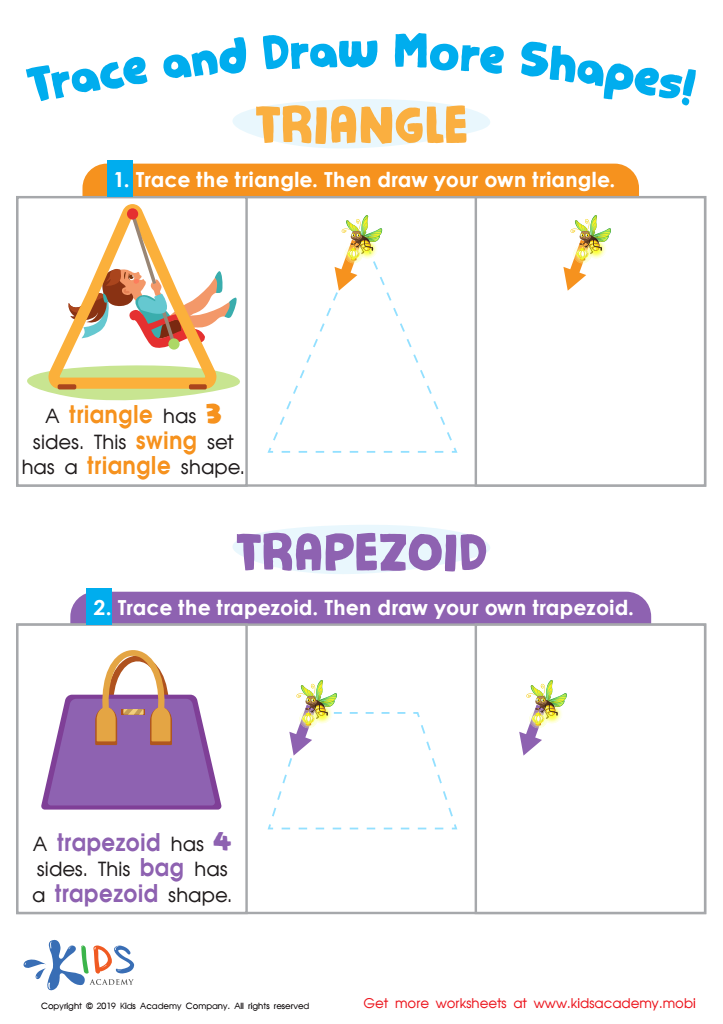
Trace and Draw More Shapes Worksheet
Help your kids with more learning! Look at images in the worksheet, read facts about the shapes, then help your kids trace and draw. This reinforces that learning is never done; use this simple worksheet to help your kids with school homework and more!
Trace and Draw More Shapes Worksheet
Worksheet
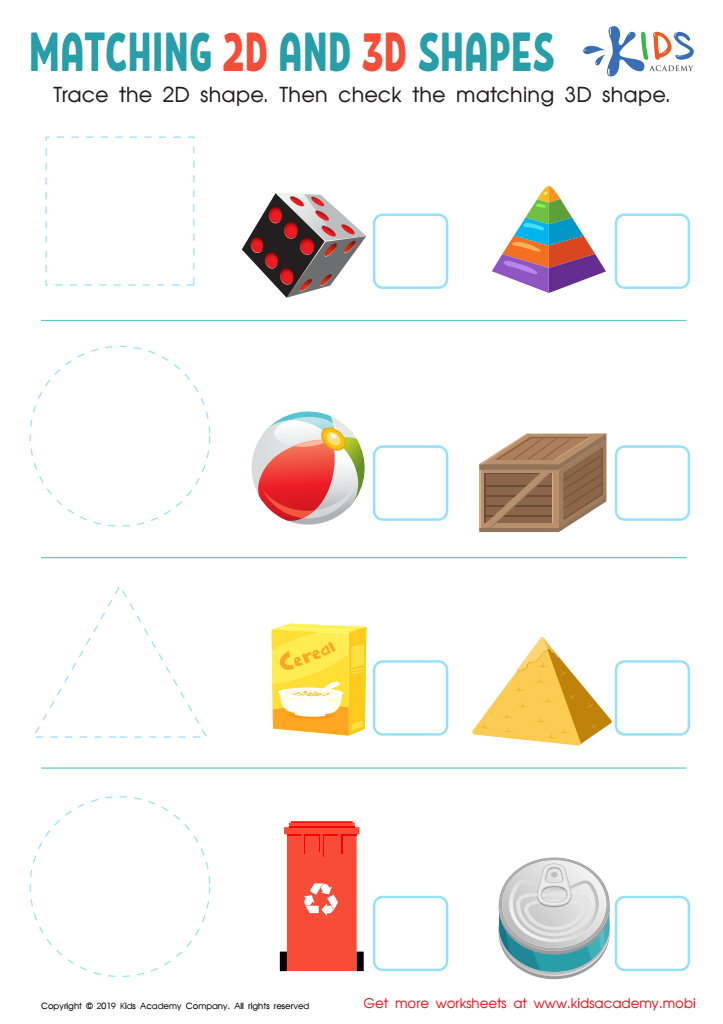
Matching 2D and 3D Shapes Worksheet
Before starting this worksheet, ask your kids what shapes they know and point out the 2D and 3D shapes on it. Help your kids trace the 2D shapes and then match them to the 3D versions. It'll be a fun new world for your kids to explore!
Matching 2D and 3D Shapes Worksheet
Worksheet
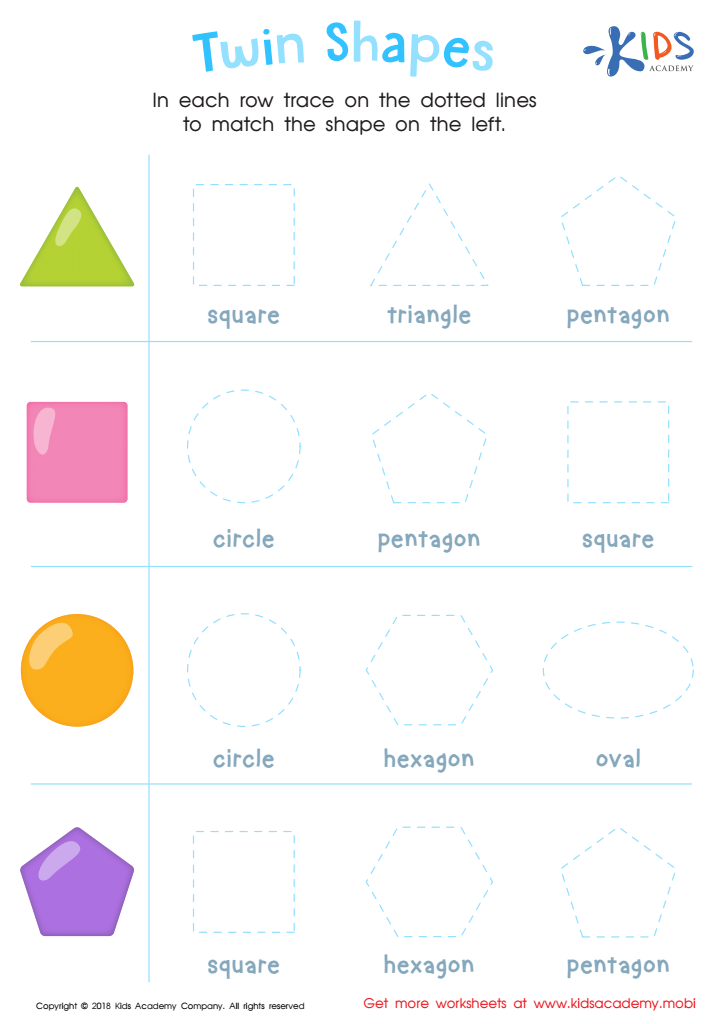
Twin Shapes Dot-to-Dot Worksheet
Test your child's ability to copy with this worksheet. Ask them to find and name the four shapes on the left. Then, they must match each with the dotted lines on the right. Help your child with all four shapes in this fun exercise.
Twin Shapes Dot-to-Dot Worksheet
Worksheet
Join Kids Academy for Free
Who is primarily going to use this learning content?








Extra Challenge Tracing Shapes activities for ages 3-5 are essential for several reasons, making them highly beneficial for early learning and development. Firstly, these activities bolster fine motor skills. Tracing shapes requires precise hand movements, which helps children enhance their hand-eye coordination and dexterity, pivotal skills for writing and other daily tasks.
Secondly, early exposure to shapes through tracing promotes cognitive development. Recognizing and understanding various shapes is fundamental in organizing and processing visual information. It lays the groundwork for mathematical concepts, as shapes are integral to geometry, pattern recognition, and problem-solving.
Moreover, these activities foster focus and concentration. The detailed nature of tracing helps young children practice patience and attention to detail, critical skills for their academic journey and life in general. Additionally, successfully completing shape tracing builds children's confidence and encourages a sense of achievement, motivating them to engage in more challenging tasks.
Lastly, tracing shapes links to language development. Educators can introduce shape-related vocabulary, accelerating verbal skills as children learn to describe the shapes they trace.
In summary, Extra Challenge Tracing Shapes activities are crucial as they support fine motor development, cognitive processing, concentration, self-confidence, and language acquisition, forming a robust foundation for future academic and life success.