Extra Challenge Area and Perimeter Worksheets for Ages 7-8
5 filtered results
Difficulty Level
Grade
Age
-
From - To
Subject
Activity
Standards
Explore our Extra Challenge Area and Perimeter Worksheets for ages 7-8, designed to enhance your child's math skills! These engaging worksheets provide an opportunity for young learners to deepen their understanding of area and perimeter through challenging problems and innovative activities. With a variety of formats, children will refine their problem-solving abilities while having fun. Perfect for reinforcing classroom concepts or as a captivating supplement to home learning, these worksheets are suitable for different learning levels. Encourage critical thinking and mathematical reasoning in your child today – download our Extra Challenge Worksheets and watch their confidence soar!
Favorites
With answer key
Interactive
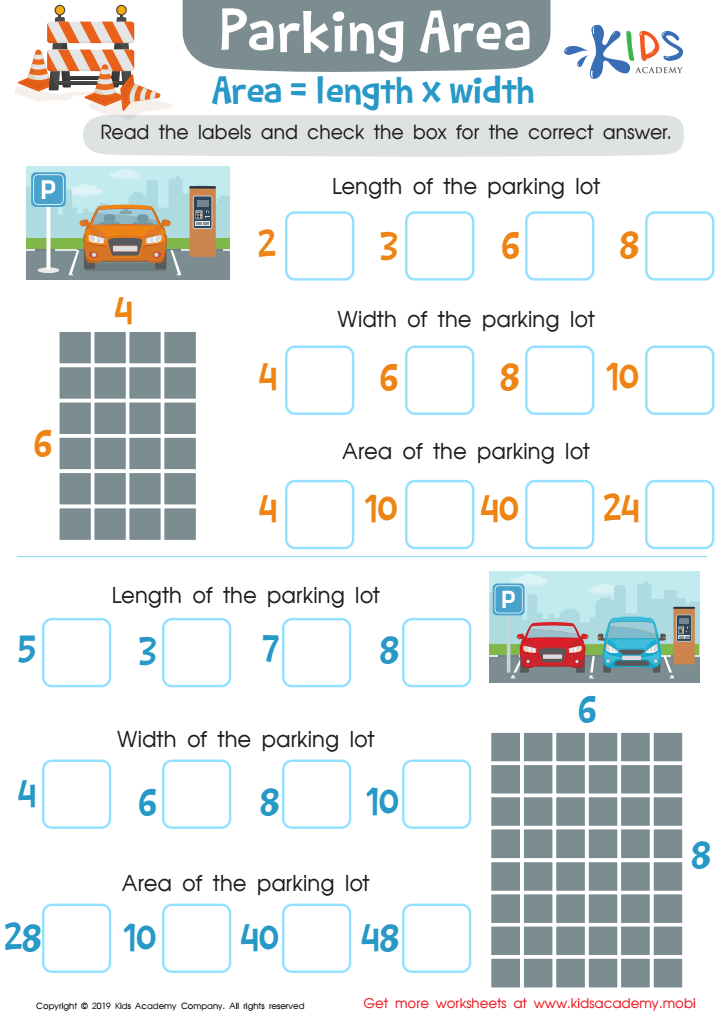
Parking Area Worksheet
Math may not be your child's favorite, but that doesn't mean they can't excel. Math can seem intimidating, but with practice, they can learn it's not so hard. In this worksheet, your kids will calculate the area of a parking lot, by adding length and width. Help them read the labels and select the correct answer.
 Assign to My Students
Parking Area Worksheet
Worksheet
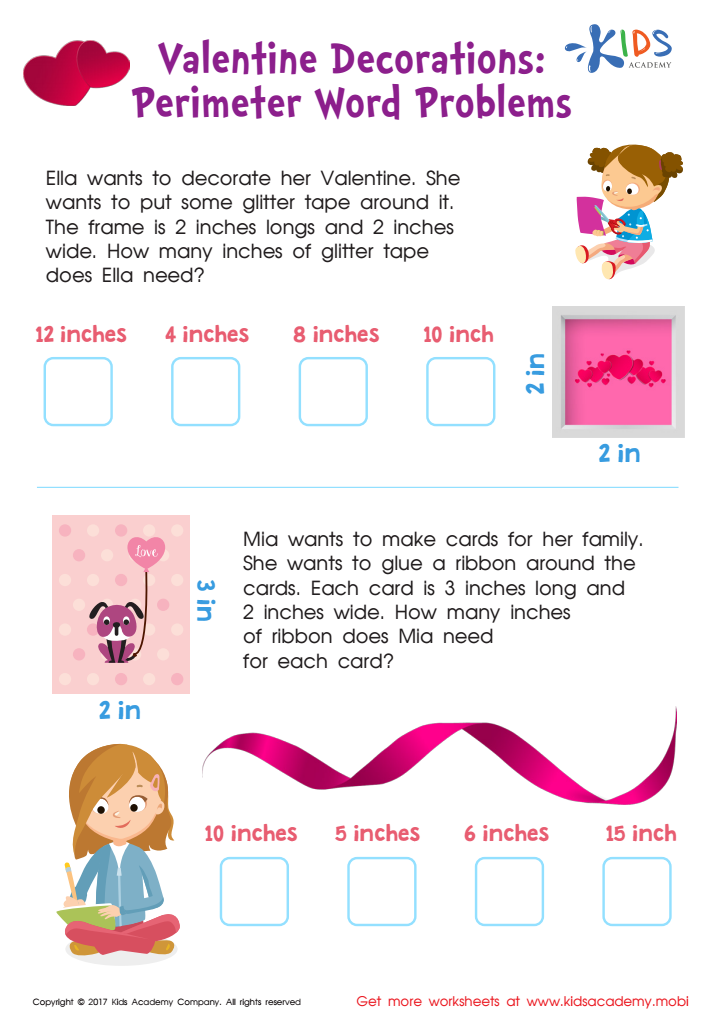
Perimeter Word Problems Worksheet
Celebrate Valentine's Day by solving perimeter word problems! This 3rd grade worksheet offers a fun, realistic way to practice. Help kids figure out how much material they'll need to make beautiful valentines!
Perimeter Word Problems Worksheet
Worksheet
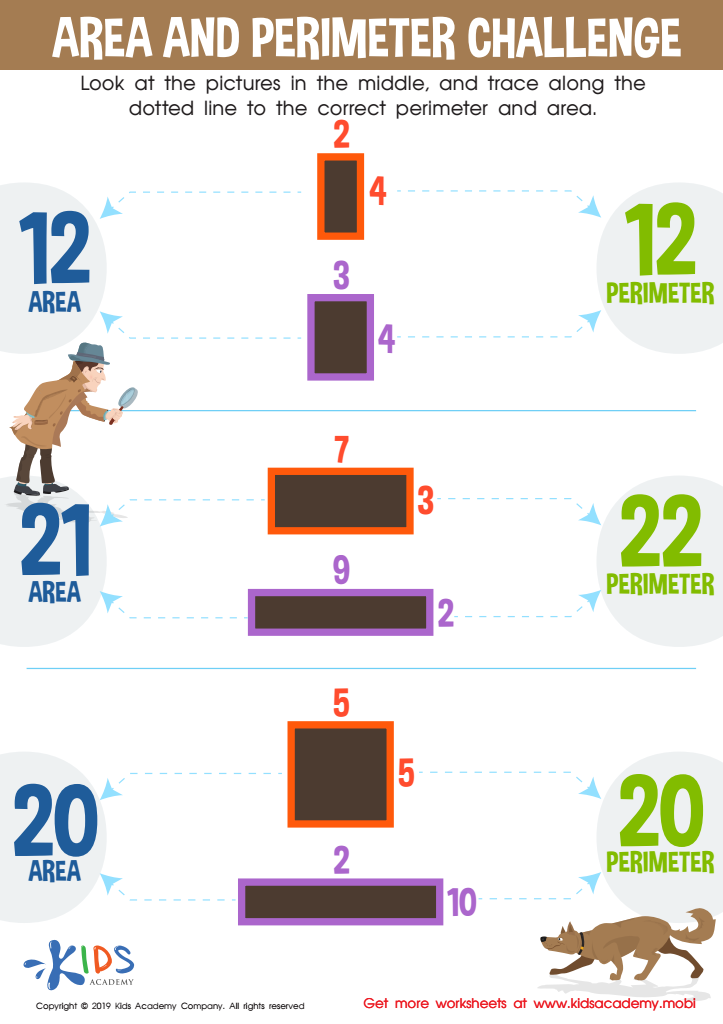
Area and Perimeter Challenge Worksheet
Calculating objects can seem tricky, but with your guidance your students will soon be pros. To help them, give them exercises to practice. Eg. Trace the dotted line on the worksheet to calculate perimeter and area. With practice, they'll soon be geometry experts.
Area and Perimeter Challenge Worksheet
Worksheet
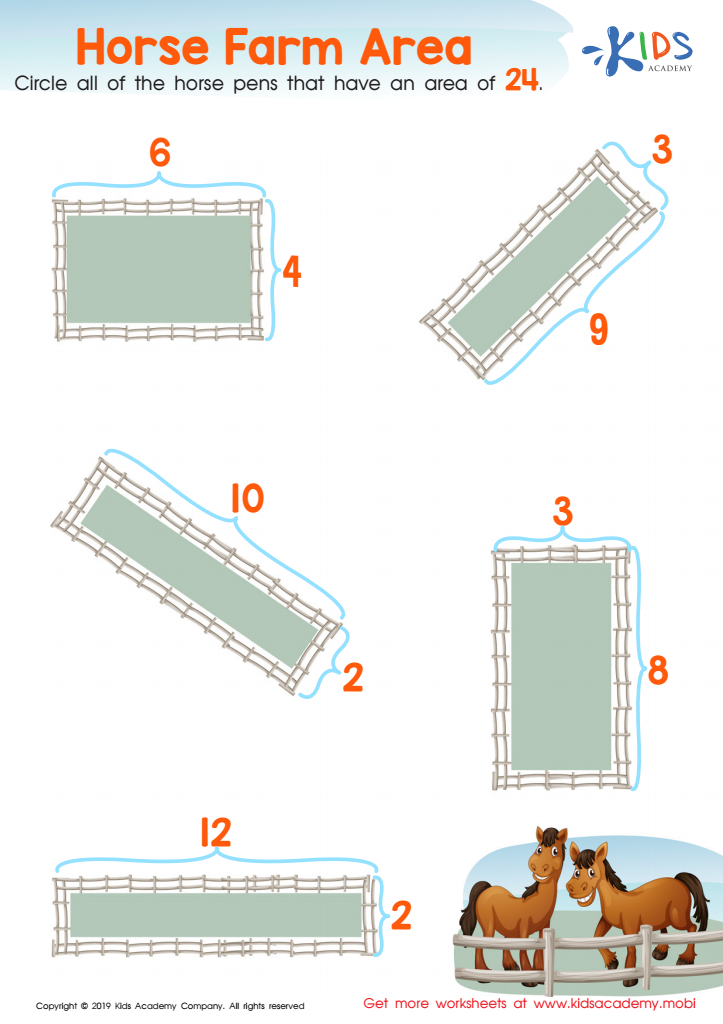
Horse Farm Area Worksheet
Take your kids to a horse farm! They'll love it – there's lots to explore, plus they can ride horses. Then challenge them with a geometry worksheet: help them calculate the area of all the horse pens, then circle the ones with an area of 24.
Horse Farm Area Worksheet
Worksheet
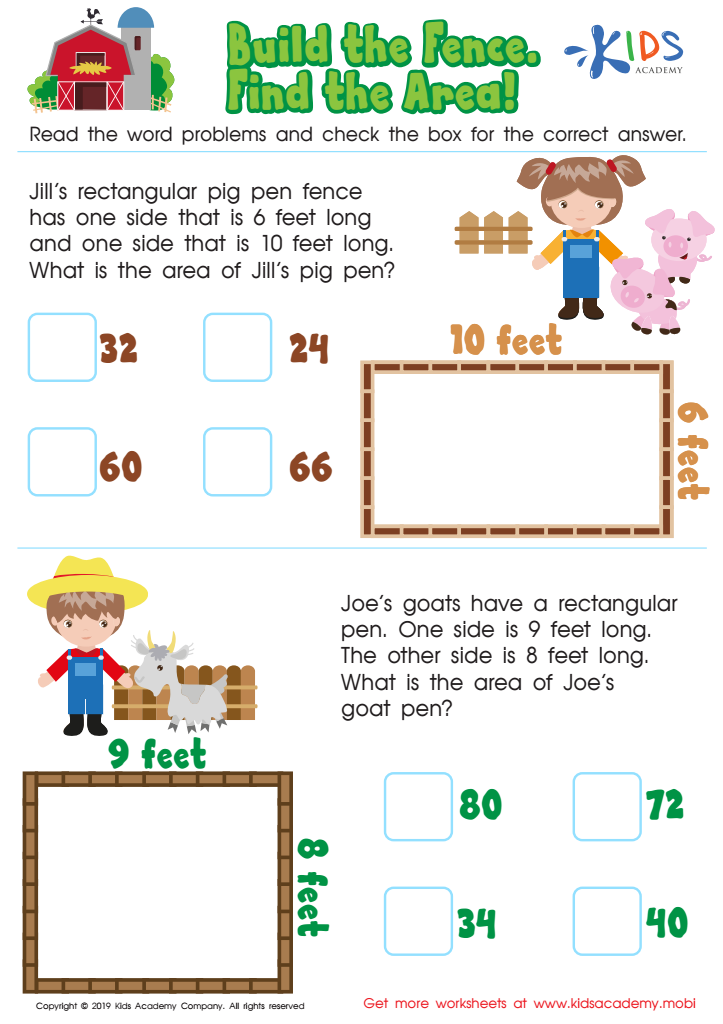
Build the Fence, Find the Area Worksheet
Help your kids gain skills in mathematics with this simple worksheet. Kids can refresh their addition and subtraction to solve geometry problems. Read the word problems and then help them check the box for the correct answer if they need extra help. This worksheet is great for improving kids' familiarity with basic equations.
Build the Fence, Find the Area Worksheet
Worksheet
Join Kids Academy for Free
Who is primarily going to use this learning content?








The Extra Challenge Area and Perimeter curriculum for ages 7-8 is crucial for developing foundational math skills that extend beyond basic calculations. Understanding area and perimeter fosters critical thinking and problem-solving abilities, encouraging young learners to approach mathematics as a creative and analytical discipline. Through engaging activities, children grasp essential concepts that can be applied in real-life scenarios, such as gardening, crafting, and even home design.
Parents and teachers should care about this topic because it not only reinforces students' spatial awareness but also instills confidence in tackling more complex mathematical concepts in the future. By challenging students to explore area and perimeter, educators can enhance their understanding of measurement, spatial reasoning, and geometry—all essential skills in today's world, from architecture to engineering.
Moreover, these challenges can promote collaborative learning experiences, allowing kids to work in groups, share ideas, and learn from their peers. This interaction builds social skills and fosters a love for math. Lastly, early exposure to these concepts sets the foundation for a well-rounded education, preparing children not only for higher-level mathematics but also for problem-solving in everyday life. Engaging in these challenges inspires curiosity and a lifelong appreciation for math-related inquiry.