Normal Addition and Subtraction Word Problems Worksheets for Ages 3-5 - Page 2
29 filtered results
-
From - To
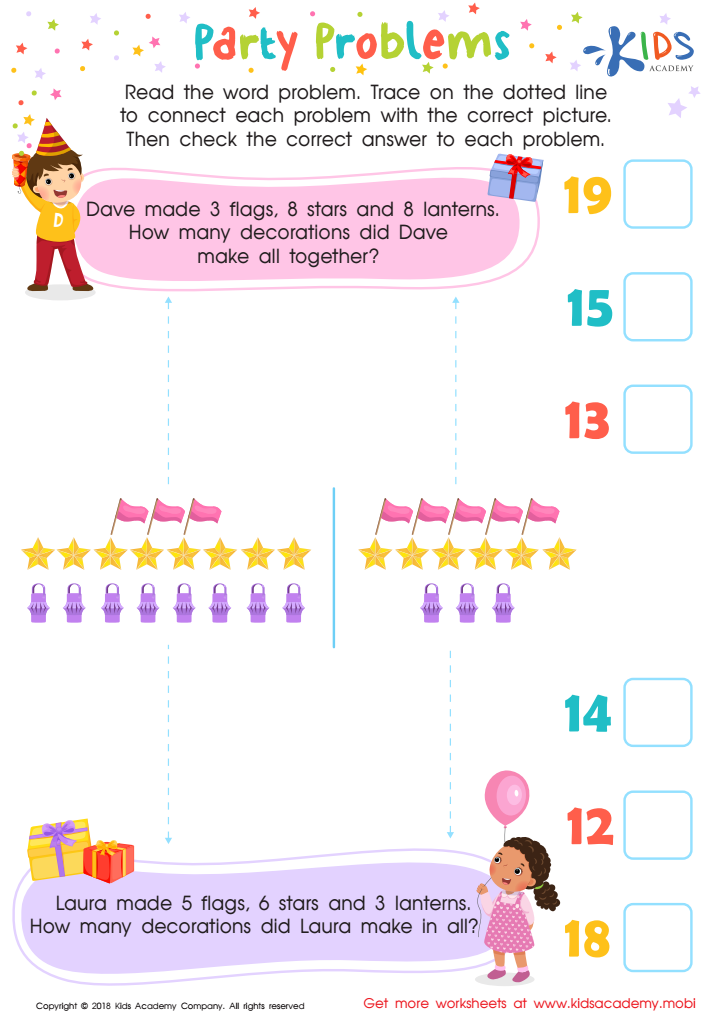
Party Problems Worksheet
 Assign to My Students
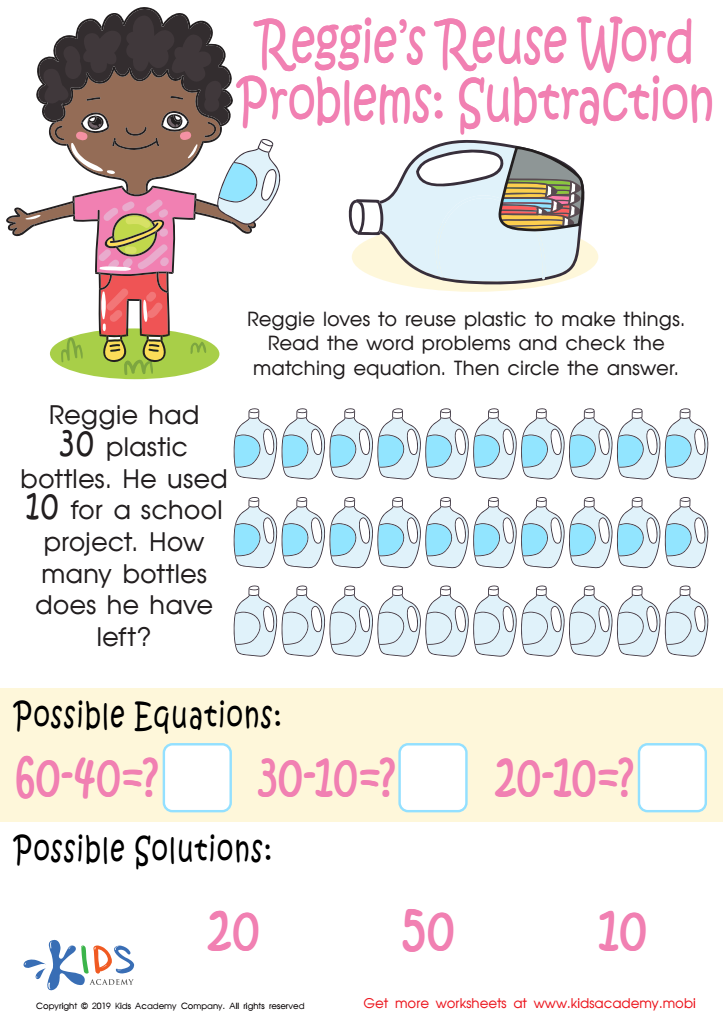
Reggie's Reuse Word Problems: Subtraction Worksheet
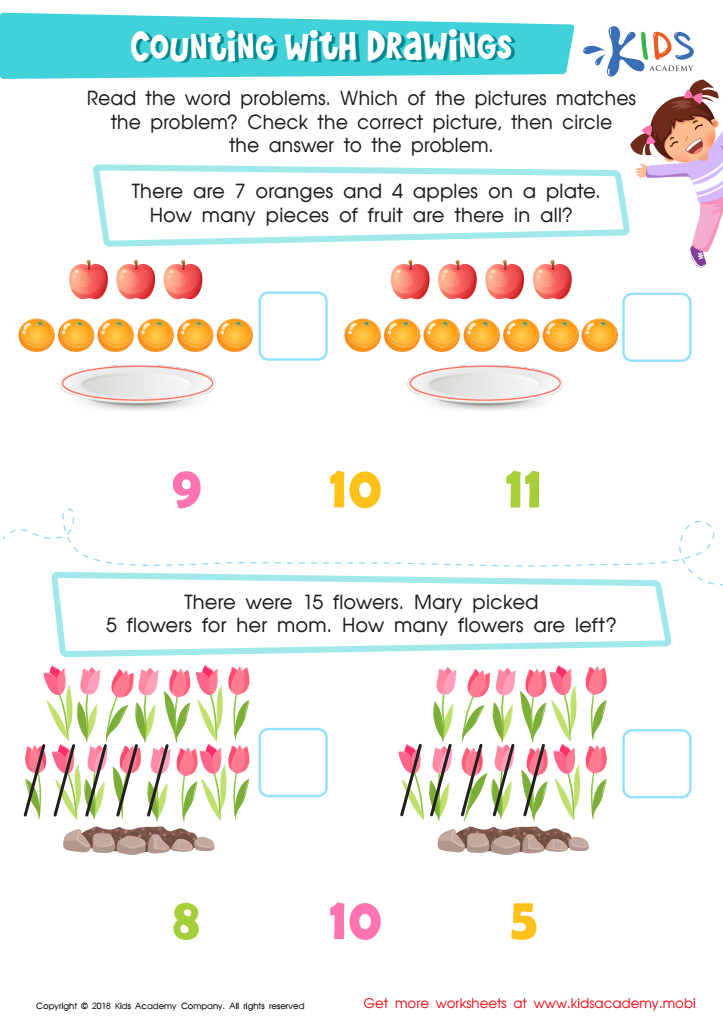
Counting with Drawings:Fruits & Flowers Worksheet
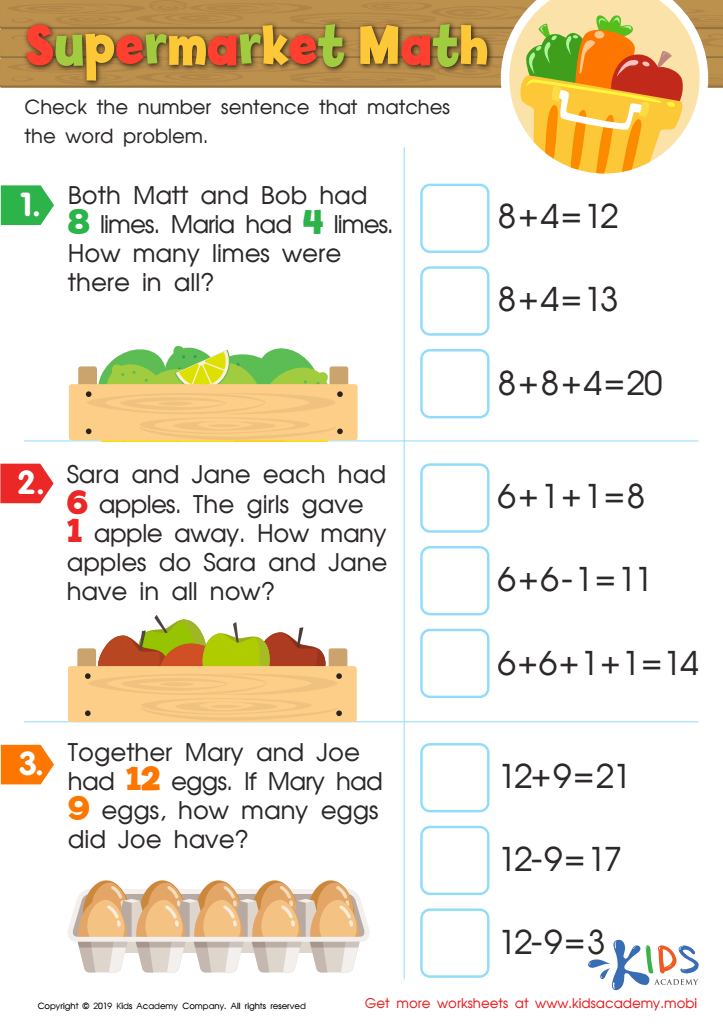
Supermarket Math Worksheet
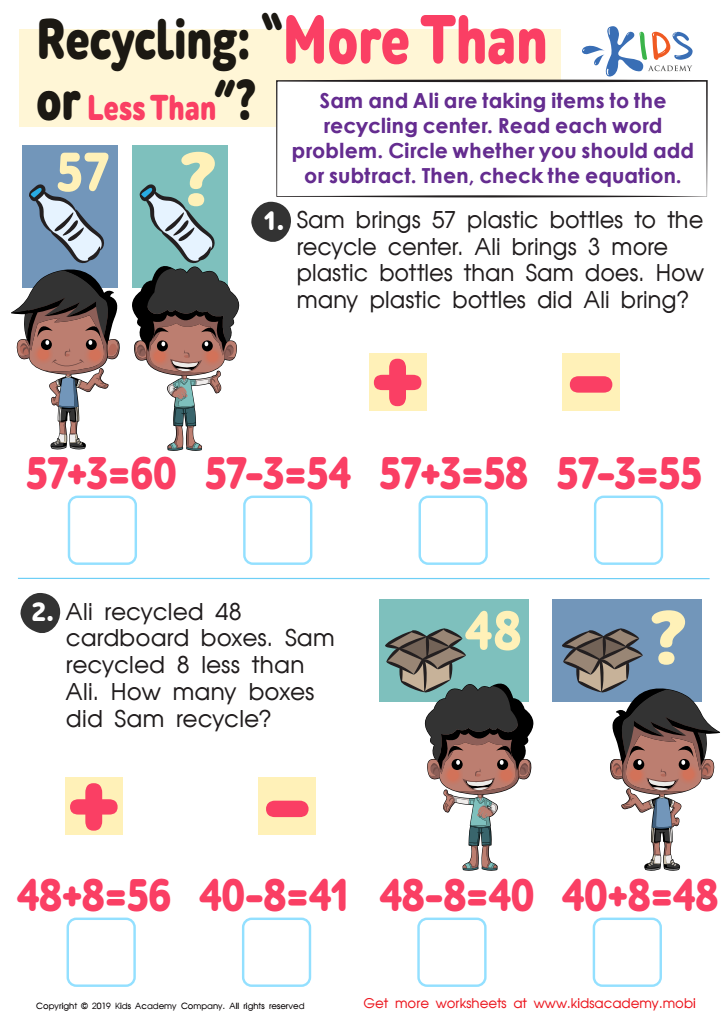
Recycling - More or Less Worksheet








The Importance of Educational Worksheets on Addition and Subtraction Word Problems for Ages 3-5
In the foundational years of early childhood, grasping the basics of mathematics is crucial. For children aged 3 to 5, educational worksheets specifically designed to tackle addition and subtraction through word problems can play an instrumental role in their cognitive and academic development. These worksheets are not just tools for learning numbers but are stepping stones that build logical thinking, problem-solving skills, and an understanding of real-world applications of mathematics.
Addition and subtraction are the cornerstones of arithmetic. At ages 3 to 5, children are just beginning to understand the concepts of adding to and taking away, which are integral not only in math but in everyday situations. Educational worksheets that focus on these topics through word problems help contextualize math in ways that are understandable and relatable to young learners. When children see math problems as part of a story or a practical problem that needs solving, it piques their interest and enhances their engagement.
Moreover, word problems in such worksheets encourage reading and comprehension skills. As children read through the problems (or listen to someone read them), they learn to identify key information and understand the scenario before applying mathematical operations. This dual practice of math and literacy skills is invaluable, promoting a more holistic educational development. By integrating reading comprehension with math, children not only learn to calculate but also to comprehend and apply their knowledge practically.
Educational worksheets on addition and subtraction word problems are also designed to be interactive and visually appealing, which is crucial for the age group of 3 to 5 years. These worksheets often use colorful images and familiar scenarios, such as playing with toys or eating fruits, to illustrate the problems. This captures the young learners' attention and helps them visualize the math problems, making abstract concepts more tangible. Visual learning plays a key role in early education, and by combining visuals with word problems, children can better understand and remember the concepts being taught.
Furthermore, these worksheets are excellent tools for parents and teachers to assess the progress and understanding of their children. They provide a structured means for young ones to practice new skills and allow educators to pinpoint areas where a child might need more support. Regular practice with these worksheets can help reinforce learning and increase confidence, making children more prepared for formal schooling.
Lastly, the use of educational worksheets on addition and subtraction word problems nurtures a child’s curiosity and confidence. As they solve problems successfully, their self-esteem grows. This early confidence in their mathematical abilities can have a lasting impact, setting a positive tone for their attitude towards more complex mathematical concepts as they progress in their educational journey.
Additionally, these worksheets can foster a sense of independence in young learners. As children work through the problems, they learn to apply reasoning and make decisions based on the scenarios presented. This ability to think independently is a critical life skill, and instilling it at a young age through such educational materials can be highly beneficial.
The flexibility of educational worksheets also allows for personalized learning. Each child develops at their own pace, and these worksheets can be selected based on the child's current ability level, then gradually increased in complexity as their skills improve. This tailored approach ensures that children are neither under-challenged nor overwhelmed, keeping their learning experience positive and encouraging.
In a classroom setting, these worksheets can facilitate cooperative learning as well. Children can work in pairs or small groups to solve word problems, discussing their thoughts and strategies. This interaction not only makes learning more enjoyable but also enhances social skills such as communication, cooperation, and respect for others’ ideas.
In conclusion, educational worksheets on addition and subtraction word problems for children aged 3 to 5 are more than just simple math drills. They are comprehensive educational tools that foster numerical literacy, reading comprehension, problem-solving skills, visual learning, independence, and social interaction. Through these engaging and age-appropriate activities, children can develop a robust foundation in mathematics and other essential life skills, setting them up for success in their ongoing educational endeavors. Thus, incorporating these worksheets into early childhood education is an investment in building capable, confident, and curious young learners.