Normal Missing Letters Worksheets for Ages 4-5
1 filtered results
-
From - To
Introducing our captivating Normal Missing Letters worksheets, meticulously crafted for children Ages 4-5! Designed to engage young minds in the fundamental stages of literacy, these worksheets offer an exciting journey into the world of alphabets. Through playful, yet challenging exercises, your child will learn to identify and fill in missing letters, bolstering their understanding of letter sequences and word formation. Perfect for preschoolers and kindergarteners, our Normal Missing Letters collection promises to enhance your child's cognitive skills while ensuring they have fun learning. Embark on this educational adventure and watch your child's confidence in reading and writing grow!
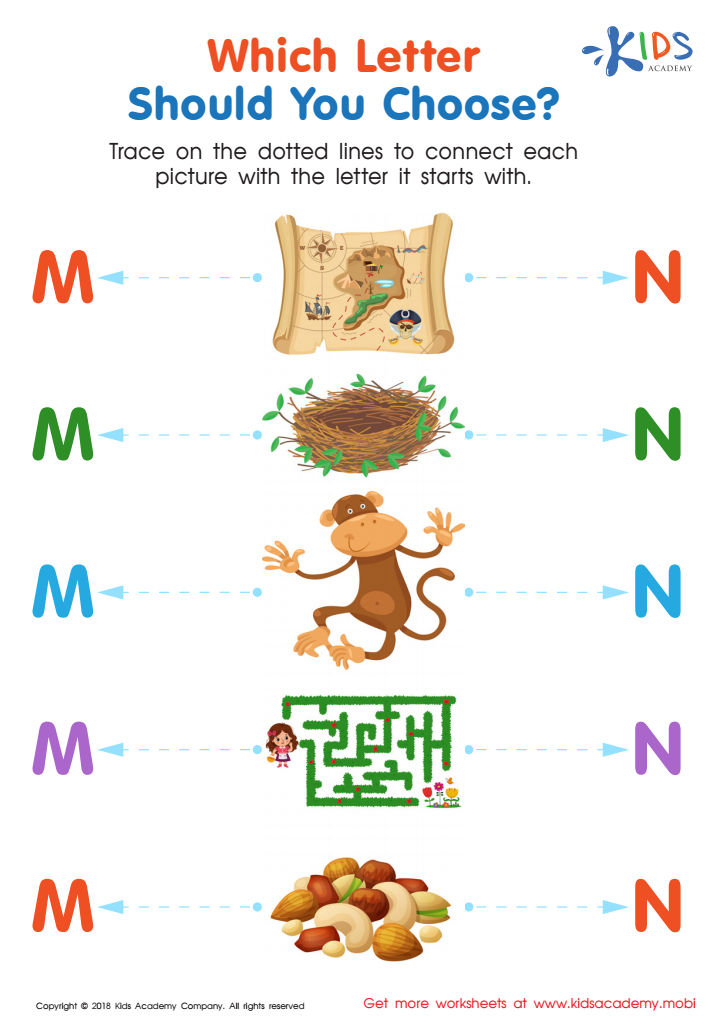
Which Letter Should you Choose? Worksheet
 Assign to My Students



Normal Missing Letters worksheets for Ages 4-5 are an invaluable tool in the foundational stage of a child’s literacy and language development. At this critical age, children are just beginning to recognize letters, understand their sounds, and grasp how they come together to form words. These specially designed worksheets provide a structured yet engaging approach to learning, making them an essential part of early childhood education.
Firstly, Normal Missing Letters worksheets for Ages 4-5 help to enhance a child’s phonemic awareness—an ability to hear, identify, and manipulate phonemes (the smallest units of sound). By filling in the missing letters, children learn to associate sounds with their corresponding letters, a fundamental skill for reading and spelling.
Moreover, these worksheets improve a child’s observation skills and attention to detail. To correctly identify the missing letters, children must carefully observe the structure of words, fostering a meticulous and attentive approach to learning that will benefit them across all subjects.
Additionally, completing these worksheets boosts a child’s confidence. Successfully identifying missing letters and forming complete words encourages children, reinforcing their learning and motivating them to explore more complex reading and writing tasks.
In conclusion, Normal Missing Letters worksheets for Ages 4-5 play a crucial role in early childhood education by developing phonemic awareness, enhancing observation skills, and building confidence in young learners, laying a strong foundation for their future academic success.







