Normal Vowels Worksheets for Ages 4-8 - Page 4
73 filtered results
-
From - To
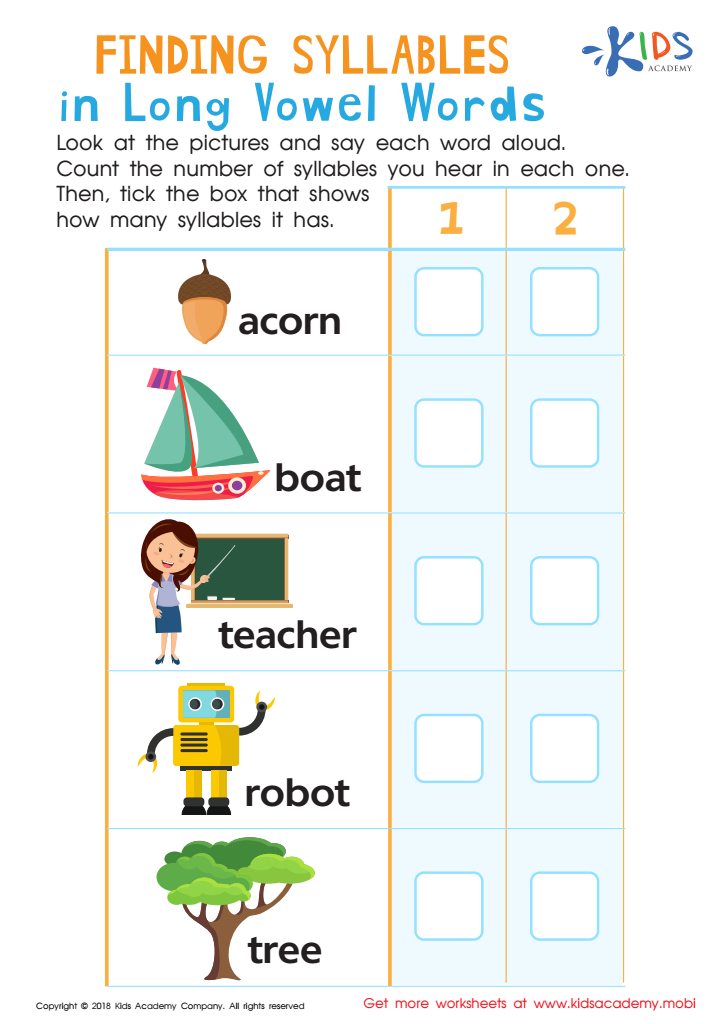
Finding Syllables in Long Vowel Words Worksheet
 Assign to My Students





Normal vowels, also known as short vowels, are fundamental building blocks in early literacy for children aged 4-8. It is crucial for parents and teachers to focus on them because mastering these sounds lays the groundwork for reading and writing fluency. In English, there are five short vowel sounds, represented by the letters 'a', 'e', 'i', 'o', and 'u'. Early familiarity with these sounds helps children decode words more efficiently, leading to stronger phonemic awareness, an essential precursor to successful reading skills.
At this developmental stage, children are highly receptive and can easily internalize the rules of language through repetitive and engaging activities. When children can accurately produce and recognize these vowels, they are better equipped to pronounce words correctly, enhancing their ability to spell and write. Additionally, mastering normal vowels aids in vocabulary development; as children piece together these sounds to form words, they expand their expressive language capabilities.
Moreover, understanding short vowels facilitates the learning of more complex phonics skills, such as recognizing long vowels and distinguishing between different vowel sounds in assorted contexts. Consequently, the early focus on normal vowels supports smoother academic advancement, boosts confidence in literacy tasks, and fosters a lifelong love of reading.






