Normal Multiplication and Division Word Problems Worksheets for 5-Year-Olds
10 filtered results
Difficulty Level
Grade
Age
-
From - To
Subject
Activity
Standards
Introduce your five-year-old to the fundamentals of math with our Homeschool Downloadable Worksheets, expertly designed to teach Normal Multiplication and Division through engaging word problems. These worksheets are specifically crafted to cater to young learners, making complex concepts simple and fun. Each sheet is filled with colorful, age-appropriate questions that not only keep children entertained but also enhance their mathematical skills and problem-solving abilities. Ideal for homeschool settings, these worksheets offer a great way to build a strong mathematical foundation early on. Start your child's journey towards math proficiency today with our captivating and educational worksheets!
Favorites
With answer key
Interactive
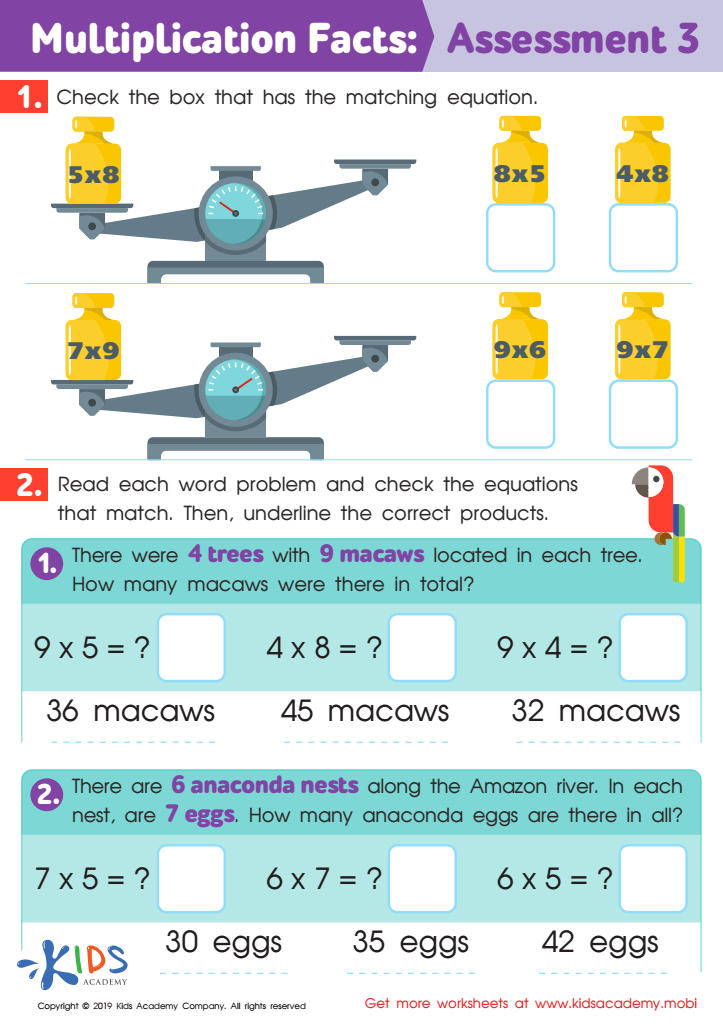
Multiplication Facts: Assessment 3 Worksheet
Test your kid's maths skills with this easy to use worksheet! Help them check the box that matches the equation in the first part, then read each word problem and underline the right answers to the second part. Assess your child's muliplication knowledge and find out where they need extra help.
 Assign to My Students
Multiplication Facts: Assessment 3 Worksheet
Worksheet
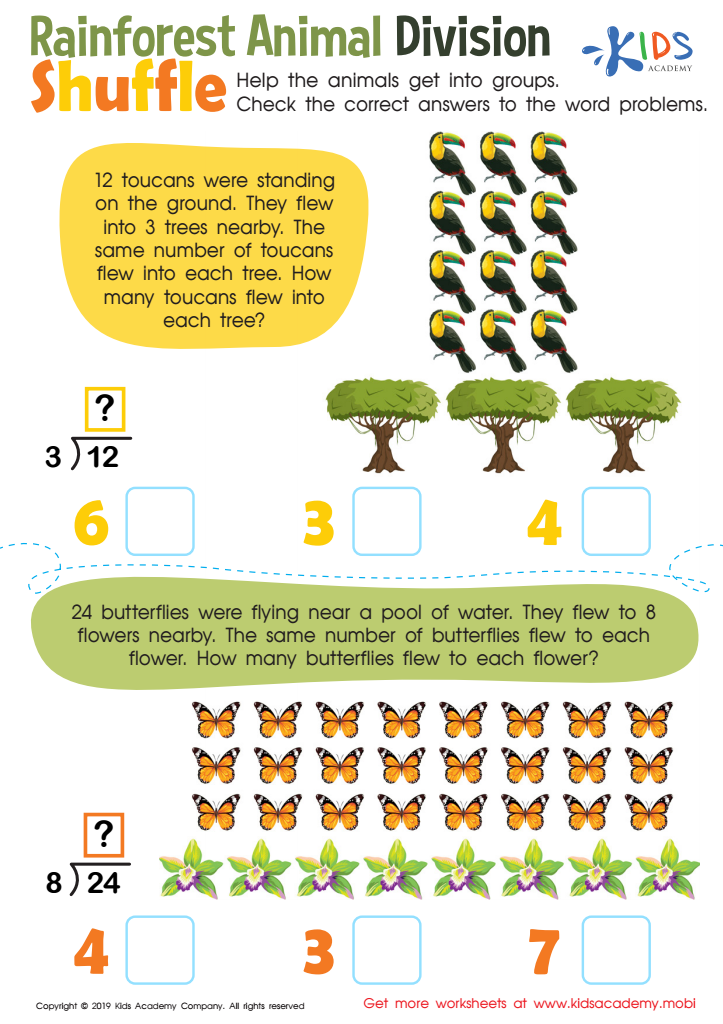
Rainforest Animal Division Worksheet
Children can save the rainforest and learn about division with this worksheet! It helps kids understand that division involves creating equal groups of specific numbers, and with its visual representation, they can grasp the concept more easily. They'll have fun learning about their place in the world and their role in protecting the environment.
Rainforest Animal Division Worksheet
Worksheet
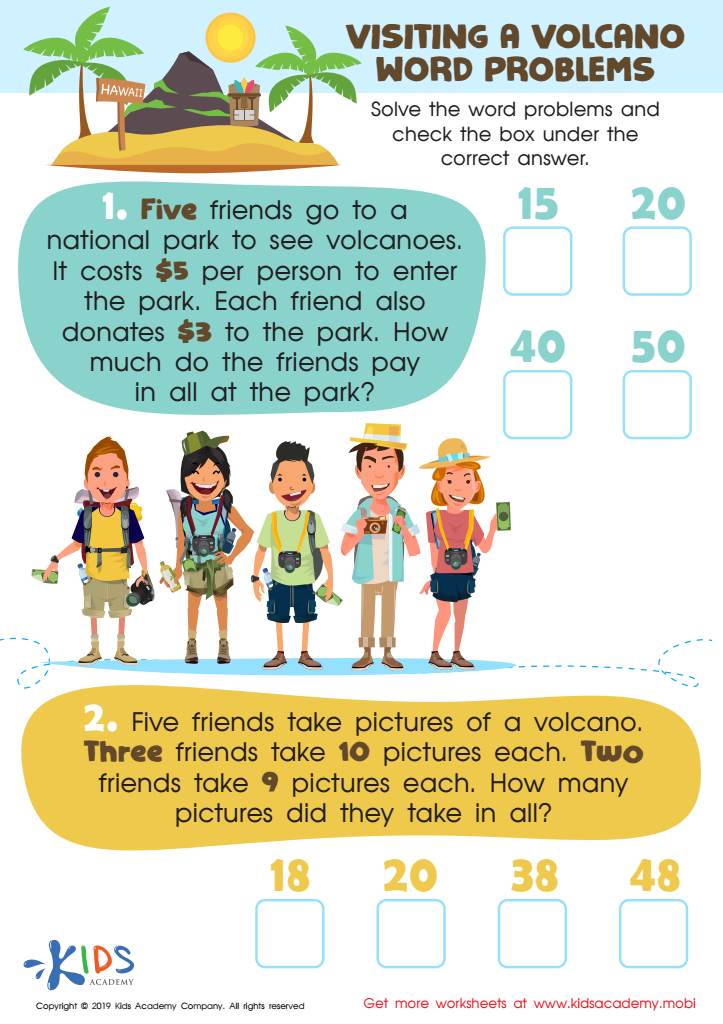
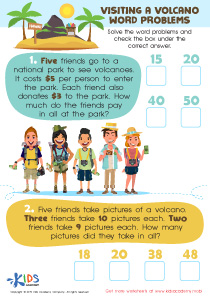
Visiting a Volcano Word Problems Worksheet
Read the word problems to your kids, note down the numbers and help them solve. Check the box under the correct answer. Word problems are sentences posed as math problems; just like regular number problems, first you must understand and interpret the sentence.
Visiting a Volcano Word Problems Worksheet
Worksheet
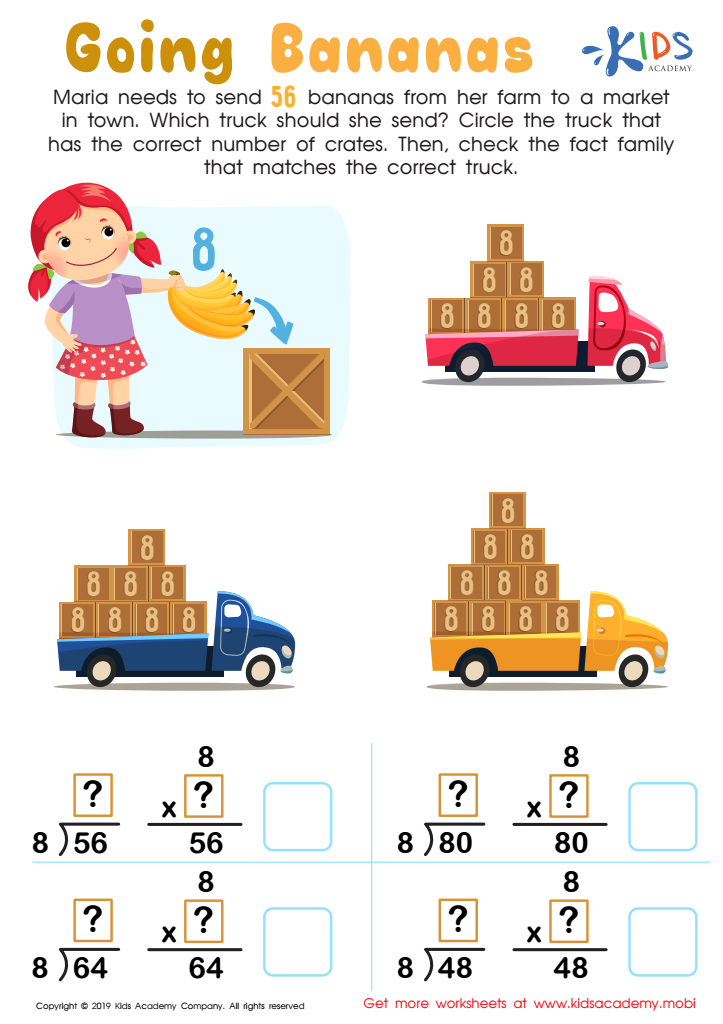
Going Bananas Worksheet
Marla needs to send 56 bananas in batches of 8. Help your child practice division and learn about fact families with this free worksheet. It'll help boost their multiplication skills and increase speed when solving problems.
Going Bananas Worksheet
Worksheet
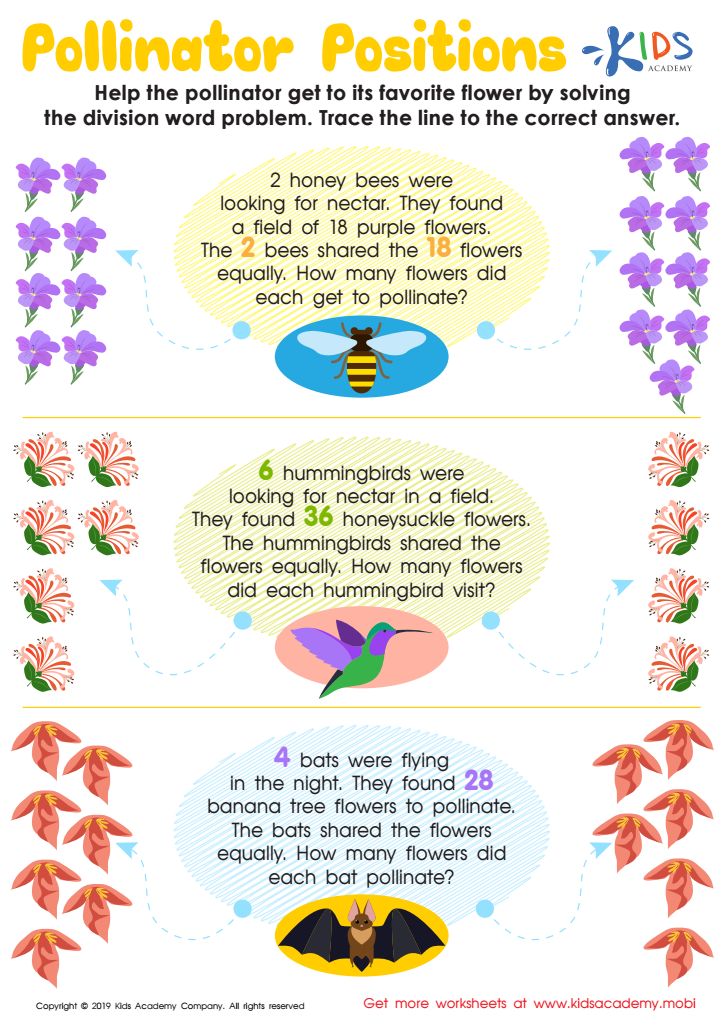
Pollinator Positions Worksheet
Kids will love learning about pollinators and how vital they are. Help their favorite friends get to the right flowers with this fun PDF. Children can solve the problems without even knowing they're doing division; just read the word problems and use the highlighted numbers. Finish by tracing the lines to the correct quotient!
Pollinator Positions Worksheet
Worksheet
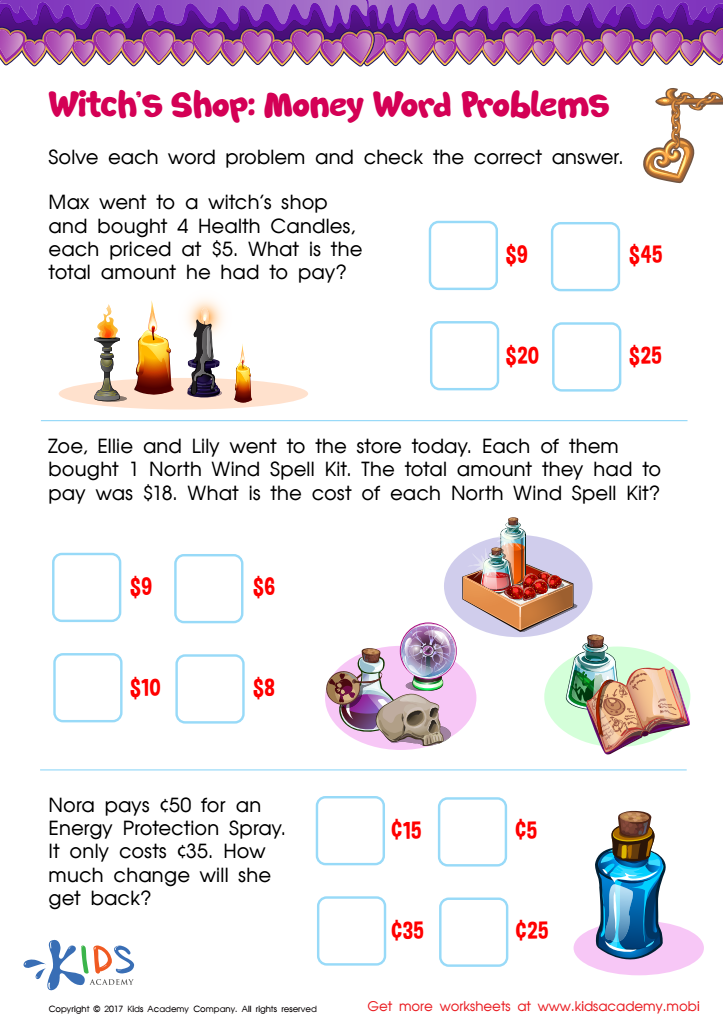
Money Word Problems Printable
Boost your 3rd grader's math skills with money word problems. This worksheet takes them to a witch's shop for a fun way to practice multiplication and division.
Money Word Problems Printable
Worksheet
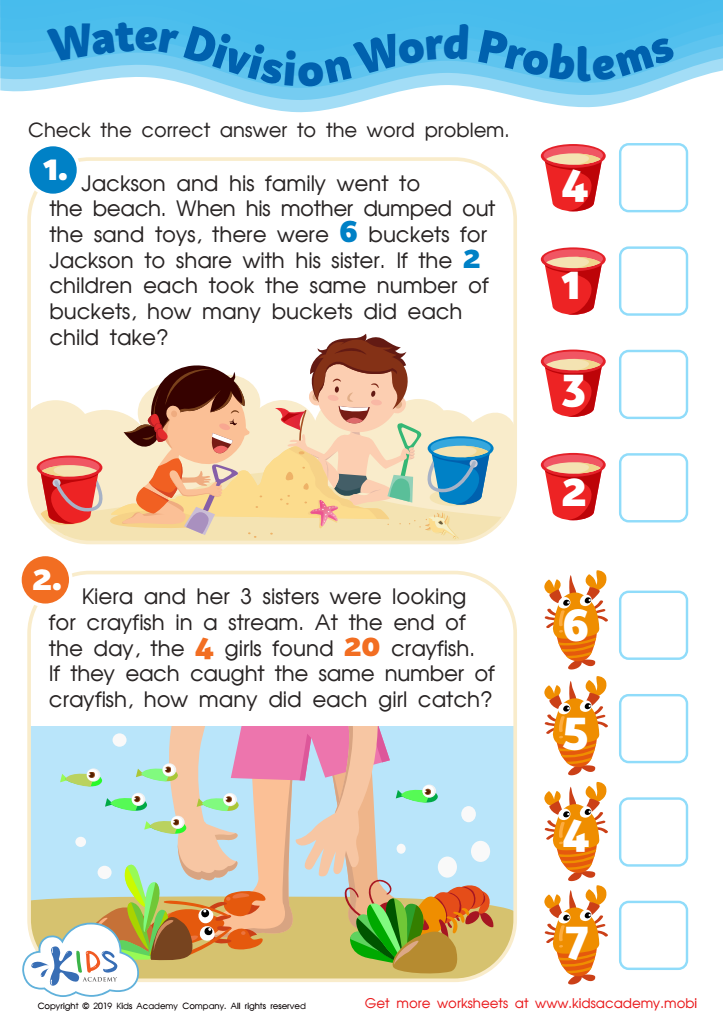
Water Division Word Problems Worksheet
Kids can sharpen their math skills with this fun PDF! They'll see pictures of friends at the beach, plus bold numbers and colorful pictures. All they need to do is read and understand the problem to find the answer - without even realizing they're doing division. A great way to make math enjoyable!
Water Division Word Problems Worksheet
Worksheet
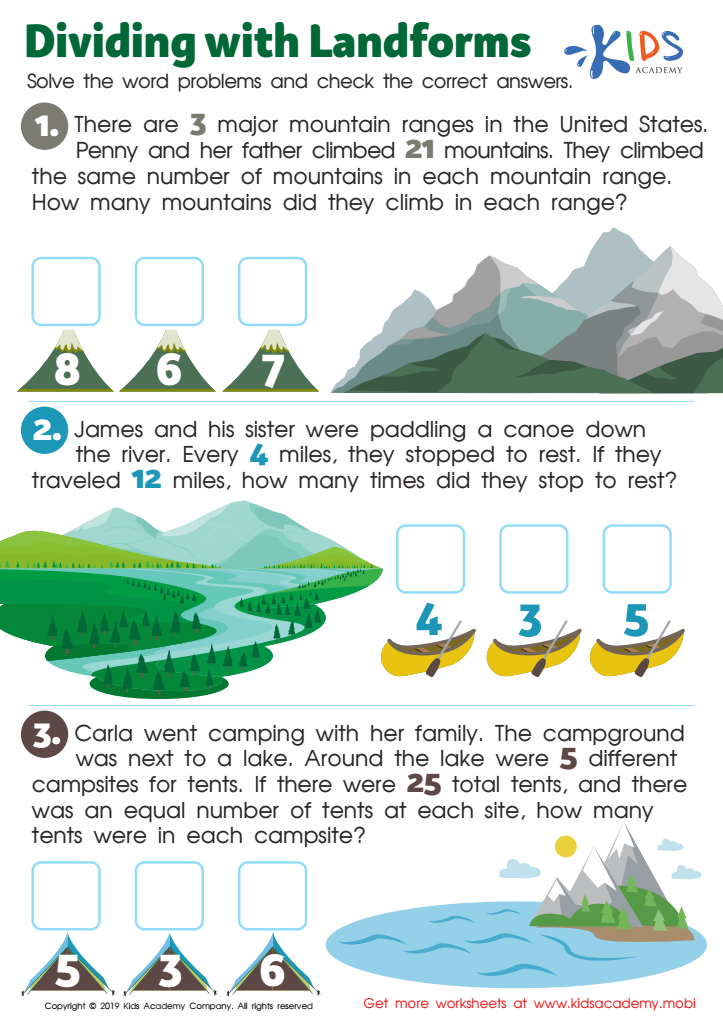
Dividing with Landforms
Mixing subjects to help your child learn is always nice. This worksheet combines landforms, problem-solving and division. The PDF highlights numbers, uses bold colors and provides pictures to help your child understand the questions and answer choices, making them feel empowered, not intimidated.
Dividing with Landforms
Worksheet
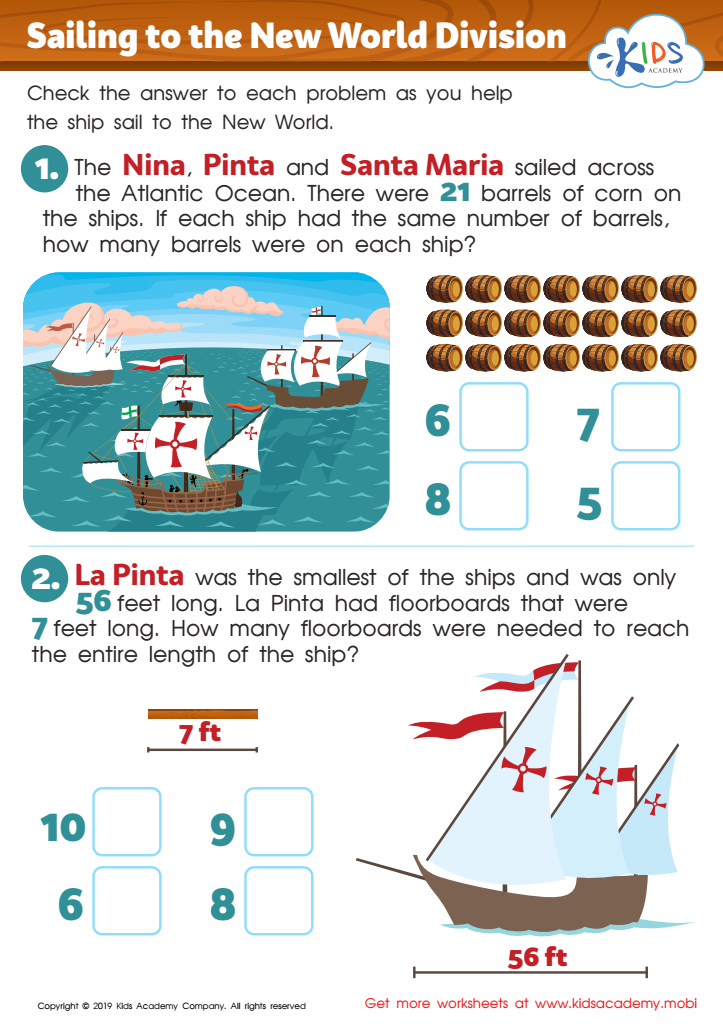
Sailing to the New World Division Worksheet
This worksheet combines history and math, helping kids make sense of problem-solving. Christopher Columbus sailing the ocean blue is combined with picture representations of division word problems in bold colors and highlighted numbers. Kids can learn while having fun figuring out the problems, regardless of whether it's math or history.
Sailing to the New World Division Worksheet
Worksheet
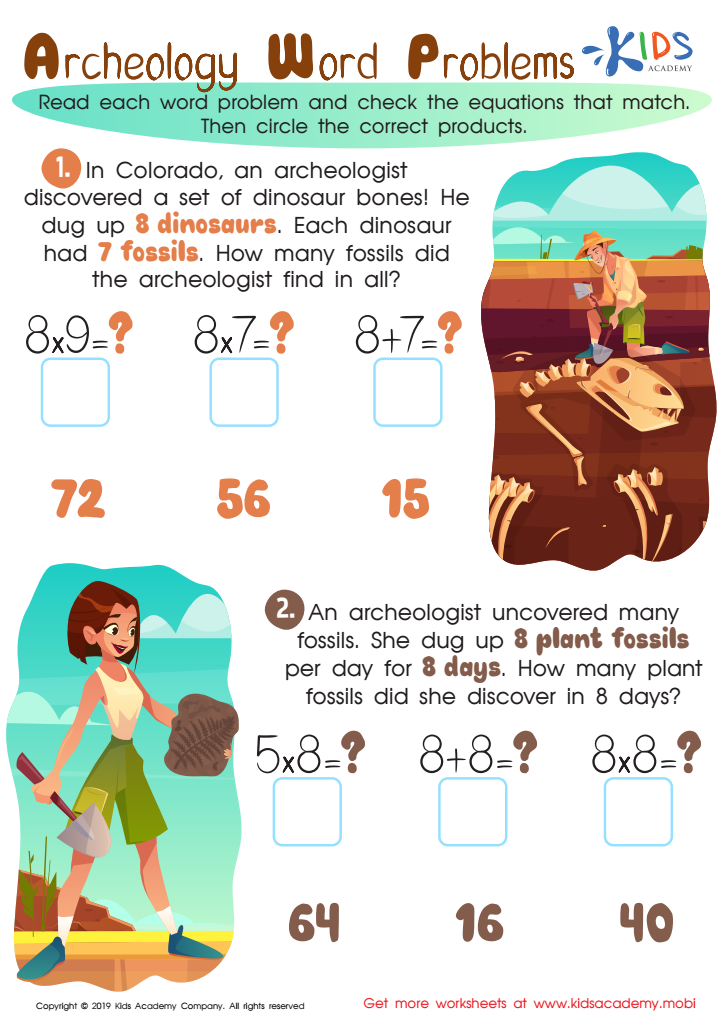
Archeology Word Problems Worksheet
Encourage your child to explore their career options! Show them an archeologist's job with this worksheet - featuring a picture of a dinosaur bone discovery. Read the accompanying text, then solve the word problems. Help your kids circle the correct answers to better understand this profession.
Archeology Word Problems Worksheet
Worksheet
Join Kids Academy for Free
Who is primarily going to use this learning content?







The Importance of Homeschool Homework Sheets for Multiplication and Division Word Problems in Early Education
In the world of early childhood education, laying a strong foundation in basic mathematics is crucial. For five-year-old children, introducing concepts like multiplication and division through word problems can significantly enhance their numerical understanding and problem-solving skills. This is where homeschool homework sheets on multiplication and division word problems become particularly useful.
Homeschooling offers a unique opportunity to tailor educational activities to a child's specific learning pace and style. Homeschool homework sheets are designed to provide structured learning yet flexible enough to adjust to the individual needs of a child. When it comes to teaching young children complex concepts such as multiplication and division, these sheets are invaluable tools.
1. Building a Solid Mathematical Foundation
At the age of five, children are typically at a stage where they are beginning to understand more complex concepts and ideas. Multiplication and division are key areas in math that, when introduced early, can help children grasp the manipulation of numbers more adeptly. Homeschool homework sheets that focus on these topics through word problems help translate abstract concepts into real-world scenarios that children can understand and relate to.
2. Enhancing Cognitive and Language Skills
Multiplication and division word problems do more than just teach math; they also enhance reading comprehension and analytical thinking. As children read through a problem, they learn to identify key information and understand the context of the problem. This process not only improves their math skills but also boosts their general cognitive abilities and language development.
3. Encouraging Independent Learning and Confidence
One of the significant benefits of using homeschool homework sheets is that they encourage children to learn independently. By working through problems on their own, children develop a sense of responsibility and confidence in their ability to tackle challenges. This is particularly true with multiplication and division problems, where finding the solution can give them a real sense of achievement and encourage a positive attitude towards learning.
4. Customizable Learning Experience
Homeschool homework sheets are highly customizable. Parents and educators can choose worksheets that match the child's current educational needs and learning speed, focusing more intensively on areas that require more attention. This customization ensures that the child is not overwhelmed and that learning remains a joy rather than a burden.
5. Preparation for Advanced Concepts
Early exposure to multiplication and division sets the stage for understanding more advanced mathematical concepts and procedures. Mastery of these basic operations is crucial for future learning in math, including fractions, percentages, and problem -solving. Homeschool homework sheets can gradually introduce more complex problems as the child's skills develop, ensuring a smooth progression in their mathematical education.
6. Supporting Structured and Repetitive Learning
The nature of multiplication and division requires practice and repetition for mastery. Homeschool homework sheets facilitate this by providing numerous problems that can be tackled in different sessions. This repetition helps reinforce learning and aids in the retention of mathematical concepts, making it easier for children to recall and apply them in different contexts.
7. Facilitating Parental Involvement in Education
Homeschooling inherently involves a greater degree of parental involvement in a child's education. Homeschool homework sheets on multiplication and division allow parents to actively participate in their child's learning process. This involvement is beneficial as parents can provide immediate feedback and support, tailor the learning experience to their child's needs, and even learn new teaching strategies along the way.
8. Real-life Application and Problem-Solving Skills
Word problems are particularly effective because they simulate real-life situations where mathematics is applied. For a five-year-old, a problem framed as a story about sharing toys or buying candies can make the concept of division and multiplication more relatable and interesting. This approach not only makes learning fun but also teaches them the practical application of math in everyday life, enhancing their problem-solving skills.
9. Fostering a Love for Math
Early positive experiences with mathematics can foster a lifelong interest and love for the subject. By making math both understandable and enjoyable through well-designed homeschool homework sheets, children are more likely to develop a positive attitude toward math and pursue it with enthusiasm as they grow older.
10. Adapting to Individual Learning Styles
Every child learns differently, and homeschool homework sheets can be adapted to fit various learning styles, whether visual, auditory, or kinesthetic. For instance, sheets can include colorful illustrations for visual learners or stories and scenarios that appeal to auditory learners. This adaptability ensures that each child’s unique learning style is addressed, promoting more effective learning outcomes.
In conclusion, homeschool homework sheets for multiplication and division word problems are not just tools for teaching basic math. They are comprehensive educational resources that enhance cognitive skills, encourage independence, facilitate parental involvement, and make learning a dynamic and enjoyable experience. For five-year-olds, these sheets provide the foundational skills necessary not only for future academic success in mathematics but also for practical problem-solving in everyday life.