Normal Fractions of Shapes Worksheets for Ages 7-9
5 filtered results
Difficulty Level
Grade
Age
-
From - To
Subject
Activity
Standards
Enhance your child’s understanding of fractions with our "Normal Fractions of Shapes Worksheets" designed specifically for ages 7-9. These engaging, visually appealing printables help young learners grasp fundamental fraction concepts by dividing various shapes into equal parts. Ideal for classroom activities or homeschooling, each worksheet supports kids in mastering halves, thirds, quarters, and beyond. Our expertly crafted worksheets make fraction learning enjoyable and straightforward, reinforcing crucial math skills through hands-on practice. Equip your child with the confidence and proficiency needed in fractions while making math an exciting adventure with our educational resources.
Favorites
With answer key
Interactive
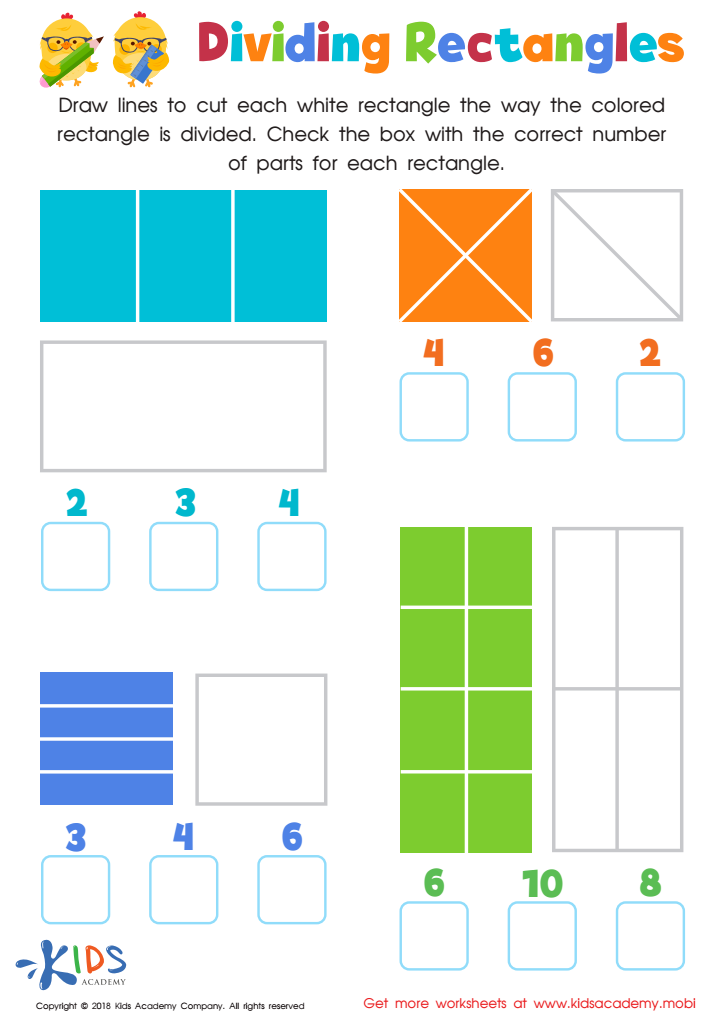
Dividing Rectangles Worksheet
Ask your child to draw lines to divide the white rectangles like the colored ones. Then, have them count the parts in each and choose the correct number. This worksheet will help them practice counting and dividing.
 Assign to My Students
Dividing Rectangles Worksheet
Worksheet
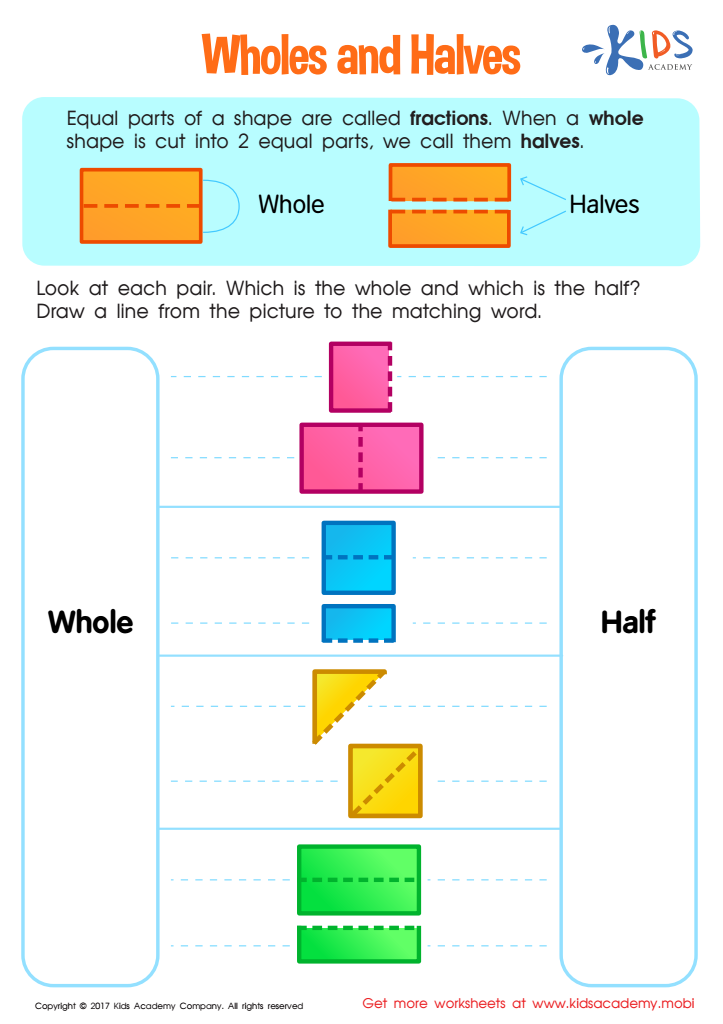
Wholes and Halves Worksheet
Students can feel overwhelmed with fractions. Help take the stress off by using a colorful worksheet to explain whole shapes and how to find halves. Ask them to identify the whole and point to the matching word for the half. A free printout can help guide them.
Wholes and Halves Worksheet
Worksheet
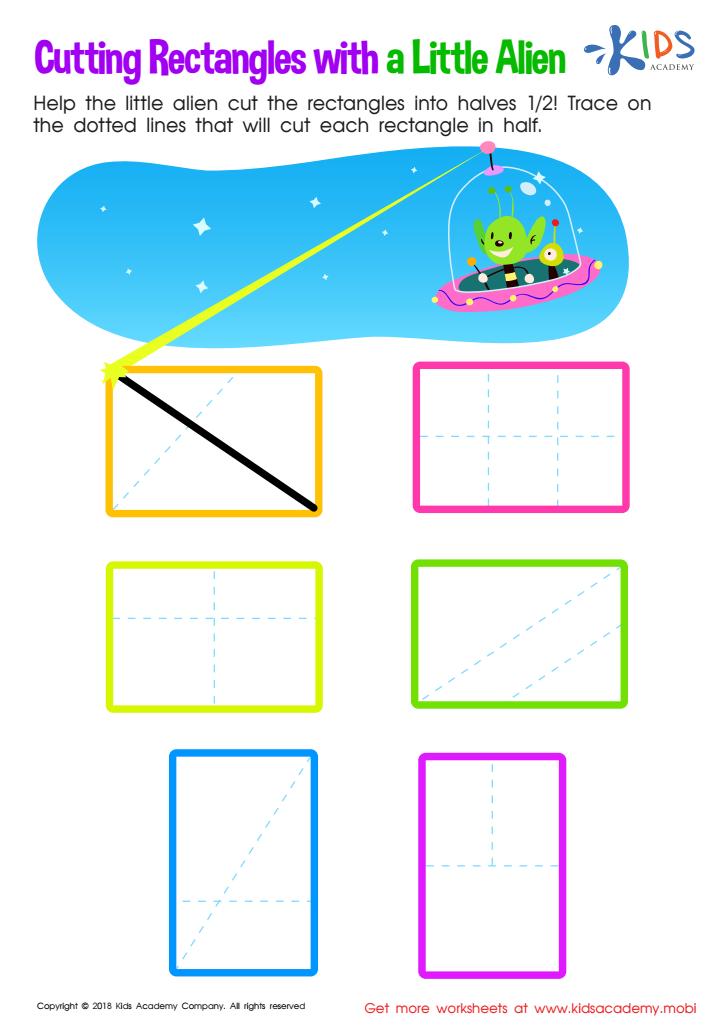
Cutting Rectangles with Alien Worksheet
If your students are interested in aliens and otherworldly events, they'll love this exercise! It requires them to help a small alien cut rectangles into halves (½). They must trace the dotted lines to accurately cut each rectangle.
Cutting Rectangles with Alien Worksheet
Worksheet
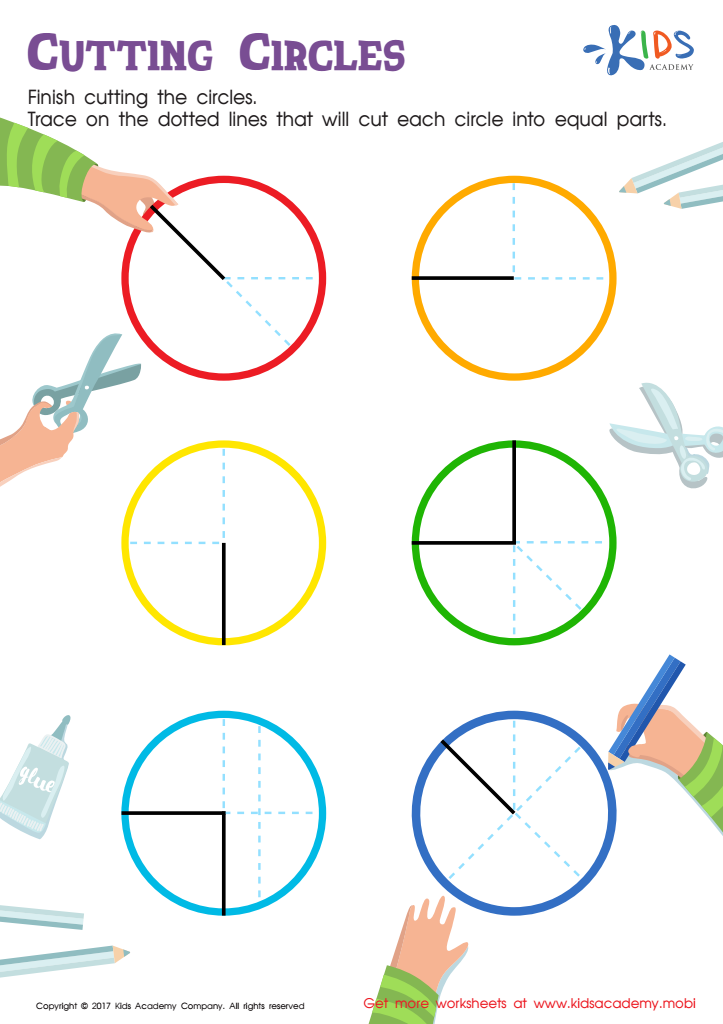
Cutting Circles Worksheet
Allow your child to refresh their memory by asking them what two equal halves, four equal parts and three equal parts are called. Then, look at the picture pdf with them. Challenge them to cut up the circles into equal parts, by tracing the dotted lines. This exercise will help them with their math skills!
Cutting Circles Worksheet
Worksheet
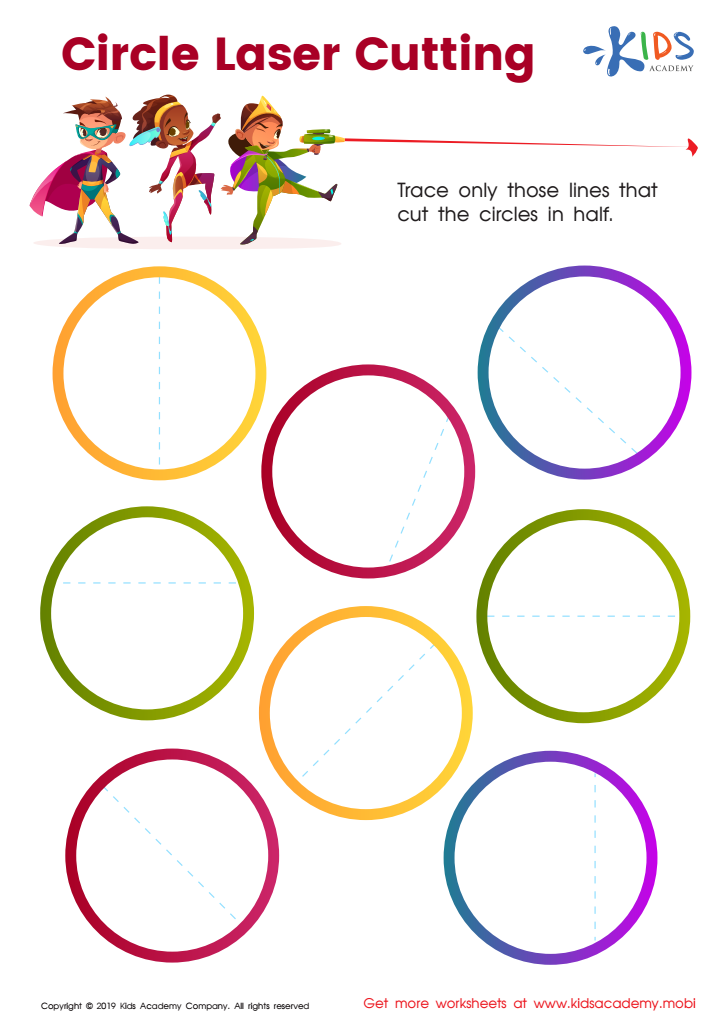
Circle Laser Cutting Worksheet
Encourage your kids to learn geometry! Remind them that when shapes are cut into two equal parts, they are called halves. Have them look at the circles in the worksheet, and trace the lines that cut the circles in half. Geometry is an essential part of education, and although it may not be exciting, it's a valuable skill to have.
Circle Laser Cutting Worksheet
Worksheet
Join Kids Academy for Free
Who is primarily going to use this learning content?








Teaching normal fractions of shapes to children aged 7-9 is crucial as it lays down the essential groundwork for their mathematical development. At this age, students are typically in the early elementary school years, eagerly absorbing foundational concepts that will support more complex math skills later on. Understanding fractions as parts of a whole introduces children to the idea of division and proportionality in a tangible way. For example, when they see a pie cut into equal parts, they grasp the concept of each part representing a fraction of the whole.
This, in turn, enhances their ability to think critically about numbers and spatial relationships. By recognizing that four quarters make a whole or that two halves are the same as an entire object, students begin to internalize the concept of equivalency. Moreover, teaching fractions through shapes helps students engage with material concretely, making abstract numbers more relatable and easy to visualize.
Investing time in mastering fractions also boosts problem-solving skills and mathematical reasoning. Students become equipped to tackle more advanced topics like decimals, percentages, and ratios with greater ease. Most importantly, a solid understanding of fractions is not just an academic requisite but a critical life skill, enabling children to navigate everyday tasks like cooking, shopping, and splitting things fairly. Thus, parents and teachers alike should prioritize fractions for a strong mathematical foundation.