Spatial awareness Extra Challenge Geometry Worksheets for Ages 4-8
5 filtered results
Difficulty Level
Grade
Age
-
From - To
Subject
Activity
Standards
Unlock the potential of young minds with our Spatial Awareness Extra Challenge Geometry Worksheets for Ages 4-8. Designed to enhance critical thinking and problem-solving skills, these worksheets offer fun, challenging activities that boost spatial awareness. Each worksheet features engaging puzzles, shape recognition tasks, and pattern-based exercises that cater to early learners. Perfect for classroom or at-home learning, they help children understand and manipulate shapes and forms effectively. Set a strong foundation in geometry while keeping learning playful and enjoyable. Elevate your child's cognitive abilities with our expertly crafted, child-friendly geometry challenges.
Favorites
With answer key
Interactive
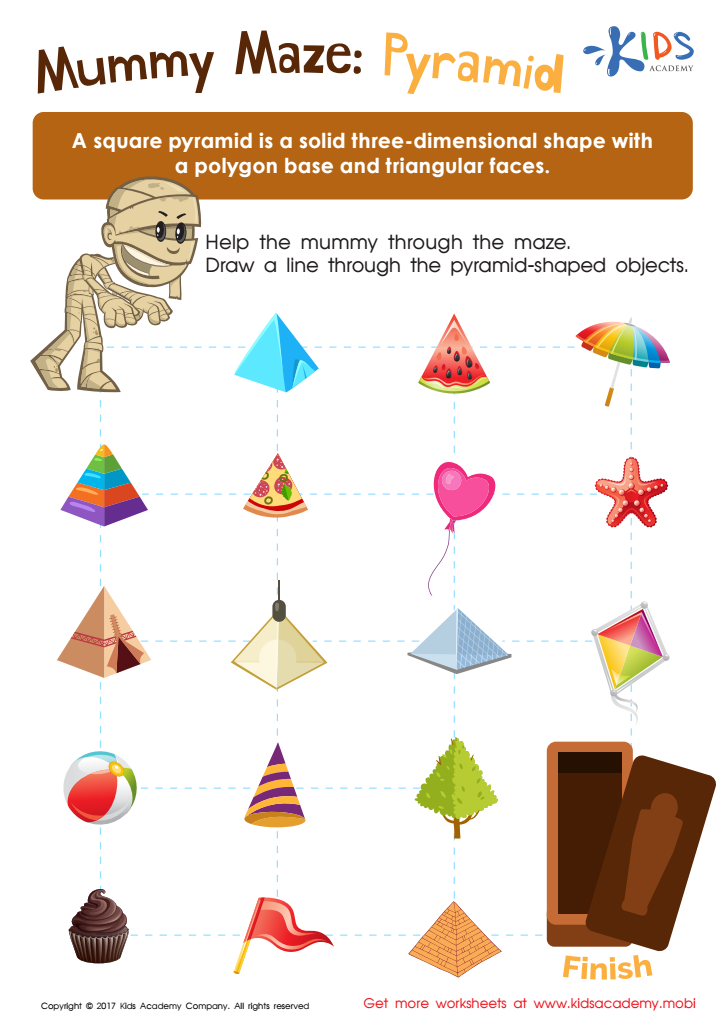
Mummy Maze: Pyramid Printable
Let's learn to spot 3D shapes, such as the iconic pyramid! This fun pyramid geometry worksheet PDF provides interesting illustrations and a maze to help your child identify pyramids in the pictures.
 Assign to My Students
Mummy Maze: Pyramid Printable
Worksheet











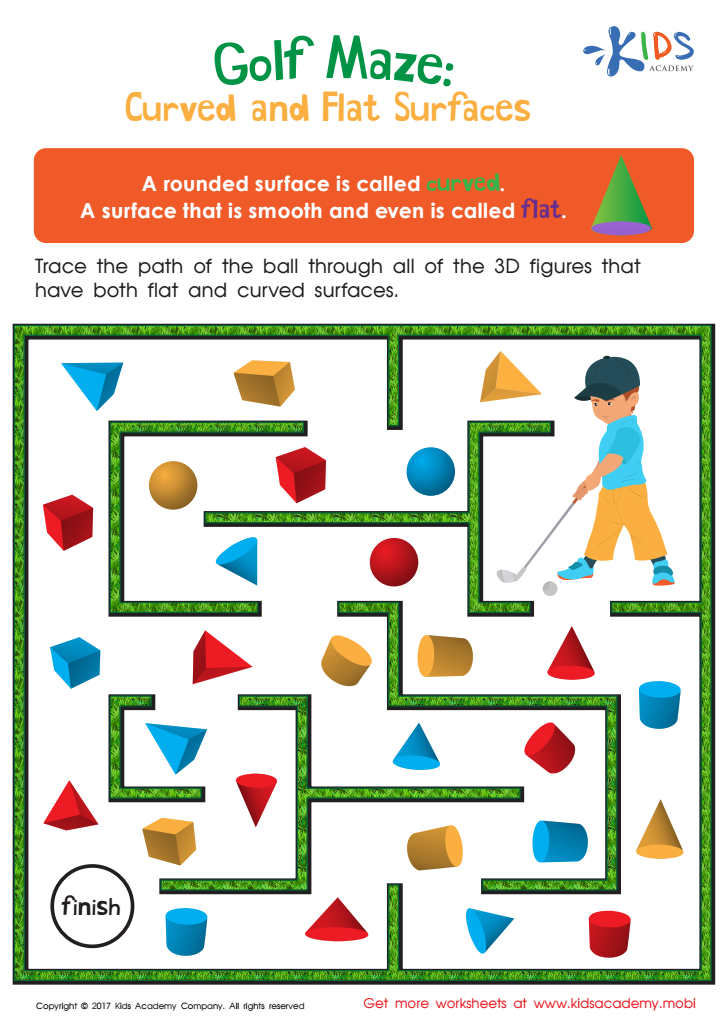
Golf Maze: Curved and Flat Surfaces Worksheet
Give your child a fun and educational challenge with this geometry maze! Your child will navigate 3D shapes to find objects with flat and curved surfaces, while learning important math concepts.
Golf Maze: Curved and Flat Surfaces Worksheet
Worksheet
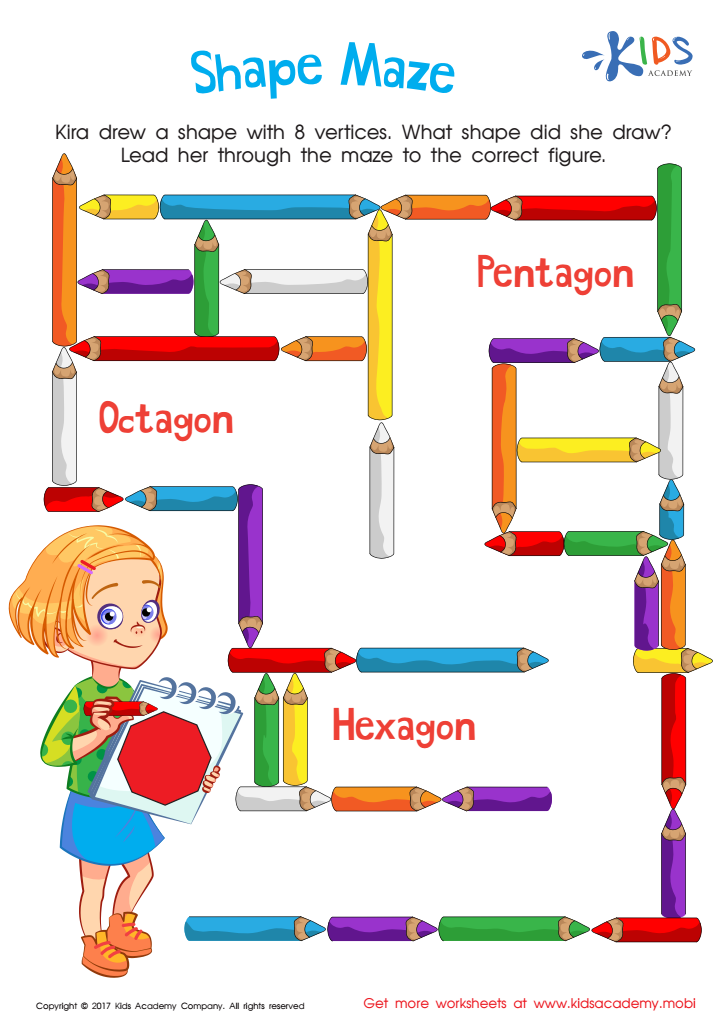
Shape Maze Worksheet
Test your child's geometry knowledge with this fun printable maze! They'll need to identify shapes with 8 vertices to find their way through the maze and get the correct answer.
Shape Maze Worksheet
Worksheet
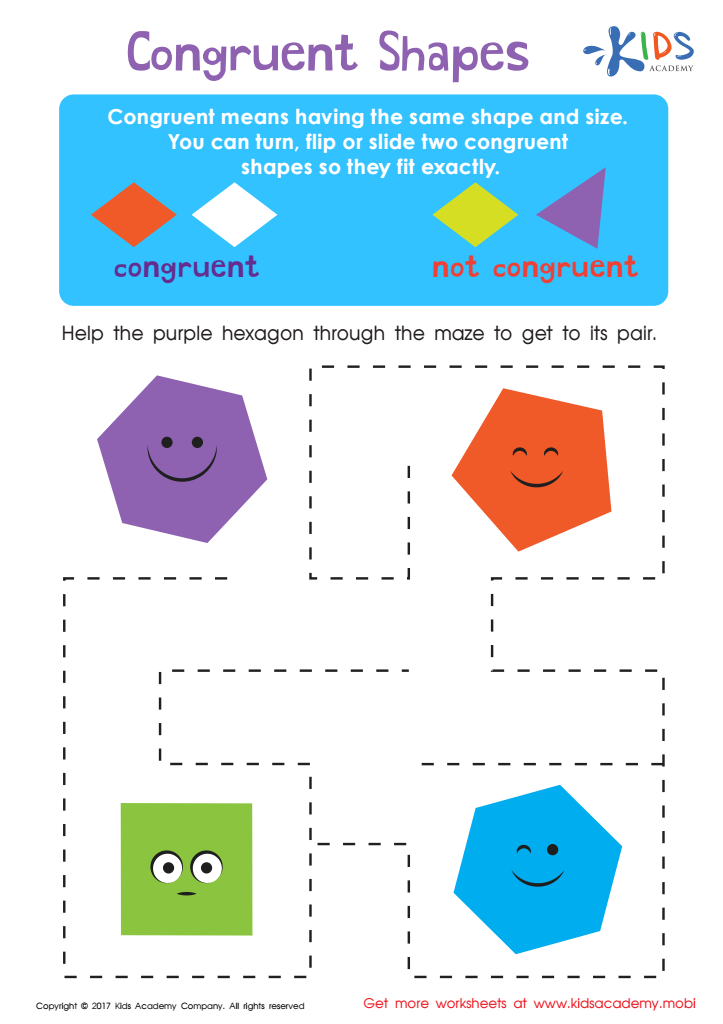
Congruent Shapes Worksheet
Help your child find the twin of the purple hexagon! This congruent shapes worksheet is great for increasing vocabulary while challenging mental rotation skills.
Congruent Shapes Worksheet
Worksheet
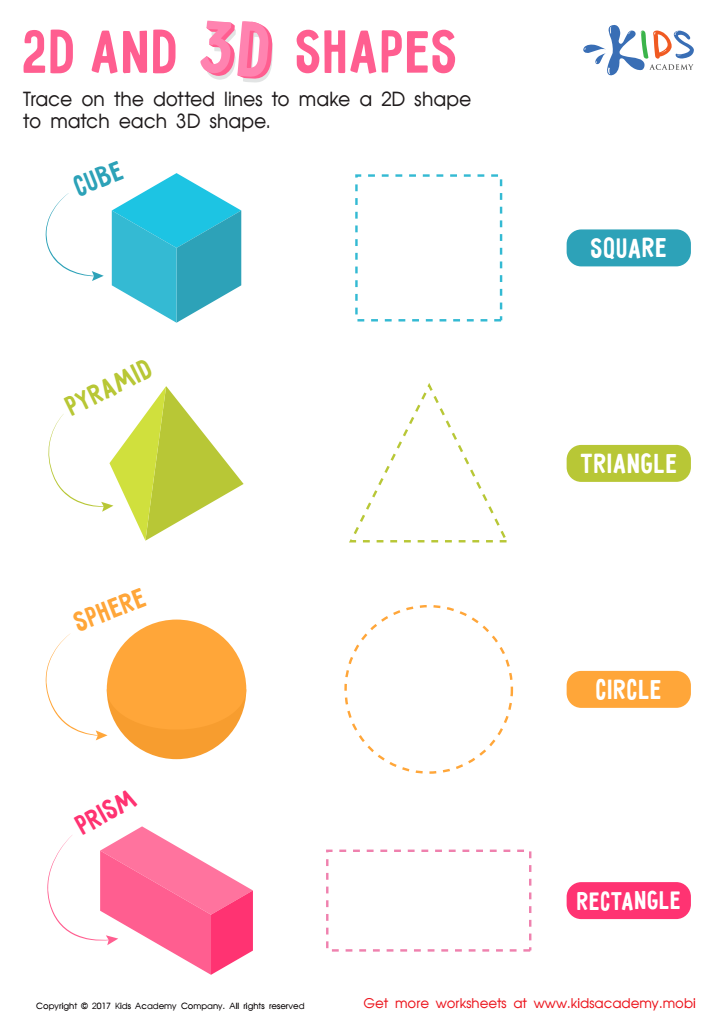
2D and 3D Shapes Worksheet
Introduce your child to 3D and 2D with this traceable worksheet. With dotted lines, help them trace and make a 2D shape for each 3D shape: square, triangle, rectangle, and circle. Show them there's more than one way to draw! You may have taken them to a 3D movie, or they've seen some fantastic 3D art. Now they can wonder no more.
2D and 3D Shapes Worksheet
Worksheet
Join Kids Academy for Free
Who is primarily going to use this learning content?








Spatial awareness and geometry are crucial building blocks in early childhood education that significantly impact a child's cognitive and social development. For children aged 4-8, engaging in activities that promote spatial awareness through extra challenges in geometry fosters essential skills that extend far beyond just mathematical ability.
First, spatial awareness is key to understanding and interacting with the environment. It helps children grasp concepts of space, position, and movement, which are foundational for day-to-day activities such as navigating through spaces, understanding directions, and organizing their personal workspace.
Second, geometry and spatial reasoning contribute significantly to problem-solving skills. When young learners tackle extra challenges in these areas, they develop critical thinking and the ability to visualize and manipulate objects mentally. This enhances their capacity to approach problems methodically and think creatively.
Socially and emotionally, mastering spatial tasks boosts self-confidence and perseverance. As children successfully navigate spatially challenging tasks, they experience a sense of accomplishment that encourages them to embrace new and difficult challenges across various domains.
Lastly, early proficiency in spatial awareness and geometry sets the stage for later academic success. Studies show that strong spatial skills are linked to achievements in STEM (Science, Technology, Engineering, and Mathematics) fields.
In sum, nurturing spatial awareness and geometry in young learners equips them with vital skills for both immediate tasks and future academic pursuits, making it an invaluable component of early education.