Spatial awareness Extra Challenge 2D Shapes Worksheets for Ages 6-7
3 filtered results
Difficulty Level
Grade
Age
-
From - To
Subject
Activity
Standards
Enhance your child's spatial awareness with our engaging "Spatial Awareness Extra Challenge 2D Shapes Worksheets" designed specifically for ages 6-7. These worksheets provide an exciting way for young learners to explore various 2D shapes through fun activities that stimulate critical thinking and improve visual-motor skills. Each worksheet encourages kids to identify, compare, and manipulate shapes, all while developing essential problem-solving abilities. Perfect for reinforcing classroom lessons or providing extra practice at home, these supplementary worksheets offer a comprehensive approach to mastering spatial concepts. Empower your child to become confident thinkers and eager learners while they have fun with shapes!
Favorites
With answer key
Interactive
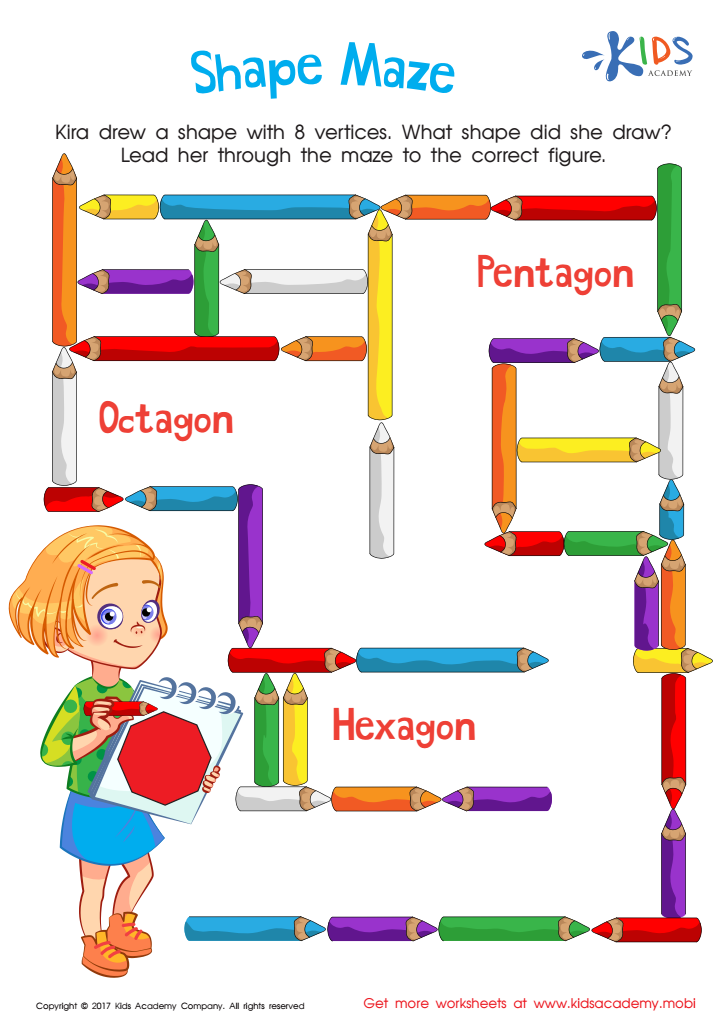
Shape Maze Worksheet
Test your child's geometry knowledge with this fun printable maze! They'll need to identify shapes with 8 vertices to find their way through the maze and get the correct answer.
 Assign to My Students
Shape Maze Worksheet
Worksheet

Congruent Shapes Worksheet
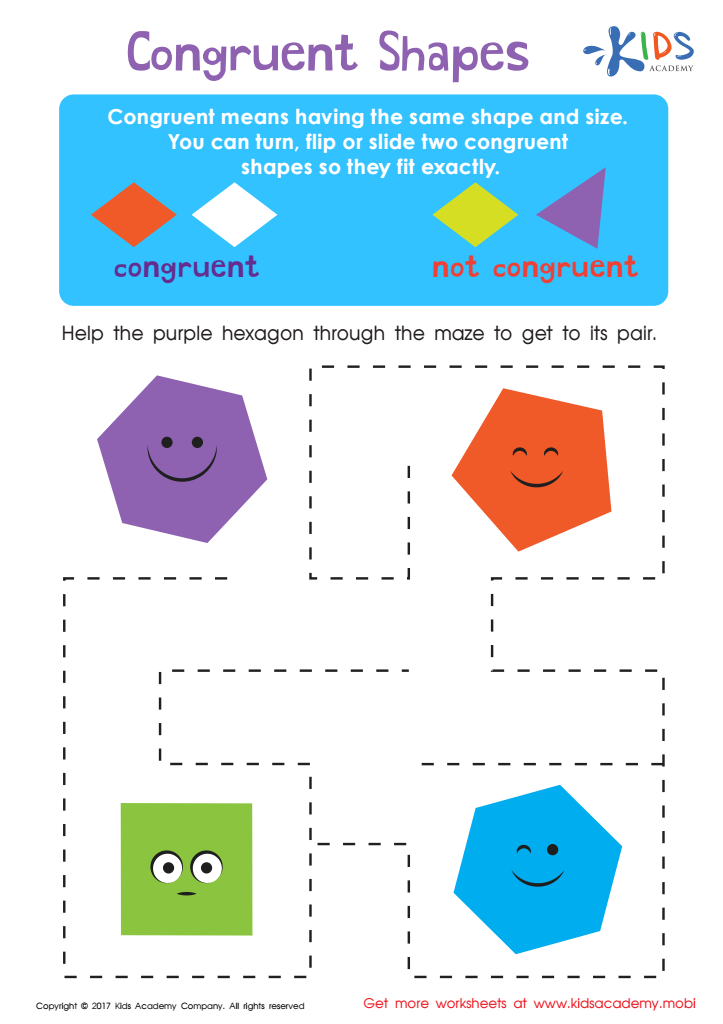
Help your child find the twin of the purple hexagon! This congruent shapes worksheet is great for increasing vocabulary while challenging mental rotation skills.
Congruent Shapes Worksheet
Worksheet
2D and 3D Shapes Worksheet
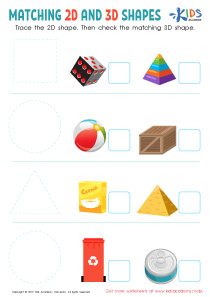
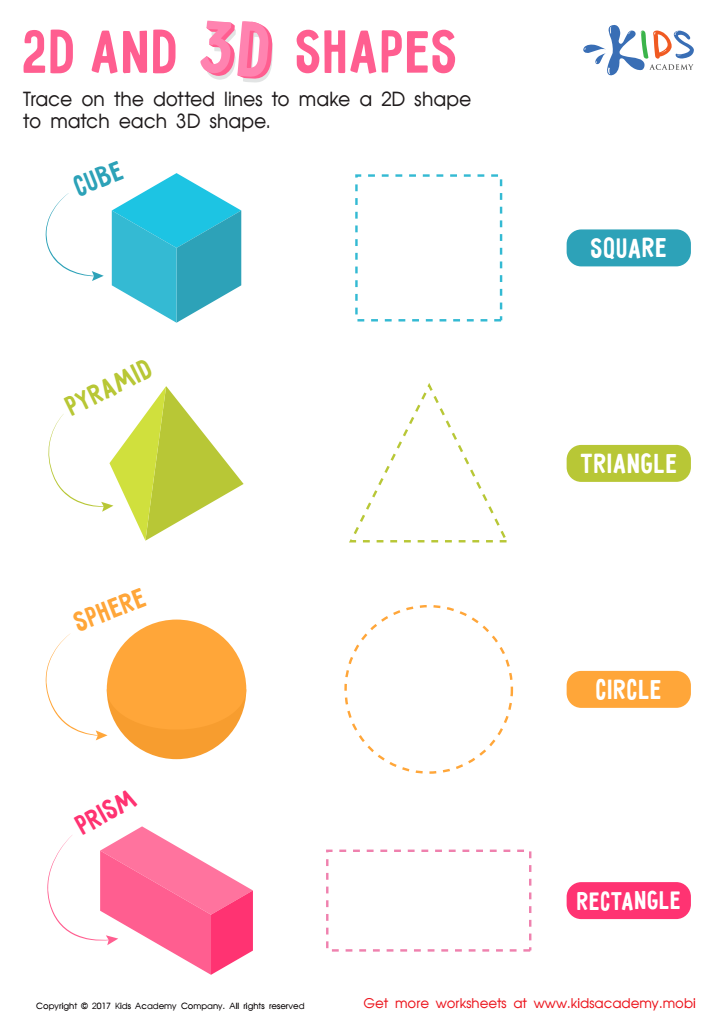
Introduce your child to 3D and 2D with this traceable worksheet. With dotted lines, help them trace and make a 2D shape for each 3D shape: square, triangle, rectangle, and circle. Show them there's more than one way to draw! You may have taken them to a 3D movie, or they've seen some fantastic 3D art. Now they can wonder no more.
2D and 3D Shapes Worksheet
Worksheet
Join Kids Academy for Free
Who is primarily going to use this learning content?








Spatial awareness is a fundamental skill that enables children to understand their environment and navigate it effectively, especially as they engage with 2D shapes. For children aged 6-7, developing spatial awareness through activities focused on 2D shapes is crucial for several reasons.
First, spatial awareness lays the groundwork for various academic subjects, including mathematics, science, and art. Understanding shapes, their properties, and how they relate to one another enhances problem-solving skills and supports the comprehension of geometric concepts. Second, engaging with 2D shapes cultivates critical thinking. When children manipulate shapes, rotate them, or combine them, they are not only learning about geometry but also practicing analytical skills that contribute to overall cognitive development.
Moreover, strong spatial awareness promotes everyday life skills. From reading maps to constructing objects and participating in sports, these skills help children navigate their physical world confidently. By embracing activities that enhance spatial awareness, parents and teachers are not only supporting academic success but also fostering essential life skills that contribute to a child’s overall growth and future potential. Ultimately, promoting engagement with 2D shapes at this age is both beneficial and essential, preparing children for the complexities of the world around them.