
Mathematical reasoning Extra Challenge Word Problems Worksheets for Ages 6-7
3 filtered results
Difficulty Level
Grade
Age
-
From - To
Subject
Activity
Standards
Enhance your child’s critical thinking skills with our Mathematical Reasoning Extra Challenge Word Problems Worksheets for Ages 6-7. These meticulously designed worksheets are crafted to stimulate young minds, encouraging them to apply logical reasoning to solve complex math problems. Perfect for first graders, the exercises cover essential topics like addition, subtraction, counting, and more, all within engaging word problems. By tackling these challenges, kids will not only improve their math abilities but also learn to think analytically and approach problems with confidence. Ideal for both classroom and home use, these worksheets make mastering math fun and rewarding.
Favorites
With answer key
Interactive
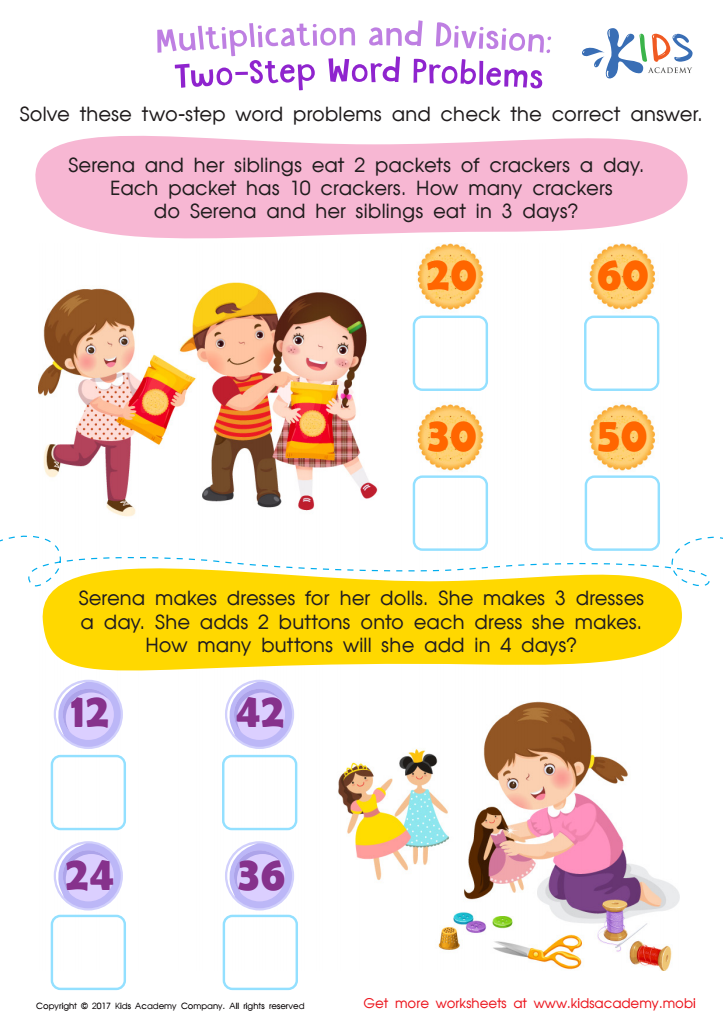
Two Step Word Problems Worksheet
Boost your child's math skills with this fun and realistic two-step word problems worksheet! Kids will learn to break down complex multiplication word problems into easier steps to solve. Download this free PDF worksheet and help them reach the next level.
 Assign to My Students
Two Step Word Problems Worksheet
Worksheet
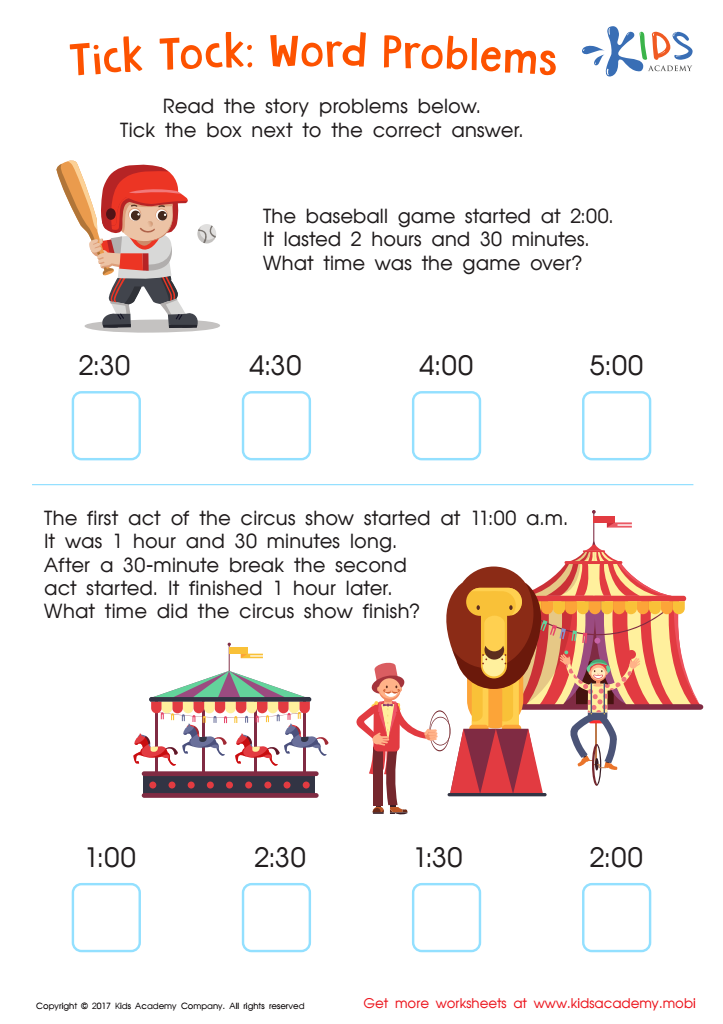
Tick Tock Word Problems Time Worksheet
Mix math and fun with this telling time word problems worksheet! Your child will love solving the events' finishing times using the vivid colors and joyful illustrations. Tick Tock!
Tick Tock Word Problems Time Worksheet
Worksheet
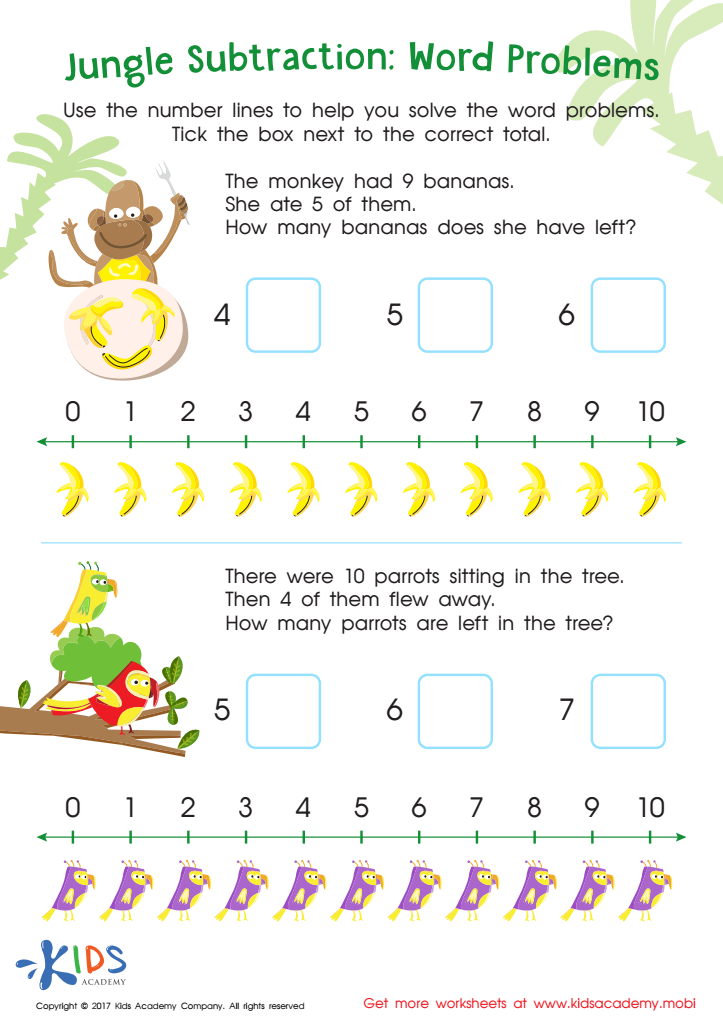
Jungle Subtraction Word Problems Substraction Worksheet
Kids will love this jungle-themed worksheet: subtraction word problems! Help the monkey work out how many bananas he has, using the number line. Encourage your child to use colorful parrots to subtract with ease and make calculations fun!
Jungle Subtraction Word Problems Substraction Worksheet
Worksheet
Join Kids Academy for Free
Who is primarily going to use this learning content?








Mathematical reasoning extra challenge word problems for ages 6-7 are essential for nurturing young minds because they foster critical thinking, problem-solving skills, and a deeper understanding of mathematical concepts. At this developmental stage, children are naturally curious and absorbent, making it the perfect time to introduce challenging problems that require them to think logically, analyze situations, and devise strategies to find solutions.
Solving these word problems helps children move beyond rote memorization of basic arithmetic operations and enables them to apply math in real-life contexts. It encourages them to read carefully, comprehend complex scenarios, identify relevant information, and ignore extraneous details. This process builds their ability to think abstractly and symbolically, skills that are foundational for future mathematical learning.
Moreover, overcoming challenging problems can boost children's confidence and persistence. Successful problem-solving experiences make them realize that struggle and effort lead to mastery, fostering a growth mindset. This type of challenge also helps identify areas where a child may need additional support or enrichment, allowing parents and teachers to customize instruction to meet individual learning needs.
Incorporating extra challenge word problems into the curriculum ensures that children are not just passive recipients of information but active participants in their learning journey, laying a strong foundation for academic success in mathematics and other critical disciplines.








