
Money recognition Extra Challenge Worksheets for Ages 7-9
4 filtered results
Difficulty Level
Grade
Age
-
From - To
Subject
Activity
Standards
Enhance your child's financial literacy with our engaging "Money Recognition Extra Challenge Worksheets for Ages 7-9". Designed to stimulate young minds, these worksheets offer a variety of fun activities that help kids discover the value of different coins and bills. By practicing identification, counting, and making change, children develop essential skills for real-world scenarios. Perfect for classroom or home learning, these worksheets cater to varying skill levels, ensuring every child can excel. Boost your child's confidence in handling money and support their journey towards financial responsibility. Unlock exciting learning experiences and watch them thrive with our carefully crafted challenges!
Favorites
With answer key
Interactive
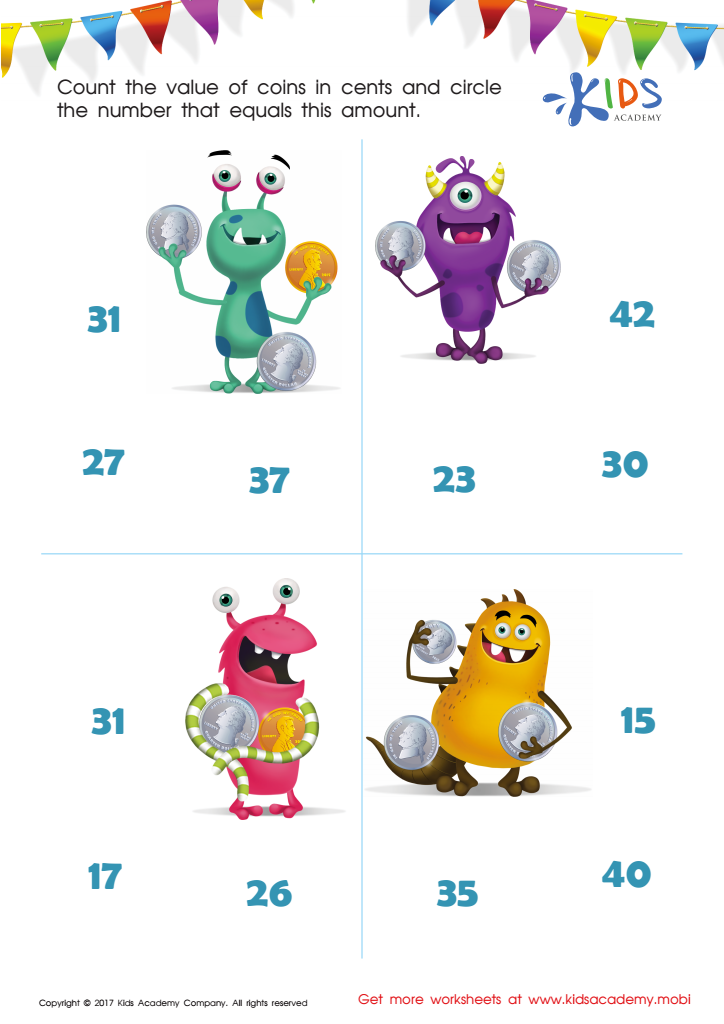
How Many Coins Money Worksheet
Have fun while counting coins: look at the monsters and count the coins in their hands. Challenge your little learners to count and write down the number of coins each one has. Enjoy the time together!
 Assign to My Students
How Many Coins Money Worksheet
Worksheet
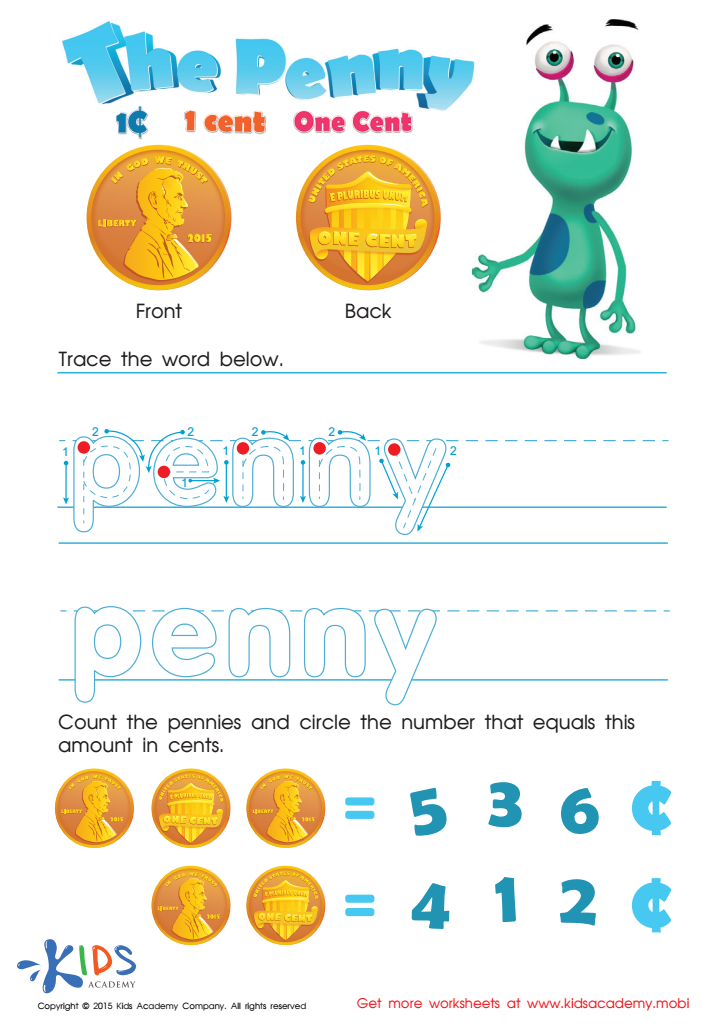
One Cent or the Penny Money Worksheet
Counting money made easy with Kids Academy's new collection of worksheets! Start with the one cent coin, or "Penny": trace it and count the pennies to work out the total. Visit our site for more free, printable money worksheets.
One Cent or the Penny Money Worksheet
Worksheet
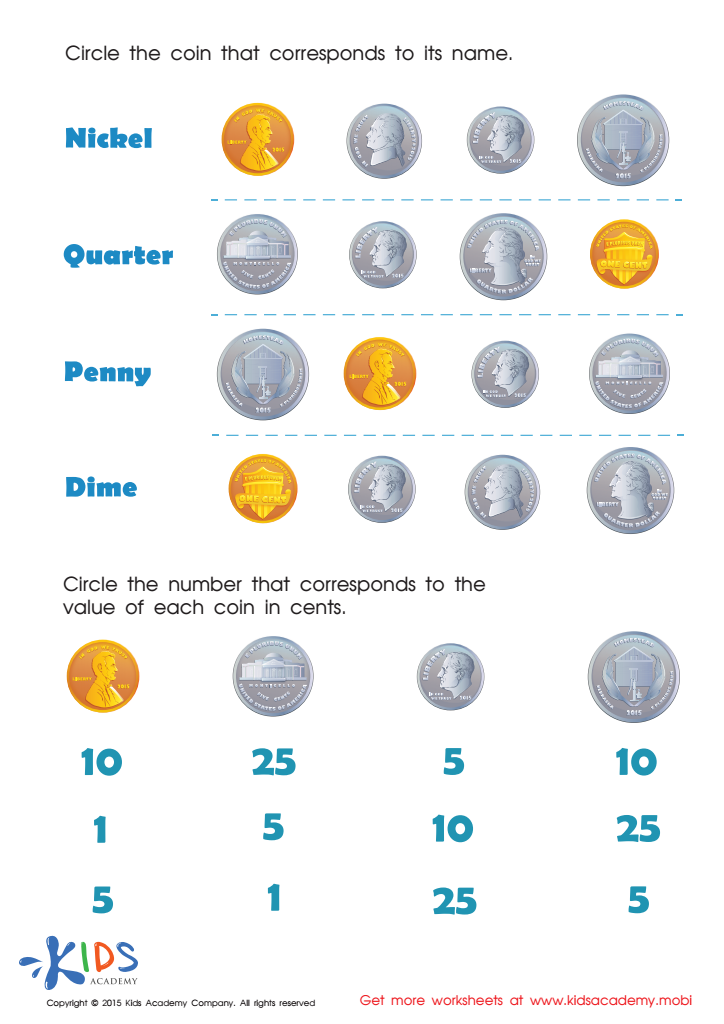
Coin Names and Values Money Worksheet
Learning about money can be easy, interesting and fun! Start by memorizing names and values of coins and then try matching pictures of coins to the right names and values. Find a great selection of counting money worksheets at our web site and keep learning.
Coin Names and Values Money Worksheet
Worksheet
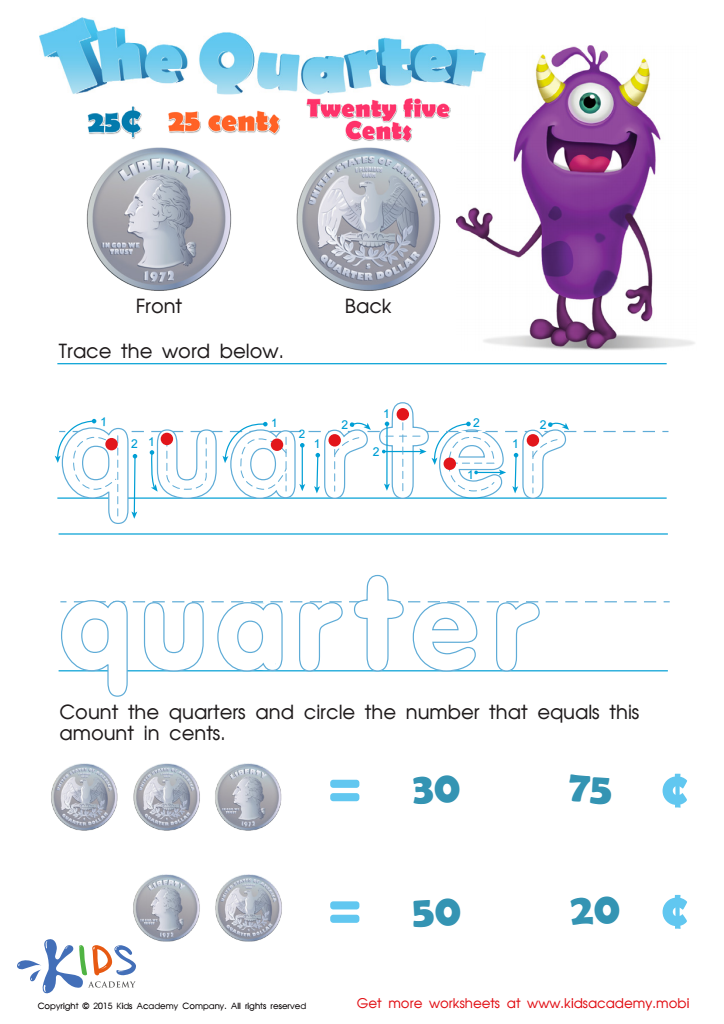
Twenty Five Cents or the Quarter Money Worksheet
Check out our new printable money games - learn to count money easily! With quarters, trace the word, count them and calculate the amount in cents. More worksheets at our website. Give it a try!
Twenty Five Cents or the Quarter Money Worksheet
Worksheet
Join Kids Academy for Free
Who is primarily going to use this learning content?






Money recognition is a vital skill for children aged 7-9, and both parents and teachers should prioritize it for several reasons. First, understanding money lays the groundwork for essential life skills. At this age, children start making their own decisions regarding money, whether it's saving allowance or buying small treats. Recognizing different denominations helps them make informed choices, develop budgeting skills, and avoid potential pitfalls like overspending.
Moreover, money recognition fosters mathematical skills. By identifying and learning to calculate with coins and bills, children practice addition, subtraction, and even multiplication in practical scenarios. This hands-on learning makes math more relatable and enjoyable.
Additionally, money recognition can cultivate a sense of responsibility and independence. When children understand the value of money and how to manage it, they build confidence in their ability to handle financial decisions in the future.
Extracurricular challenges, like a “Money Recognition Extra Challenge,” engage kids in a fun, interactive way, reinforcing these concepts through games and activities. This not only enhances learning but also promotes teamwork and social skills. In summary, prioritizing money recognition is essential for developing lifelong financial literacy, responsibility, and confidence in young learners.








