
Comparing quantities Kindergarten Worksheets
4 filtered results
Difficulty Level
Grade
Age
-
From - To
Subject
Activity
Standards
Our "Comparing Quantities Kindergarten Worksheets" are designed to help young learners develop essential early math skills. These engaging and colorful worksheets introduce concepts like greater than, less than, equal to, and comparing groups of objects. Perfect for young minds, the activities not only make learning fun but also reinforce critical thinking and observation skills. Our printable worksheets are ideal for both classroom use and at-home practice, promoting confidence in children as they discover the fundamental principles of math. Start your child's journey towards mathematical proficiency with our expertly crafted resources!
Favorites
With answer key
Interactive
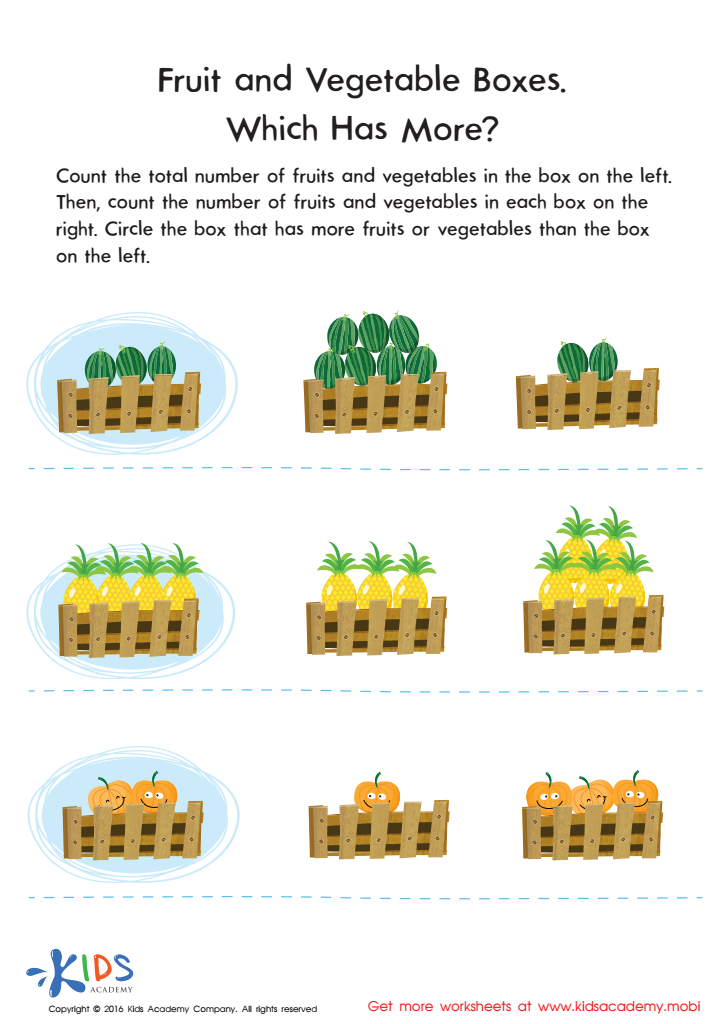
Which Has More? Size Worksheet
This worksheet is perfect for your child to practice critical thinking and logical reasoning. Your child will count and compare the fruits and veggies in the crates to decide which one has more. They will use complex cognitive skills and practice following precise rules. Guide them through the directions and help keep their focus, while enjoying the images.
 Assign to My Students
Which Has More? Size Worksheet
Worksheet
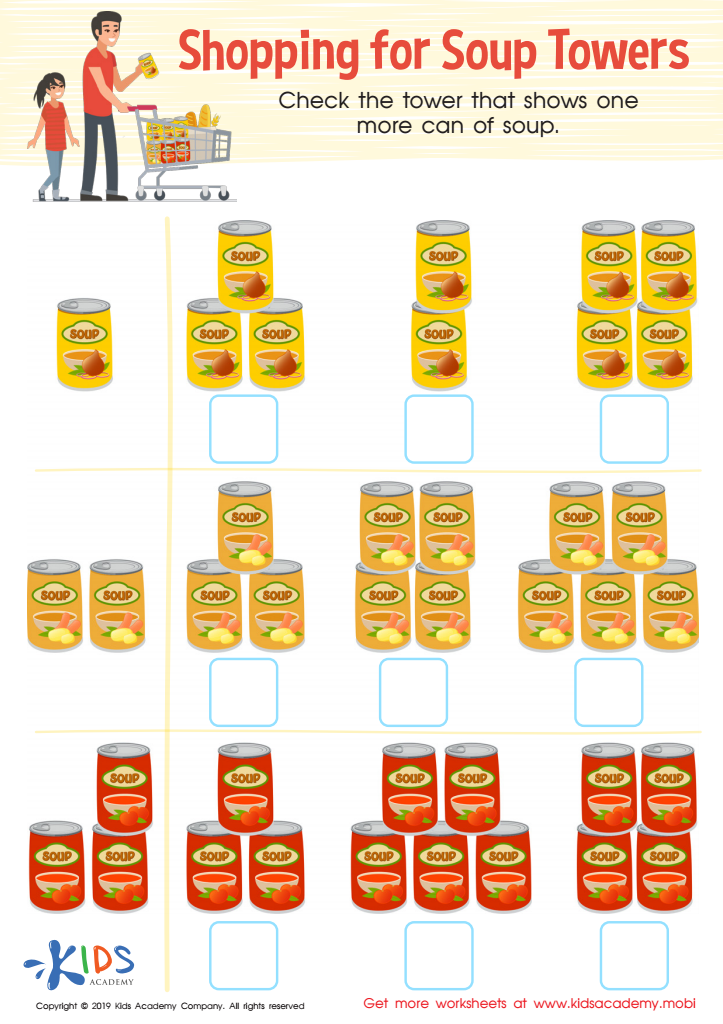
Soup Towers Worksheet
Do your kids come shopping? Transform it into a learning experience! Point out items and ask your kids what they are. Count each stack of cans, and have them check the tower with an extra can of soup. It's a great way to teach them counting and counting up!
Soup Towers Worksheet
Worksheet
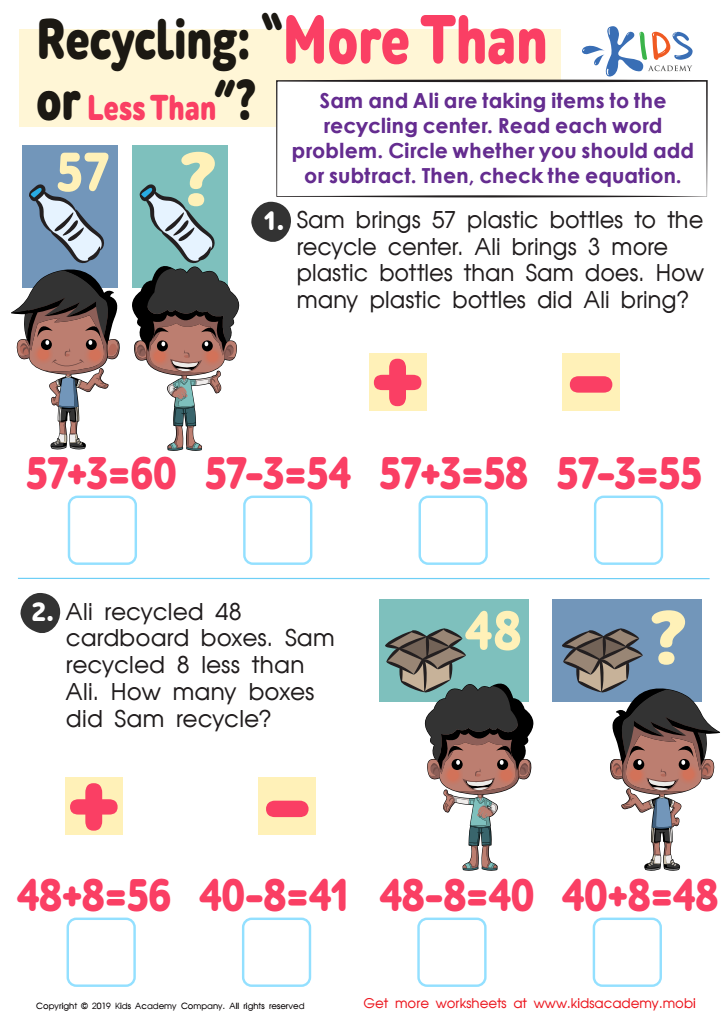
Recycling - More or Less Worksheet
Your child can compare numbers and solve word problems with this free worksheet. Help them understand what's being asked as Sam and Ali take items to the recycling center. They can choose the correct equation to match the word problem and apply their skills in reading and pulling out the appropriate information.
Recycling - More or Less Worksheet
Worksheet
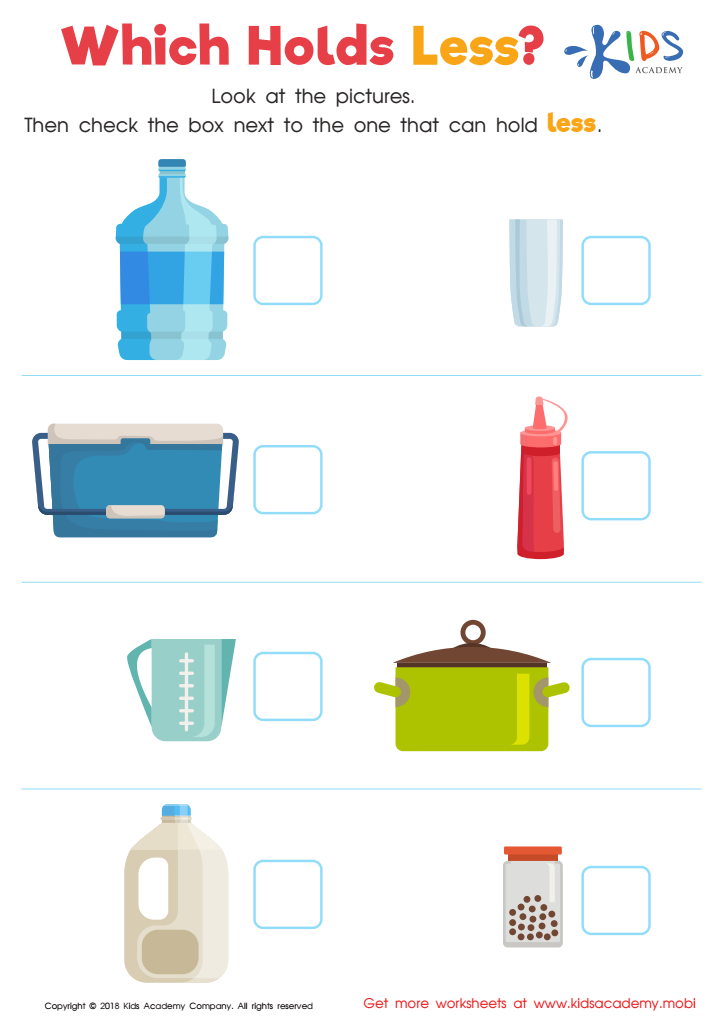
Which Holds Less? Worksheet
Students may find it hard to grasp volume without a visual aid. This free, downloadable worksheet helps with understanding by providing pictures of familiar objects. It allows students to practice comparing volumes and deciding which container holds less. It's a great introduction before they move onto using greater than and less than symbols.
Which Holds Less? Worksheet
Worksheet
Join Kids Academy for Free
Who is primarily going to use this learning content?





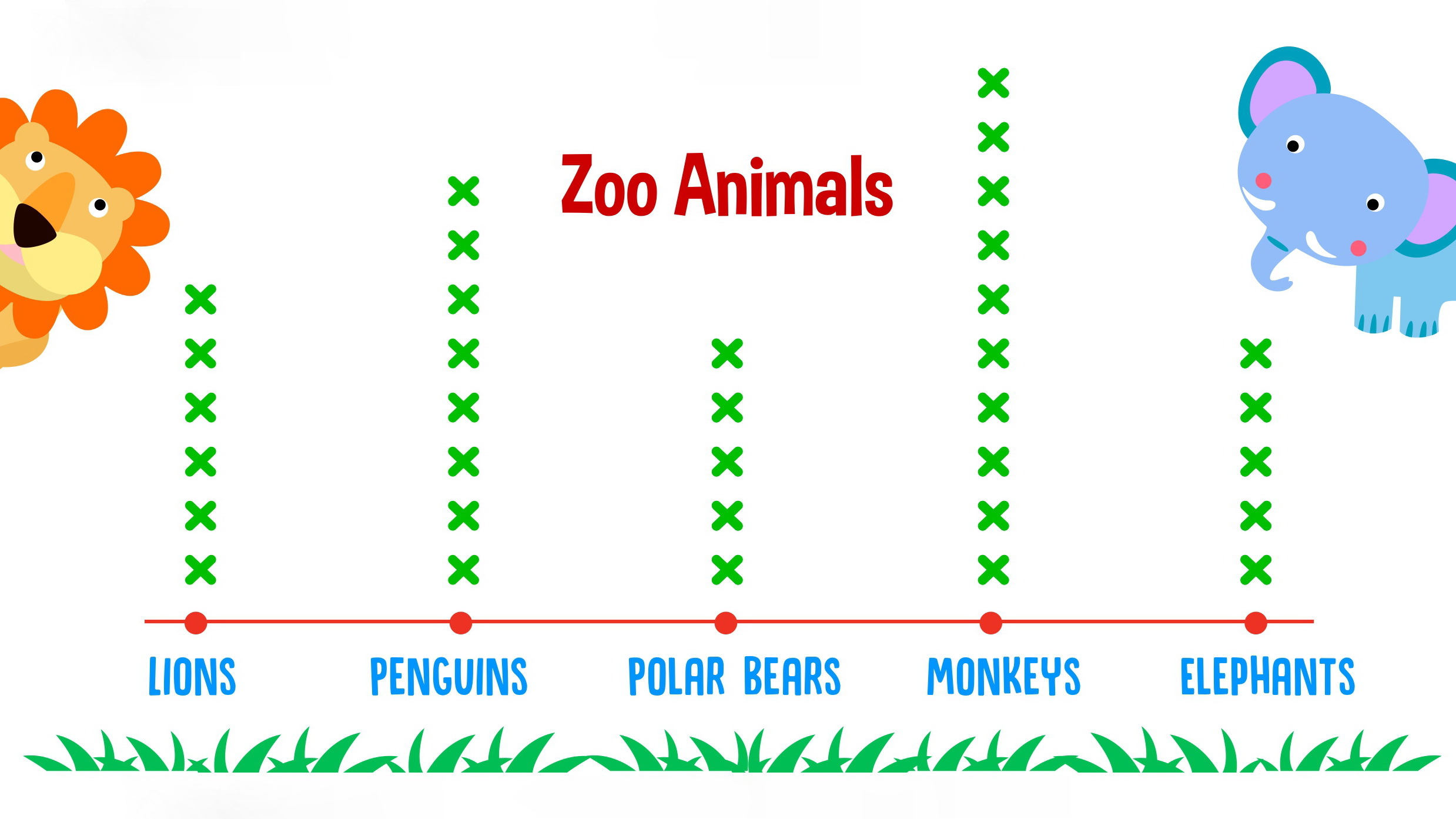

Comparing quantities in kindergarten is fundamental for early childhood development and plays a crucial role in laying the groundwork for future mathematical understanding. First, it enhances cognitive skills. When children compare quantities, they engage in a process that hones their ability to differentiate, match, and measure items, boosting their analytical thinking. For instance, understanding concepts such as “more than,” “less than,” or “equal to” are foundational elements of math literacy.
Secondly, it promotes language development. Discussing quantities necessitates the use of specific mathematical vocabulary, thereby expanding children’s language skills. Phrases involving comparison also help in better understanding adjectives and grammatical structures.
Thirdly, comparing quantities supports problem-solving abilities. When children encounter situations that require determining the larger or smaller quantity, they naturally develop strategies to approach and solve these basic problems. This problem-solving mindset is crucial throughout their educational trajectory.
Lastly, these activities are important for real-world understanding. From sharing toys to distributing snacks, children often face everyday scenarios that demand comparisons. Early practice instills a sense of fairness and operations of everyday math without formal instruction.
Therefore, by prioritizing comparing quantities, parents and teachers set children on a path towards academic success, critical thinking, effective communication, and a practical understanding of the world around them.








