Energy comprehension Worksheets for Kids
1 filtered results
-
From - To
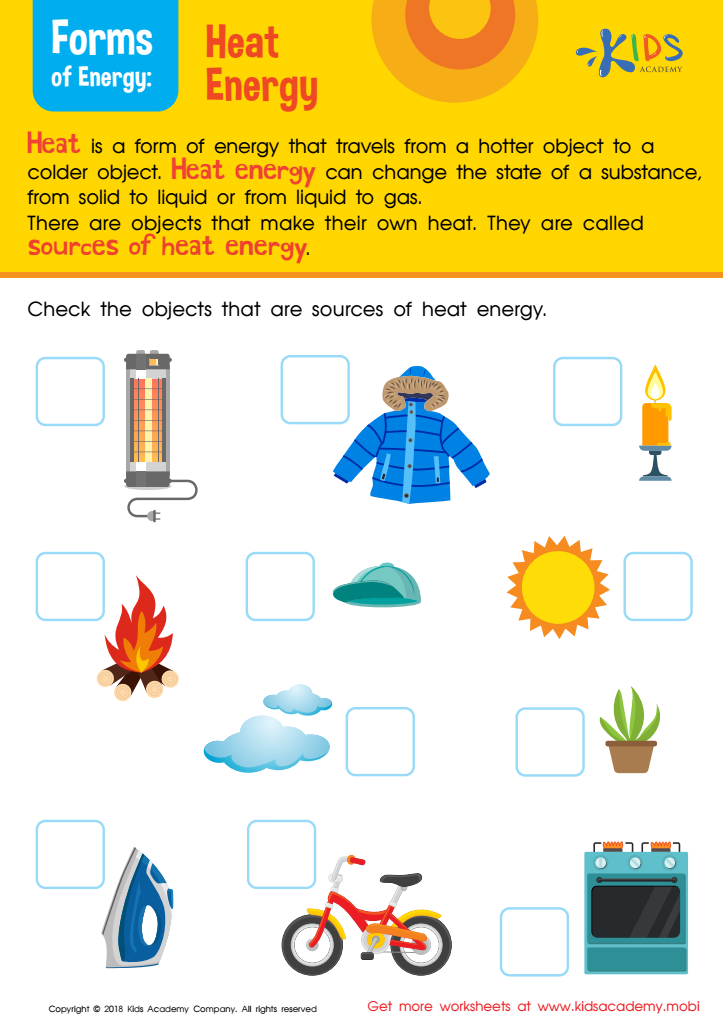
Sources of Heat Energy Worksheet
 Assign to My Students
Question/Answer

How to train the Energy comprehension skill in Grade 3 students learning about Physical Science?
To train the Energy comprehension skill in Grade 3 students, use hands-on activities such as simple experiments showcasing energy forms and transformations (e. g. , solar energy to heat, mechanical energy from wind). Incorporate visual aids like diagrams and videos to illustrate concepts.
How to test a Grade 3 student’s Energy comprehension skills?
To test a Grade 3 student's Energy comprehension skills, create a short quiz or activity that includes basic energy concepts, such as types (kinetic, potential), sources (solar, wind), and the importance of energy conservation. Use a mix of multiple-choice questions, true or false statements, and simple experiments to evaluate their understanding in a hands-on, engaging way.
Why is the Energy comprehension skill important for Grade 3 students?
The Energy comprehension skill is important for Grade 3 students because it lays the foundational understanding of basic energy concepts, such as sources, types, and conservation.