Enhancing geographical knowledge Worksheets for Kids
1 filtered results
Difficulty Level
Grade
Age
-
From - To
Subject
Activity
Standards
Enhancing geographical knowledge Worksheets are an excellent tool for students of all ages to expand their knowledge of the world. These worksheets cover a wide range of geographical topics, from continents and oceans to countries and capitals. By engaging in these activities, students can improve their understanding of global geography in a fun and interactive way.
Favorites
With answer key
Interactive
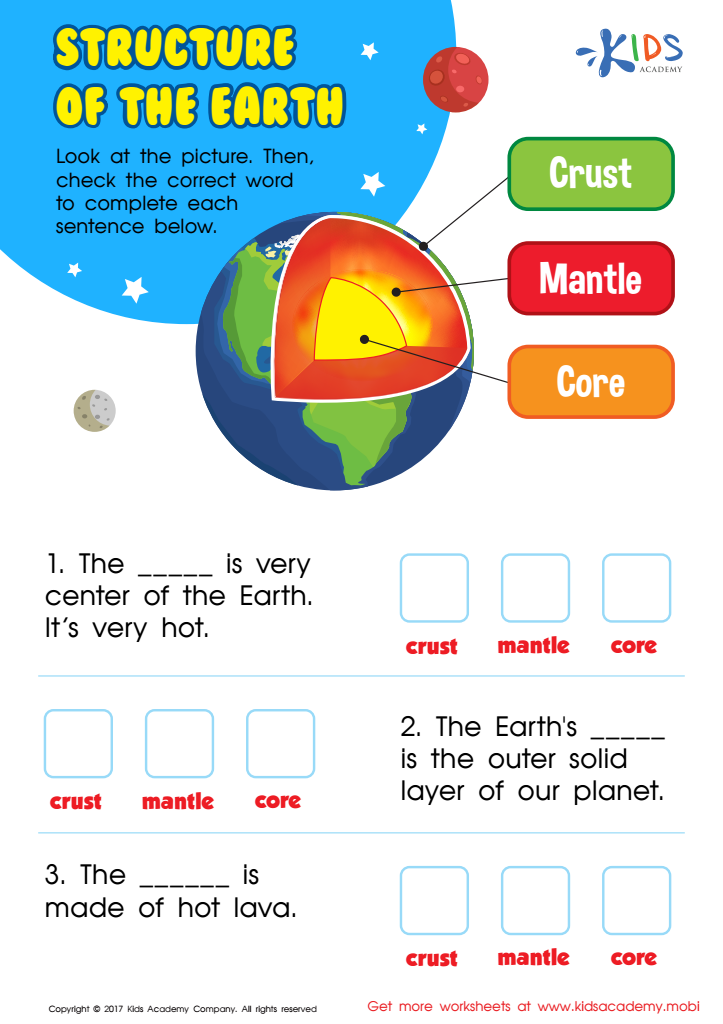
Structure of the Earth Worksheet
Discover the hidden structure of the Earth with this worksheet! Learn about the three main parts: crust, mantle and core. Help your little scientist increase their geological vocabulary and knowledge.
 Assign to My Students
Structure of the Earth Worksheet
Worksheet
Question/Answer

What are some effective activities to train students’ Enhancing geographical knowledge skill when teaching them about Our Planet and Environment?
Effective activities include interactive map exercises, virtual reality explorations of different ecosystems, hands-on projects like building model landscapes, organizing climate change simulations, and using geographical information systems (GIS) to analyze spatial data. Incorporating field trips, case studies on diverse habitats, and guest lectures from environmental scientists also deeply enrich students' understanding of geography and environmental issues.
How does the mastery of the Enhancing geographical knowledge skill affect a student's performance at an early age?
The mastery of the Enhancing geographical knowledge skill at an early age significantly boosts a student's performance by improving spatial thinking, understanding of world cultures, environmental awareness, and analytical skills. This foundation aids in better comprehension in subjects like history, economics, and science, fostering a well-rounded, globally aware individual capable of critical thinking and problem-solving.
How to train the Enhancing geographical knowledge skill in Grade 2 students learning about Our Planet and Environment?
To train Grade 2 students in enhancing their geographical knowledge about Our Planet and Environment, engage them in interactive activities like map reading, globe exploration, and geographical scavenger hunts. Additionally, incorporate story-telling about different places, use educational videos, and have them create simple projects on various climates, landforms, and ecosystems to make learning engaging and memorable.
Join Kids Academy for Free
Who is primarily going to use this learning content?