Sequential ordering Worksheets for Kids
1 filtered results
Difficulty Level
Grade
Age
-
From - To
Subject
Activity
Standards
Sequential ordering worksheets are crucial for enhancing children's cognitive and logic skills. These activities help kids grasp the concept of order, improving their organization and direction-following abilities. Such skills are beneficial for school and everyday life. Children learn to predict outcomes and make decisions through these exercises, boosting their problem-solving capabilities. The worksheets also promote spatial awareness and attention to detail by requiring pattern identification and correct sequencing. They play a vital role in shaping children into thoughtful, organized, and analytical individuals.
(Note: The above text has 699 characters without spaces.)
Favorites
With answer key
Interactive
Question/Answer

How to test a Grade 2 student’s Sequential ordering skills?
To test a Grade 2 student's sequential ordering skills, present them with a series of pictures, words, or numbers that are out of order. Ask the student to arrange them in the correct sequence, such as the steps of a daily routine, a simple story, a number line, or the alphabet.
How does the mastery of the Sequential ordering skill affect a student's performance at an early age?
The mastery of sequential ordering skill at an early age significantly enhances a student's ability to organize thoughts and actions, follow instructions, solve problems, and understand the concept of time. This foundational skill lays the groundwork for effective learning, reading comprehension, mathematical reasoning, and the development of critical thinking skills, leading to improved overall academic performance.
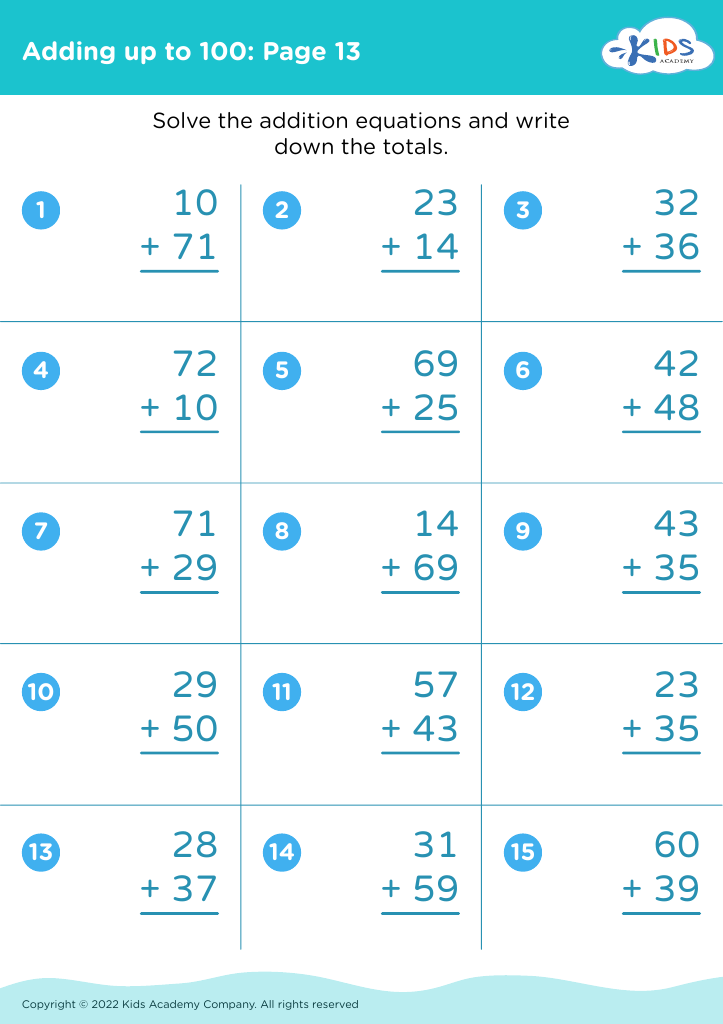
What are some effective activities to train students’ Sequential ordering skill when teaching them about Adding up to 100 Misc?
Effective activities for training students’ Sequential ordering skill in Adding up to 100 include: 1. Number line jumps: Students use a number line to visualize addition steps. 2. Sequence puzzles: Cutouts of addition steps that students arrange in order. 3. Step-by-step story problems: Students solve problems that require adding numbers in a sequence. 4.
Join Kids Academy for Free
Who is primarily going to use this learning content?