Hand-eye Coordination Addition & Subtraction Worksheets - Page 2
29 filtered results
-
From - To
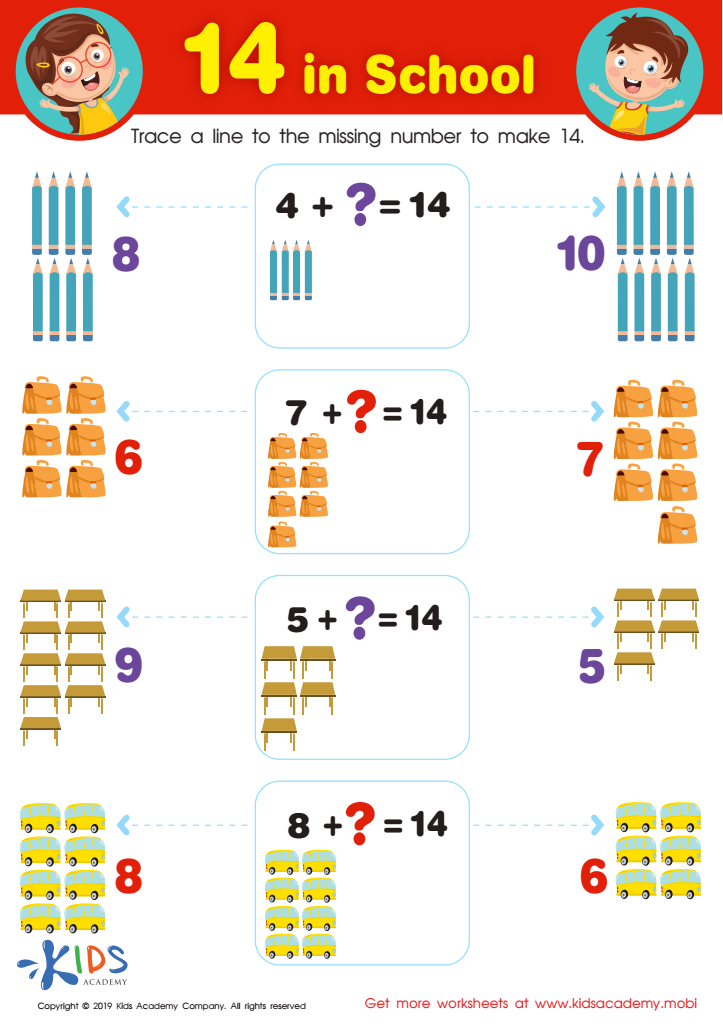
14 in School Worksheet
 Assign to My Students







Hand-eye coordination is crucial for children as it is foundational for various skills they will need in both academic and everyday contexts. For parents and teachers, fostering hand-eye coordination, particularly in activities related to addition and subtraction, is essential for several reasons.
Firstly, hand-eye coordination supports better control over pencil, crayon, or mouse movements, which are necessary for writing and drawing. As children practice addition and subtraction through manipulatives or manipulable tools like blocks or counters, they enhance their fine motor skills alongside mathematical understanding. The physical act of counting and organizing objects directly reinforces numbers and operations.
Secondly, proficient hand-eye coordination improves cognitive processing speed and timing. As children work with math problems actively, they develop quicker reasoning skills, which are crucial for advancing in more complex mathematical concepts.
Moreover, when parents and teachers engage children in playful activities that require physical interaction with numbers—such as games or crafts—they make math enjoyable, thereby reducing anxiety surrounding calculations. Strengthening hand-eye coordination can create more confident learners who are better prepared for greater academic challenges. For these reasons, investment in developing hand-eye coordination through math-focused activities is essential for holistic child development.








