
Observation skills Addition & Subtraction Worksheets
3 filtered results
Difficulty Level
Grade
Age
-
From - To
Subject
Activity
Standards
Enhance your child's mathematical abilities with our "Observation Skills Addition & Subtraction Worksheets." These engaging worksheets are designed to improve critical observation skills, fostering a deeper understanding of math concepts. Each activity encourages children to observe patterns, analyze questions, and apply addition and subtraction in real-world contexts. Ideal for early learners, our worksheets promote independent thinking while making math fun and interactive. Parents and teachers can use these resources to support skill development at home or in the classroom. Download now to help your child build strong foundational math skills through observation and practical application!
Favorites
With answer key
Interactive
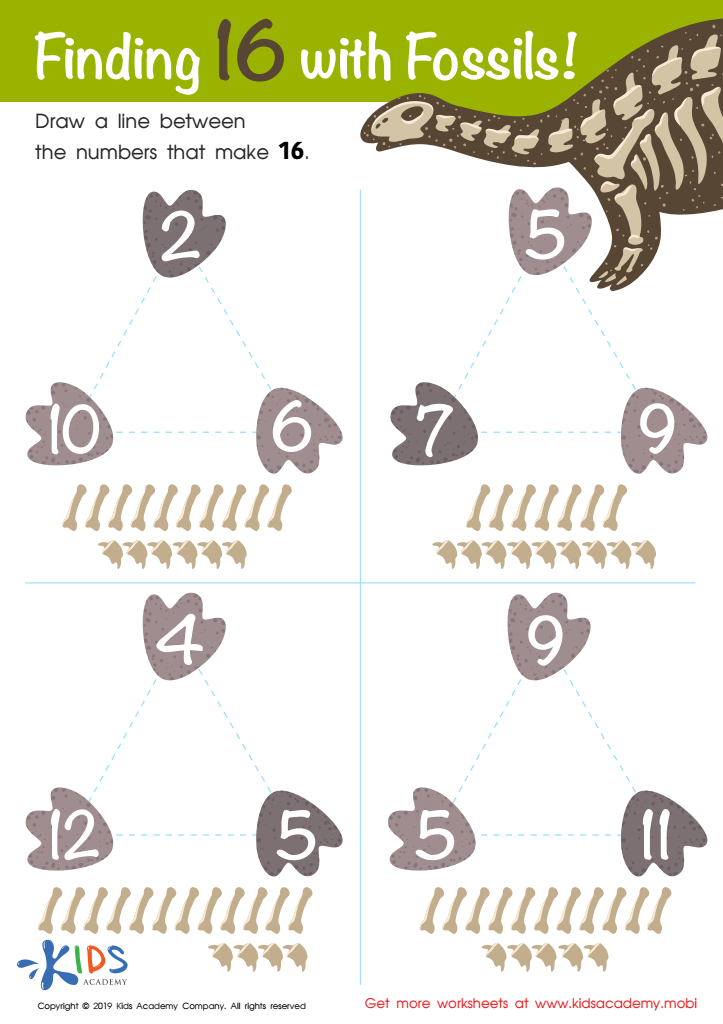
Finding 16 With Fossils Worksheet
Experts hunt for fossils, dig them up, and study them to learn more about past life forms - how they lived, what they looked like, and when they lived. Show kids the picture in this worksheet and point out the fossils. Help them count the bones and draw a line between the numbers that add up to 16 in each triangle.
 Assign to My Students
Finding 16 With Fossils Worksheet
Worksheet
Join Kids Academy for Free
Who is primarily going to use this learning content?








Observation skills in addition and subtraction are crucial for both parents and teachers as they form the foundation of mathematical understanding and critical thinking in young children. These skills enable children to notice patterns, relationships, and inconsistencies in numbers, which helps them grasp concepts more deeply. When children can observe and analyze problems, they are better equipped to apply addition and subtraction in real-life situations, boosting their confidence and problem-solving abilities.
For parents, encouraging observational skills at home can nurture a child's curiosity and promote a love for learning. Simple activities like counting objects, discussing prices during shopping, or playing math games can solidify these skills indirectly.
For teachers, fostering observation skills in the classroom creates an interactive learning environment. It encourages active participation and enhances student engagement, making math feel more relevant and enjoyable. By integrating observational activities into lessons, teachers can identify individual student needs, tailor instruction, and promote collaborative learning.
Ultimately, honing children’s observation skills in addition and subtraction lays the groundwork for higher-level math concepts and inspires a lifelong appreciation for math and critical thinking. Supporting these skills ensures children are well-prepared for academic success and problem-solving beyond the classroom.








