
Understanding Simple Machines Normal Worksheets for Ages 3-7
3 filtered results
Difficulty Level
Grade
Age
-
From - To
Subject
Activity
Standards
"Understanding Simple Machines Normal Worksheets for Ages 3-7" are engaging and educational resources designed to introduce young learners to the fascinating world of simple machines. These worksheets, suitable for preschool and early elementary students, cover basic concepts like levers, pulleys, and inclined planes in a fun and interactive way. Each worksheet features colorful illustrations and easy-to-follow instructions that make learning enjoyable. Ideal for both classroom and home use, these activities help children develop essential problem-solving and critical-thinking skills while sparking curiosity about how things work in their everyday environment. Explore now to enhance your child's understanding of simple machines!
Favorites
With answer key
Interactive
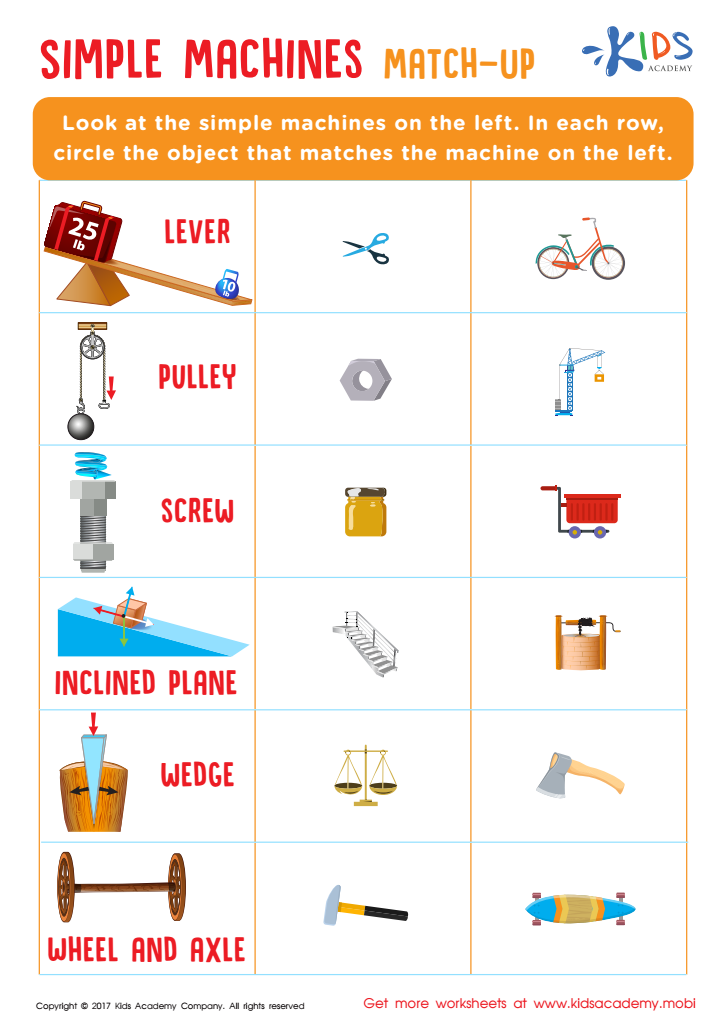
Simple Machines Worksheet
Let this colorfully illustrated PDF introduce your child to the physical science behind everyday tools and objects. Learn about simple machines like levers, pulleys, and screws – helping make our daily lives easier!
 Assign to My Students
Simple Machines Worksheet
Worksheet
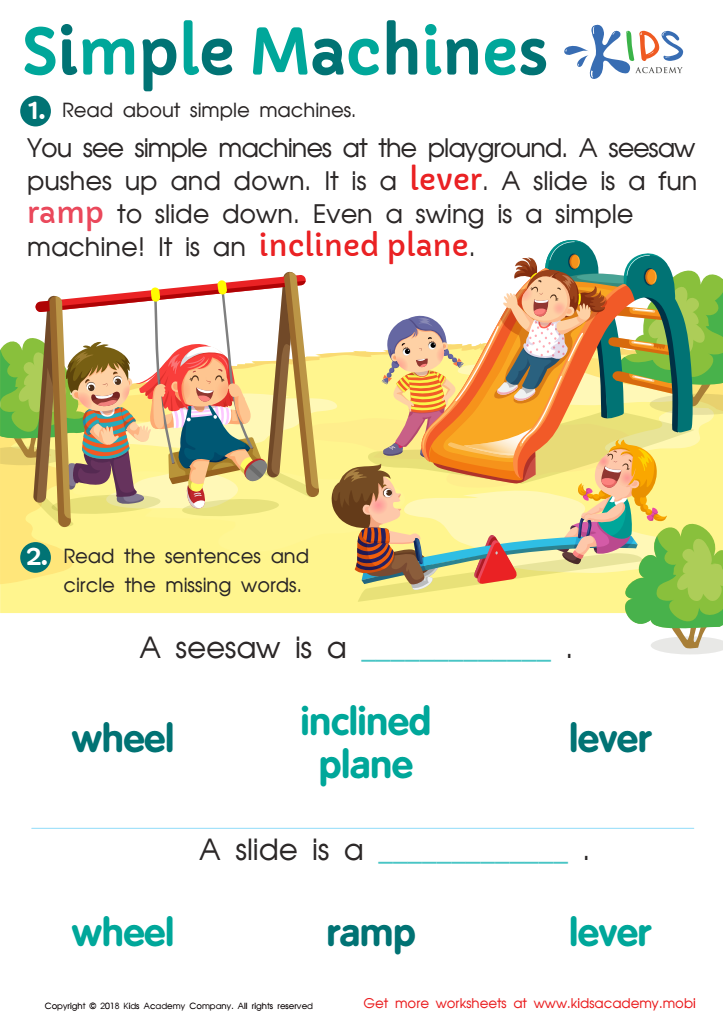
Simple Machines Worksheet
At the playground, your kids likely love to play and swing. Swings are simple machines – they work by using force to move something. Read the following sentences to them, with some words missing - help them fill in the blanks. Simple machines make work easier by __changing__ the size or __direction__ of a force. Swings use a _fulcrum_ and a _lever_ to move.
Simple Machines Worksheet
Worksheet
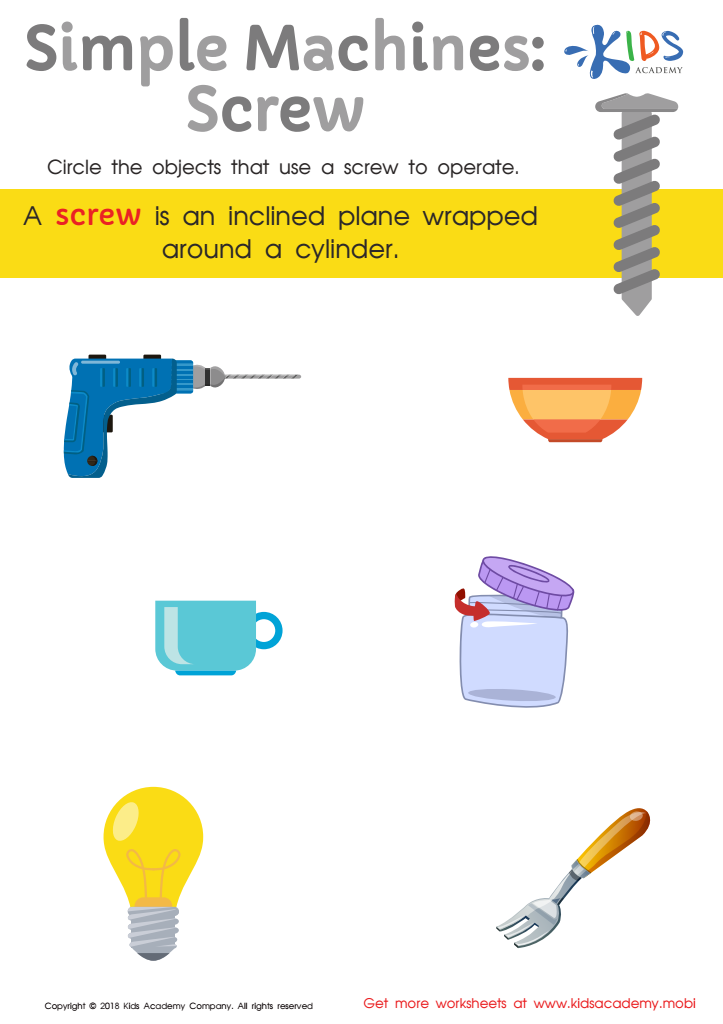
Simple Machines: Screw Worksheet
Explain to your kids that learning about simple machines can be fun - like the swings they love on the playground. Ask them to name some of their favorites. Point out that screws are used to connect simple machines. Then, look at pictures together and have your kids circle the objects that use a screw.
Simple Machines: Screw Worksheet
Worksheet
Learning Skills
Join Kids Academy for Free
Who is primarily going to use this learning content?






Understanding simple machines is crucial for young children, and parents and teachers play a vital role in facilitating this learning. For children aged 3-7, simple machines offer a gateway to comprehend basic physical concepts and mechanical principles. Engaging with levers, pulleys, wheels, and inclined planes can spark curiosity about how things work, laying a strong foundation for future STEM (Science, Technology, Engineering, and Mathematics) education.
From a developmental perspective, exploring simple machines enhances fine and gross motor skills. Activities like building a lever from blocks or using a pulley system involve physical coordination and mental planning, helping children to develop cognitive abilities and problem-solving skills. Additionally, understanding these tools in everyday contexts — such as observing a see-saw, using a screwdriver, or riding a bicycle — makes the learning process relatable and practical.
Moreover, early exposure to simple machines strengthens critical thinking and fosters creativity. Children begin to make connections between cause and effect, learning how altering one variable can lead to different outcomes. This investigative approach nurtures persistence and resilience as they experiment and solve mechanical problems.
Ultimately, understanding simple machines instills confidence and fosters a lifelong interest in learning, preparing children for more complex scientific and engineering concepts as they grow. Teachers and parents who emphasize these fundamental ideas in engaging ways set the stage for continuous intellectual curiosity and academic success.








