
Multiplication practice Normal Addition & Subtraction Worksheets for Ages 3-7
3 filtered results
Difficulty Level
Grade
Age
-
From - To
Subject
Activity
Standards
Help your child build a strong math foundation with our Multiplication, Normal Addition & Subtraction Worksheets for ages 3-7! Designed to make learning fun and engaging, these age-appropriate worksheets offer a variety of activities that reinforce fundamental math skills. Each worksheet provides opportunities to practice and master multiplication, addition, and subtraction, ensuring your child gains confidence and proficiency. With colorful visuals and kid-friendly tasks, your little learner will enjoy exploring math concepts while progressing at their own pace. Perfect for classroom use or at-home practice, these worksheets are a valuable resource for young math enthusiasts.
Favorites
With answer key
Interactive
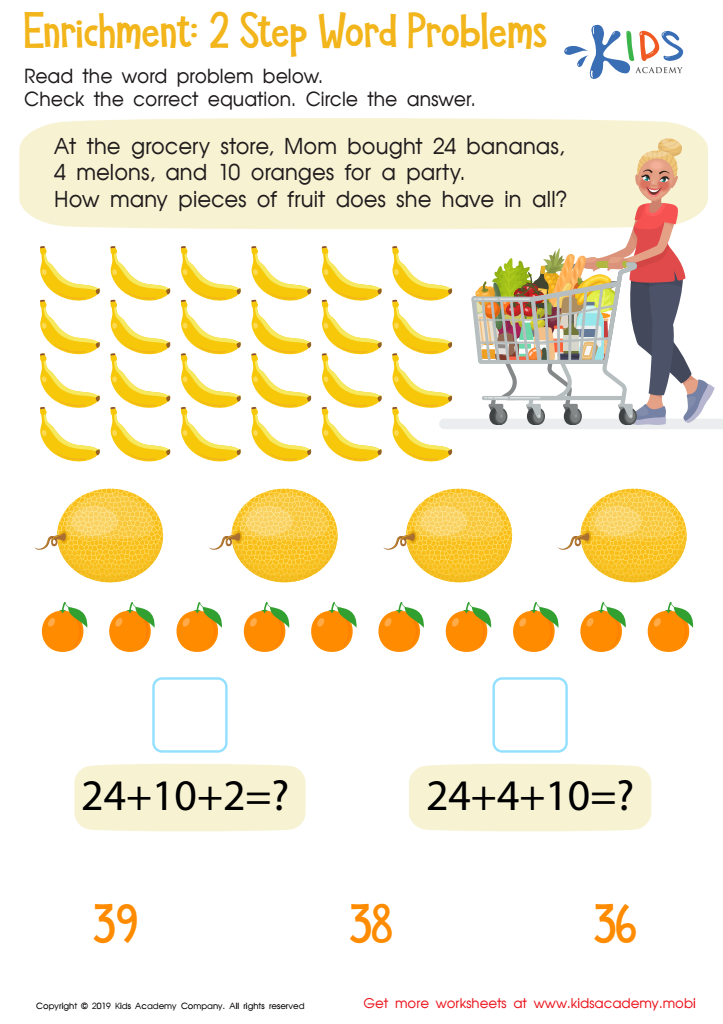
Enrichment -2 Step Word Problems Worksheet
Help your students learn math easier and faster with this colorful worksheet. Read the word problem and then guide them in checking the correct equation and finding the answer. Your students will benefit from the extra help, as they work through new concepts each day.
 Assign to My Students
Enrichment -2 Step Word Problems Worksheet
Worksheet
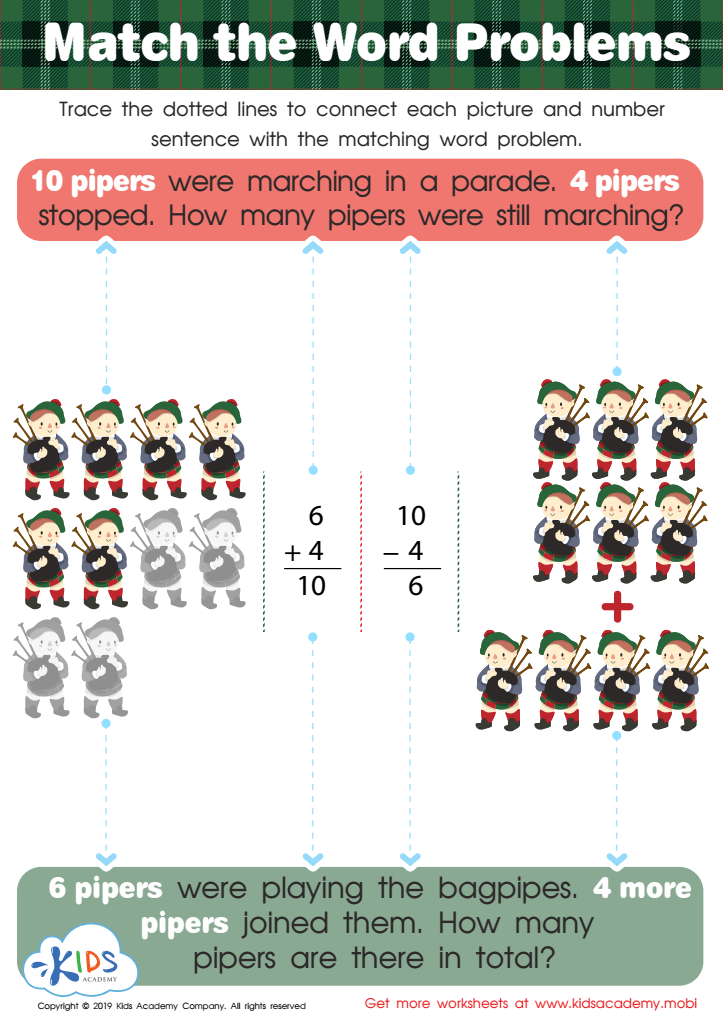
Match the Word Problems Worksheet
Read this word problem to your kids: Help them understand how it can be translated into a number problem. Trace the dotted lines to see how each picture and number sentence match the problem. With this worksheet, you can show your kids how easy it is to transform a word problem into a number problem.
Match the Word Problems Worksheet
Worksheet
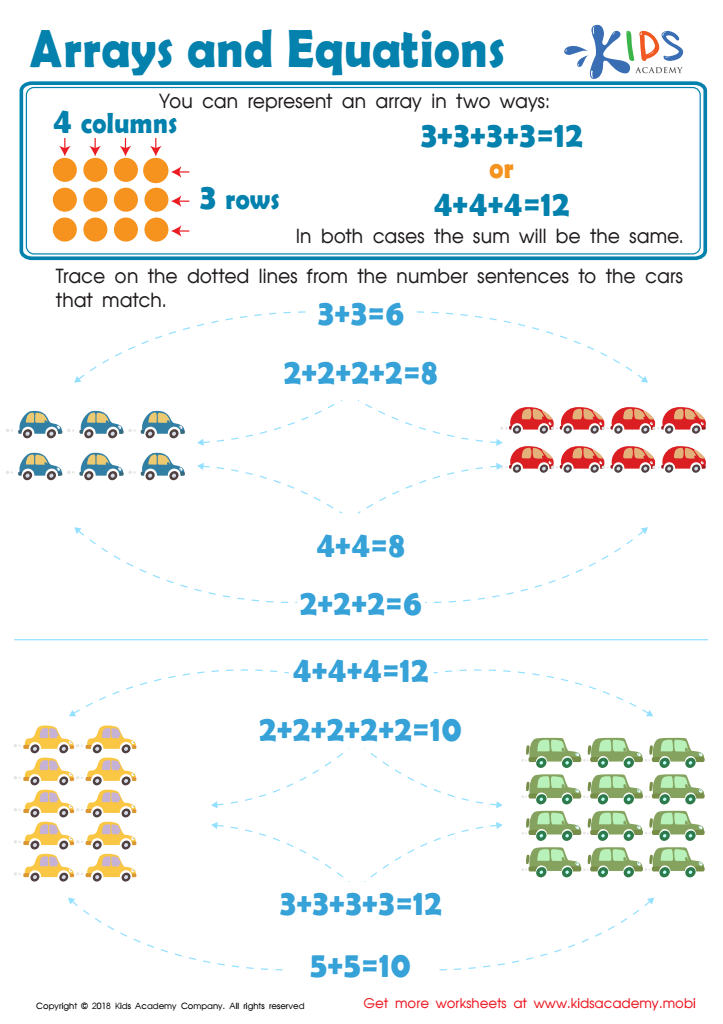
Arrays and Equations Worksheet
An array is objects, pix, or numbers organized in rows and columns. Show kids two ways to interpret this: 3 rows in 4 places = 12 and 4 columns in 3 places = 12. Help your child trace the number sentences to the matching cars. All equations always add up to the same amount.
Arrays and Equations Worksheet
Worksheet
Join Kids Academy for Free
Who is primarily going to use this learning content?








Parents and teachers should emphasize multiplication, addition, and subtraction practice for children aged 3-7 because these mathematical skills form foundational elements of a child’s overall cognitive development. Early mathematical skills help enhance logical thinking, problem-solving abilities, and pattern recognition, essential for later academic success and daily life.
Practicing addition and subtraction builds a child's understanding of basic numerical relationships, aiding in the development of number sense, which is critical during primary schooling. Introduced appropriately, multiplication (even as simple counting by 2s or 5s) can provide a preliminary framework that eases the transition to more complex math as children grow. Early math fluency also boosts confidence, fostering a positive attitude towards learning.
Understanding these basic concepts early on ensures that children become comfortable and capable of engaging with more advanced mathematical operations in the future, thus avoiding learning gaps. Moreover, these skills are tied to national academic standards, ensuring children progress at a pace aligned with educational expectations.
At ages 3-7, children's brains are particularly receptive to absorbing new information, and engaging them through fun, interactive activities can create a lasting interest in mathematics. Caring about these practices sets up children for long-term academic achievements and practical problem-solving experiences useful throughout life.








