
Mental arithmetic skills Normal Multiplication Worksheets for Ages 3-9
3 filtered results
Difficulty Level
Grade
Age
-
From - To
Subject
Activity
Standards
Enhance your child’s mental arithmetic skills with our engaging Normal Multiplication Worksheets designed for ages 3-9. These worksheets encourage early mathematical understanding through fun and interactive exercises that make learning multiplication enjoyable. Ideal for classrooms or home practice, our worksheets help kids develop their mental math abilities, improving speed and accuracy in their calculations. With colorful illustrations and age-appropriate tasks, children will build confidence while mastering essential multiplication concepts. Start your child’s journey to mathematical proficiency today with our carefully crafted resources, providing a solid foundation for lifelong learning in mathematics! Explore our collection and watch their skills flourish!
Favorites
With answer key
Interactive
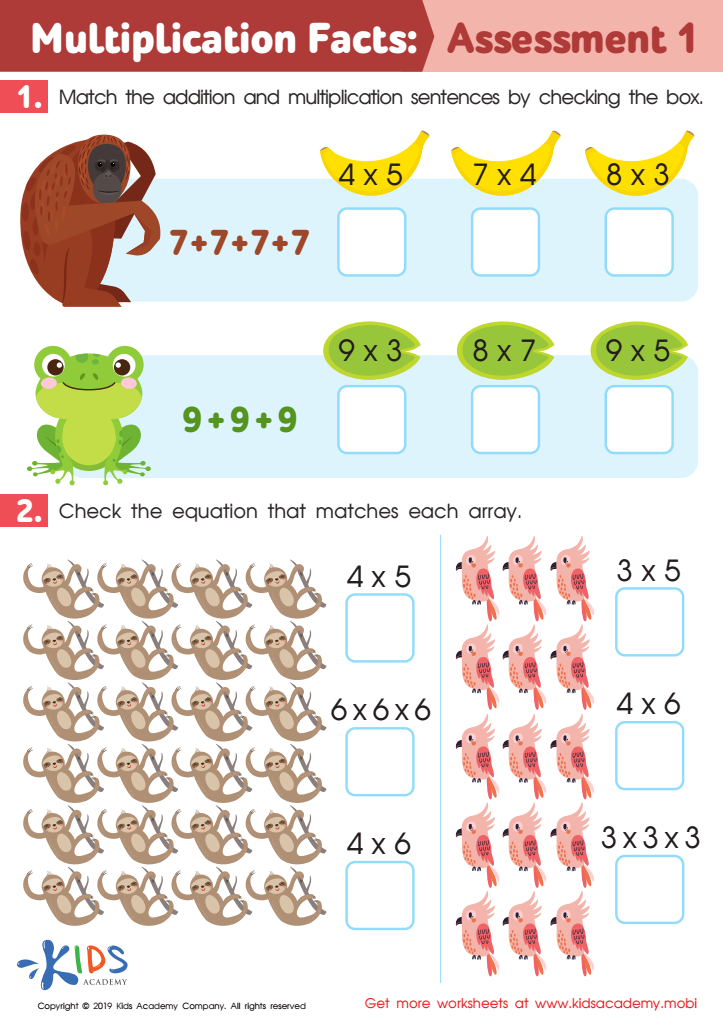
Multiplication Facts: Assessment 1 Worksheet
Teach your kids math with diligence, patience and practice. This colorful worksheet helps by matching addition and multiplication sentences, then checking the equation that matches each array. Perfect for kids having difficulty or to give extra practice. Help your little ones master mathematics with this printout.
 Assign to My Students
Multiplication Facts: Assessment 1 Worksheet
Worksheet
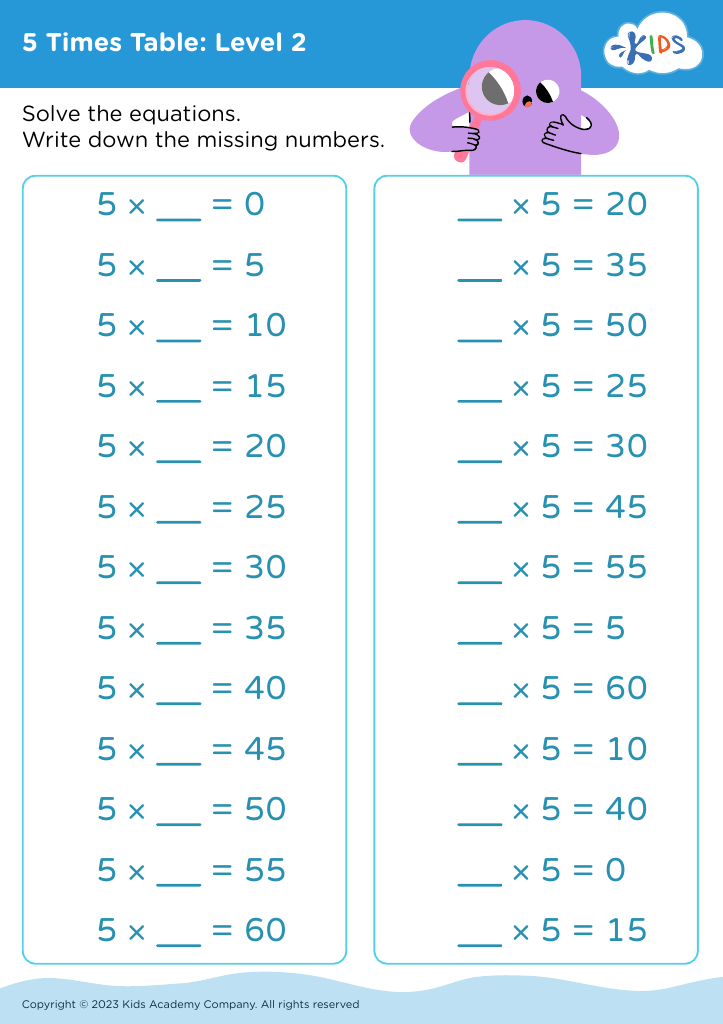
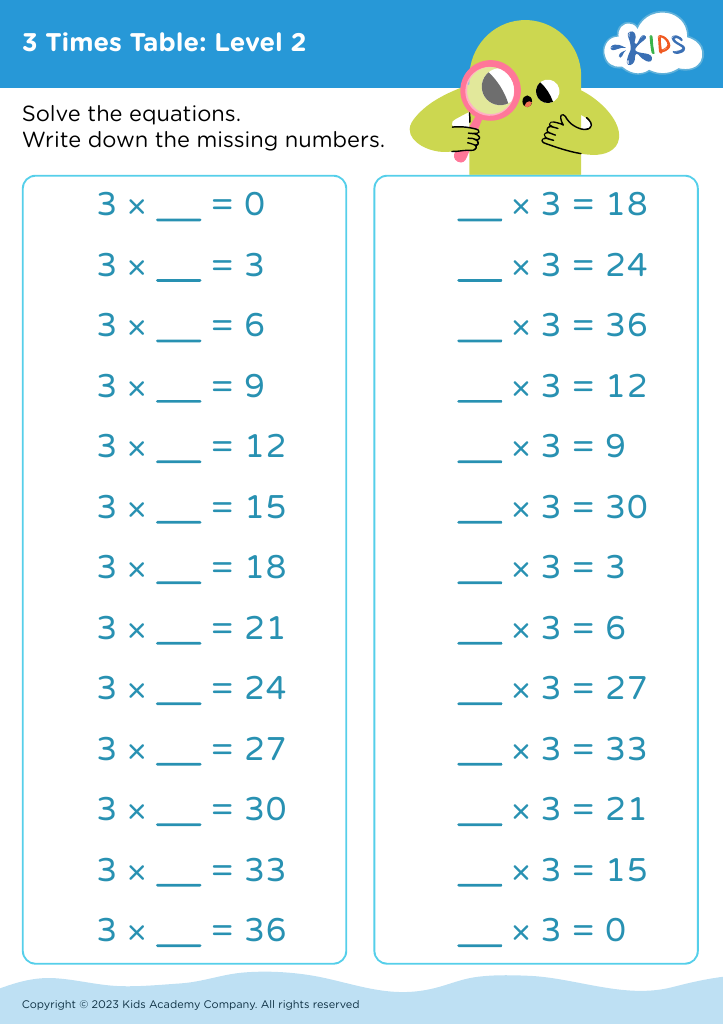
Join Kids Academy for Free
Who is primarily going to use this learning content?







Mental arithmetic skills, particularly normal multiplication, are foundational for children aged 3-9, fostering both academic and cognitive development. First, mastering basic multiplication enhances numerical fluency, allowing children to perform calculations quickly and confidently. This forms the bedrock for more complex mathematical concepts they will encounter later in their education.
Additionally, mental multiplication develops critical thinking and problem-solving skills. Children learn to recognize patterns and make connections between numbers, which enhances their overall cognitive abilities. These skills are not only essential in mathematics but also translate into improved reasoning and analytical skills across other subjects.
Furthermore, cultivating these skills at a young age instills a sense of achievement and self-efficacy. When children successfully manage multiplication problems mentally, they build confidence in their abilities, which positively influences their attitude towards learning.
For parents and teachers, supporting mental arithmetic in children nurtures resilience and persistence—they learn that practice leads to improvement. Engaging with these concepts fosters a love for mathematics that can last a lifetime. Overall, prioritizing mental multiplication skills during early learning years significantly contributes to children's academic success and personal development.








