Number Recognition Normal Subtraction Worksheets for Ages 4-9
4 filtered results
Difficulty Level
Grade
Age
-
From - To
Subject
Activity
Standards
Enhance your child's math skills with our engaging Number Recognition Normal Subtraction Worksheets, designed for ages 4-9. These worksheets encourage young learners to identify numbers and practice subtraction in a fun, interactive way. Featuring colorful graphics and age-appropriate challenges, children can build a solid foundation in math while boosting their confidence. Each worksheet promotes essential skills necessary for academic success, making learning enjoyable. Ideal for both classroom and homeschool settings, these resources cater to diverse learning styles to help children master number recognition and subtraction concepts. Download our worksheets today and watch your little mathematicians thrive!
Favorites
With answer key
Interactive
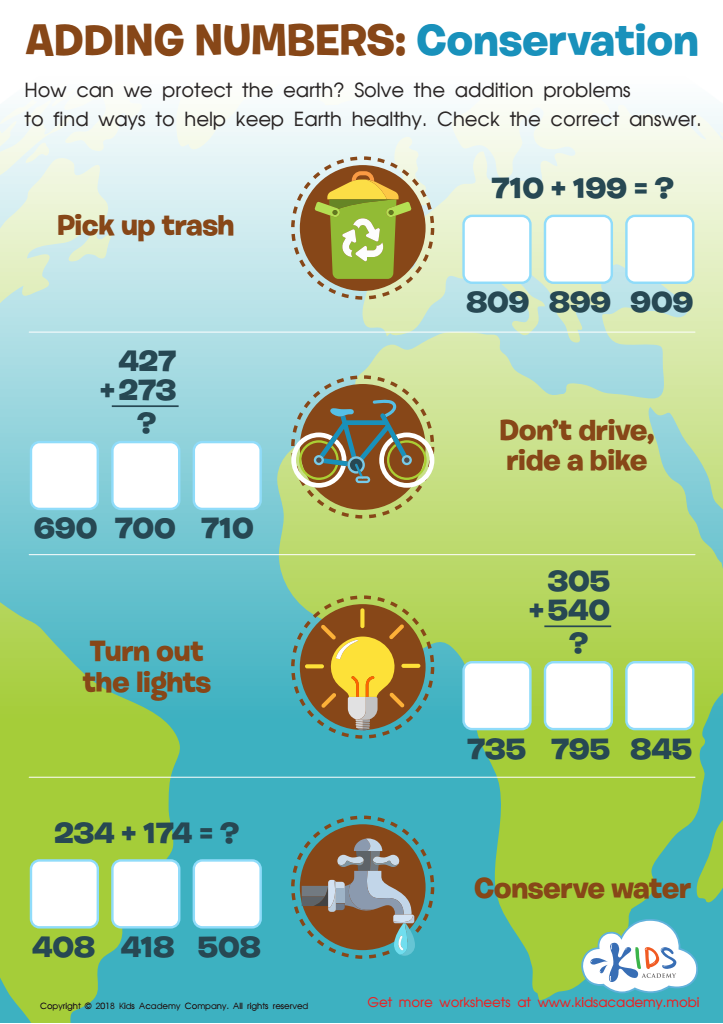
Adding Numbers: Conservation Worksheet
We all live on the Earth, which provides us with the vital necessities for survival. Unfortunately, we too often take advantage of this, causing pollution, water wastage and global warming. Help teach your kids how we can protect our planet - ask them to come up with good ideas and work together to find solutions. Challenge them to solve the subtraction problems to see what they can do to help keep the Earth healthy.
 Assign to My Students
Adding Numbers: Conservation Worksheet
Worksheet
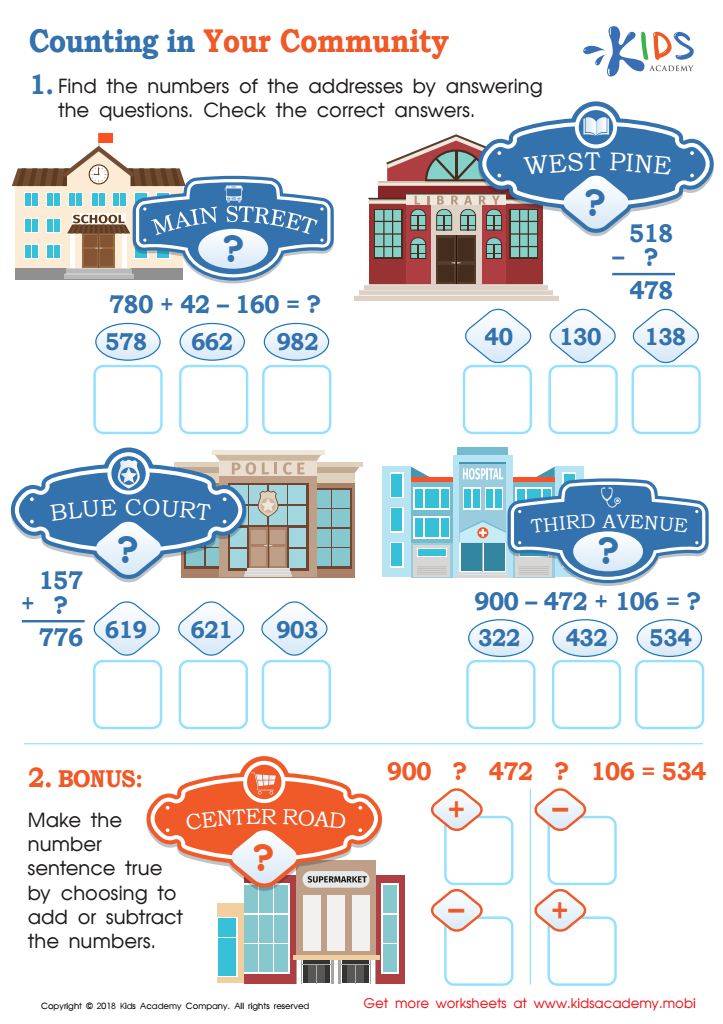
Counting in Your Community Worksheet
Introduce your kids to the idea of a community, where different people and buildings co-exist, each playing their part for the community's progress. Ask them to name the buildings they see in their community. Then work through this worksheet to find the numbers of the addresses by answering the questions. Check the answers once they've solved the equations.
Counting in Your Community Worksheet
Worksheet
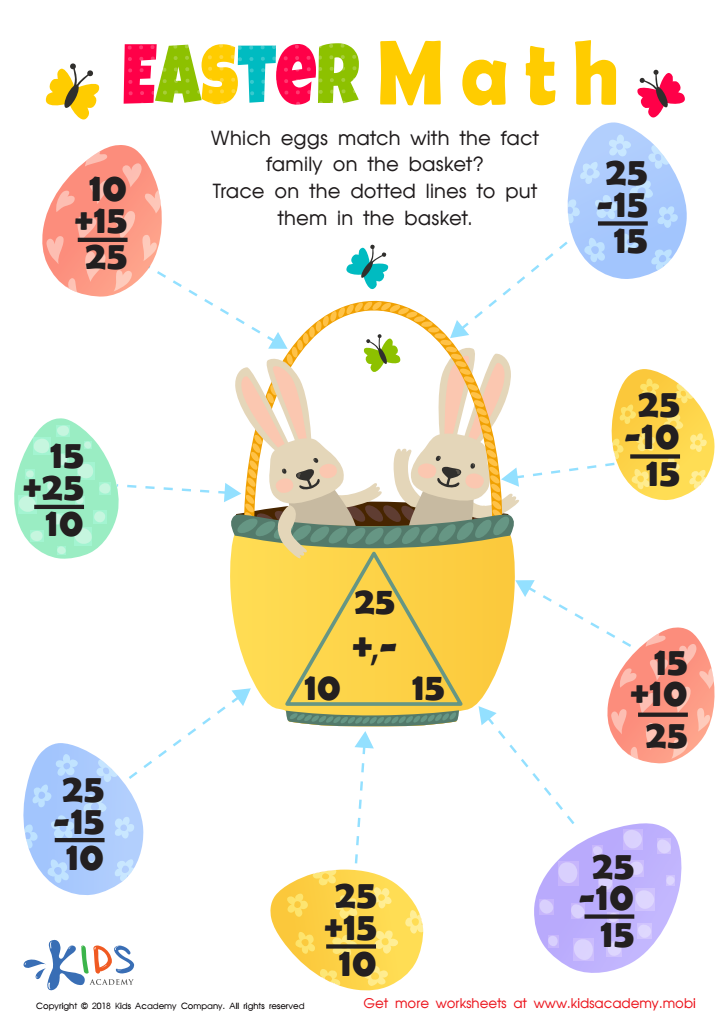
Fact Families: Easter Math Worksheet
Kids will love this vibrant PDF packed with Easter math fun! Match facts with the colorful eggs, add and subtract multiples of five to boost automaticity, and have a blast with the bunny friends!
Fact Families: Easter Math Worksheet
Worksheet
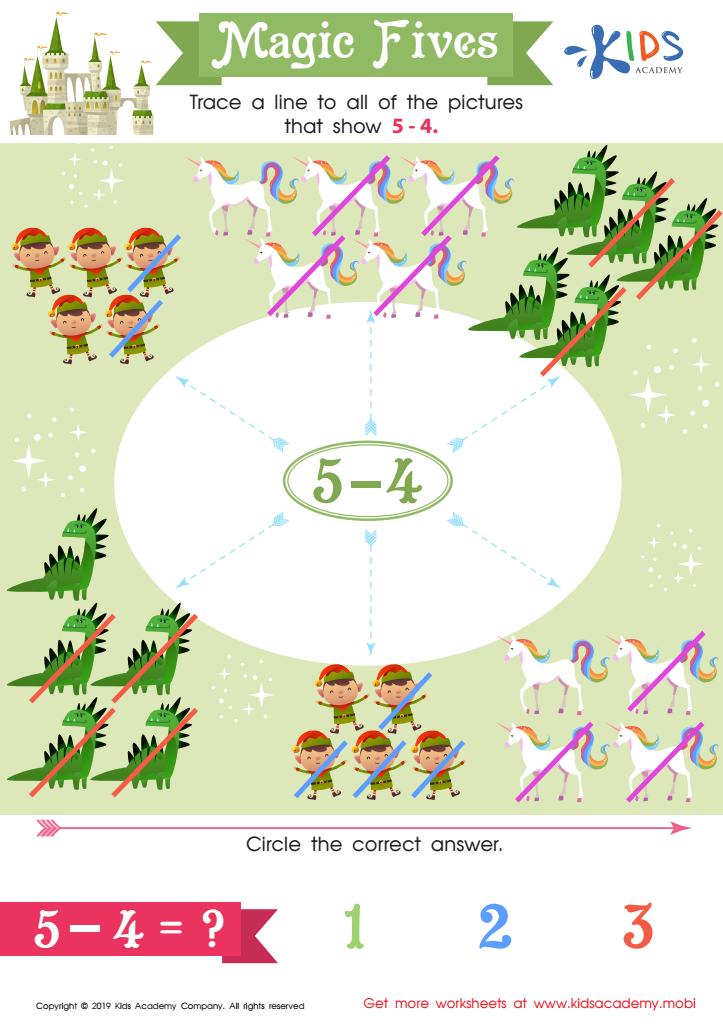
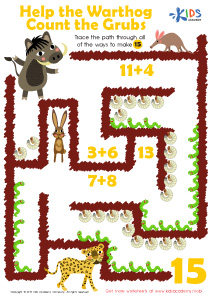
Magic Fives Worksheet
Help your students identify the objects & people in the worksheet. Point to the equation 5 -4 in the center, then get them to count the items and trace a line connecting those that add up to 5 - 4.
Magic Fives Worksheet
Worksheet
Join Kids Academy for Free
Who is primarily going to use this learning content?








Number recognition and basic subtraction skills are foundational to a child's mathematical development, particularly for ages 4 to 9. Parents and teachers should prioritize these skills for several reasons.
Firstly, number recognition is critical for early mathematical understanding. It enables children to identify, understand, and manipulate numbers, which is essential for everyday activities and problem-solving. Recognizing numbers lays the groundwork for more advanced mathematical concepts, making future learning smoother and more effective.
Furthermore, learning subtraction normalizes the idea of quantity reduction, which is crucial for understanding real-world scenarios such as sharing and distributing objects. Mastery of basic subtraction helps children internalize the concept of 'taking away,' facilitating cognitive connections that apply beyond mathematics.
Additionally, early proficiency in these skills boosts children's confidence and fosters a positive attitude toward math. By becoming comfortable with numbers and calculations at a young age, children are more likely to engage with more complex mathematical concepts in the future, reducing math anxiety.
Lastly, working together on number recognition and subtraction encourages a collaborative learning environment, strengthening the bond between parents, teachers, and students. Ultimately, these foundational skills set the stage for lifelong learning and academic success in mathematics and beyond.