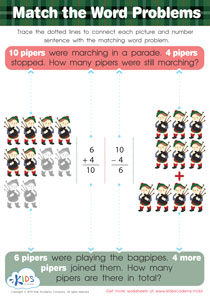
Mental math practice Normal Addition Worksheets for Ages 5-8
4 filtered results
Difficulty Level
Grade
Age
-
From - To
Subject
Activity
Standards
Boost your child's mental math skills with our Normal Addition Worksheets designed for ages 5-8. These engaging worksheets help children practice basic addition, enhancing their speed and accuracy in calculations. Each worksheet encourages young learners to solve problems mentally, laying a solid foundation for future math success. Our resources are perfect for reinforcing lesson plans at home or in the classroom, ensuring fun and educational experiences. Visit Kids Academy to access a variety of worksheets tailored to different learning needs and academic levels. Prepare your child for math excellence with our targeted, step-by-step math practice sheets!
Favorites
With answer key
Interactive
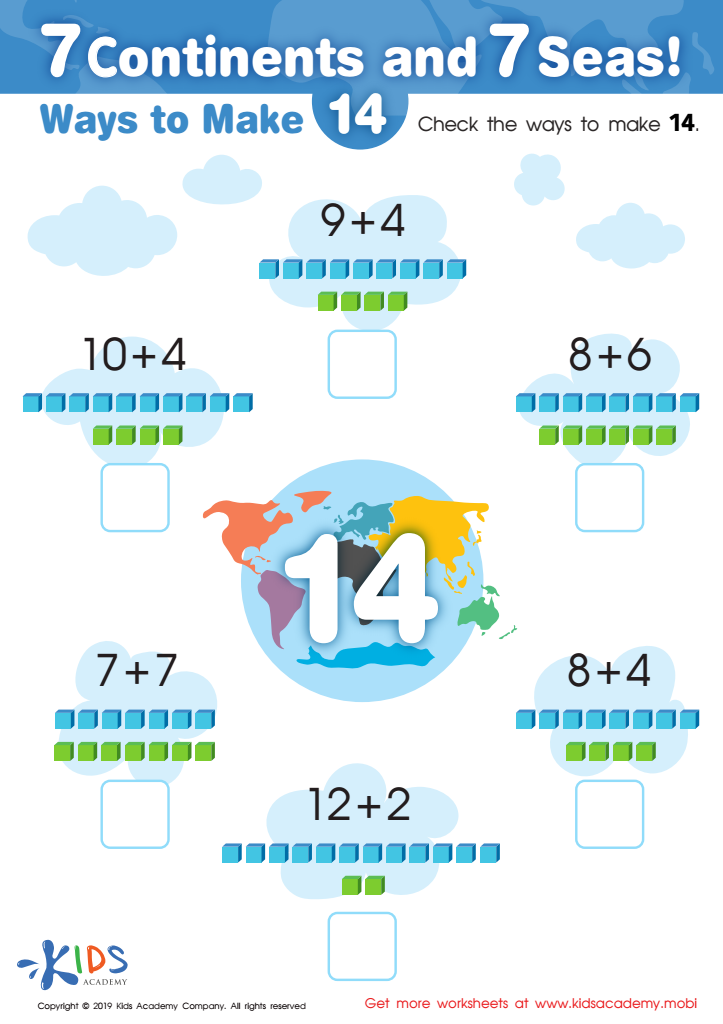
7 Continents and 7 Seas Worksheet
Remind kids of the continents and show them how different numbers can add up to the same figure. Give examples, like 2+2 =4, and 3+1 =4. Ask if they can provide other examples, then work through the simple additions in this worksheet with them. Ask them to circle all equations that make 14.
 Assign to My Students
7 Continents and 7 Seas Worksheet
Worksheet
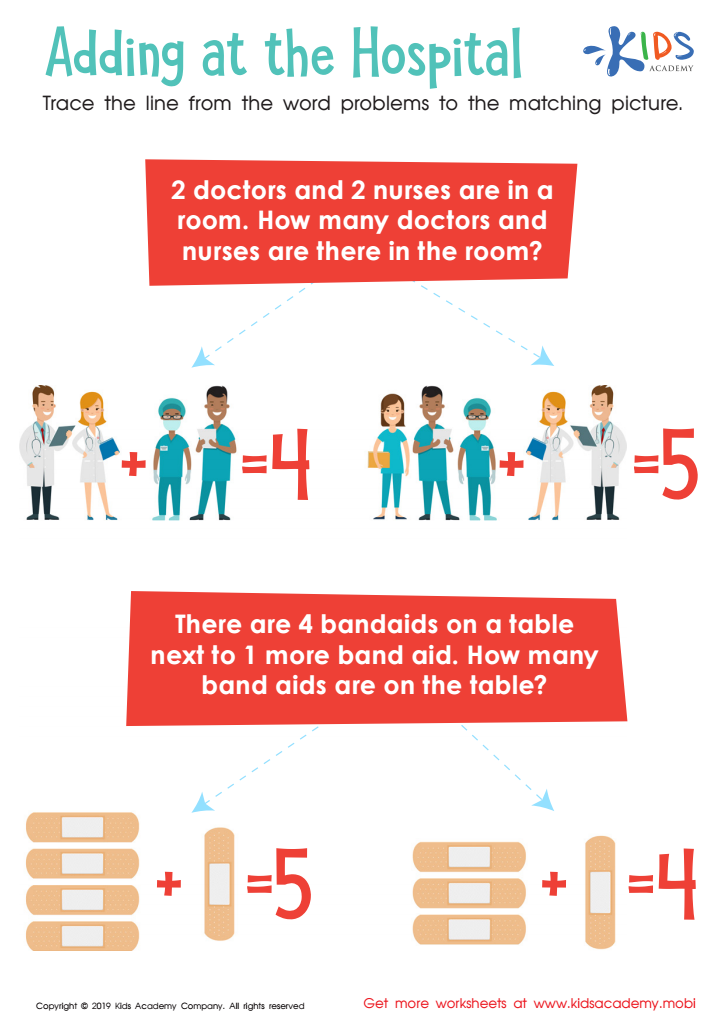
Adding at the Hospital Worksheet
A hospital visit doesn't have to be scary for kids. With this worksheet, they can count along with doctors and nurses, by reading the word problems and tracing lines to the corresponding picture. Guide them through it and you'll help them have a fun experience.
Adding at the Hospital Worksheet
Worksheet
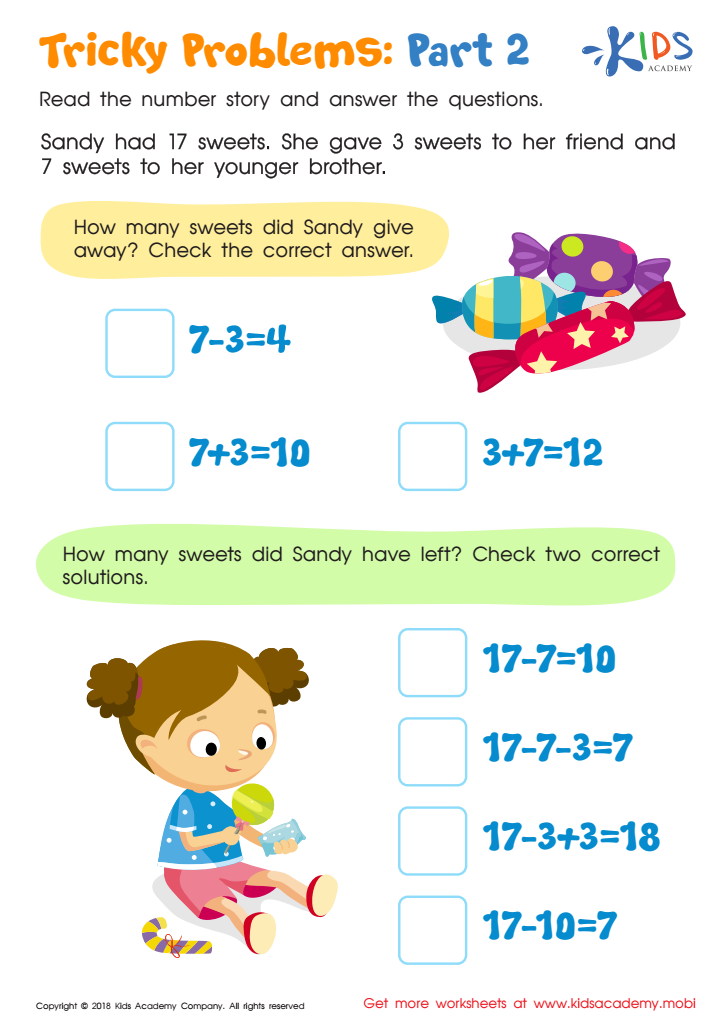
Tricky Problems Worksheet: Part 2
Help your little math learner visualize number stories with this engaging worksheet. They'll connect pictures to the story and use math facts to find the sums. After that, they'll be able to identify the correct number sentences to match. Let them practice and get better at problem solving!
Tricky Problems Worksheet: Part 2
Worksheet
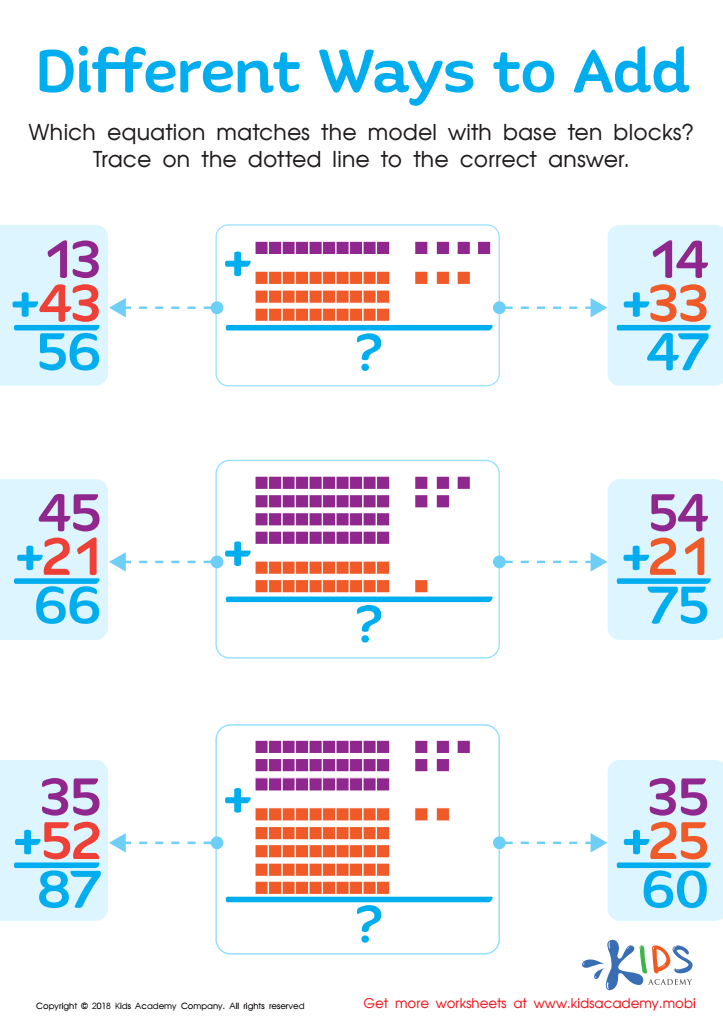
Different Ways to Add Worksheet
This worksheet enhances math skills by having students match equations to base ten pictures and tracing lines. It not only helps with fine motor skills, but also encourages number sense, with various ways to add and build upon existing math knowledge.
Different Ways to Add Worksheet
Worksheet
Join Kids Academy for Free
Who is primarily going to use this learning content?








Mental math practice for normal addition is crucial for children aged 5-8 because it forms a strong foundation for their future mathematical understanding and cognitive development. This age is a formative period where foundational skills are best developed. Here are some key reasons why parents and teachers should care:
-
Cognitive Development: Mental math enhances brain functions like problem-solving, memory, and logical reasoning. Engaging with numbers and arithmetic operations improves neural connections in the brain, enabling quicker and more efficient processing of mathematical information.
-
Building Confidence: When children master basic addition through mental practice, it boosts their confidence. Knowing they can solve problems mentally gives them a sense of accomplishment and encourages them to tackle more challenging tasks with a positive attitude.
-
Anchor for Advanced Concepts: A solid grasp of basic addition paves the way for understanding more complex mathematical concepts such as multiplication, division, fractions, and algebra. It's the building block for all future math learning.
-
Real-World Application: Mental math is not just for the classroom; it applies to everyday scenarios like shopping, cooking, or playing games. It helps children make quick and accurate calculations in real-life situations, fostering practical life skills.
-
Encourages Independence: Practicing mental math helps kids become more self-reliant by reducing their dependence on calculators and other aids.