
Spatial reasoning Normal Math Worksheets for Ages 5-8
3 filtered results
Difficulty Level
Grade
Age
-
From - To
Subject
Activity
Standards
Discover our "Spatial Reasoning Normal Math Worksheets for Ages 5-8," designed to foster critical thinking and problem-solving skills in young learners. Our engaging activities help children develop their ability to visualize and manipulate shapes, enhancing both math and cognitive abilities. Tailored for ages 5-8, these worksheets feature fun puzzles, patterns, and geometric tasks that keep children interested and challenged. Utilizing spatial reasoning techniques, children improve their understanding of math concepts, laying a strong foundation for future success. Perfect for classroom activities or at-home learning, our worksheets offer an enjoyable and effective way to boost spatial intelligence.
Favorites
With answer key
Interactive
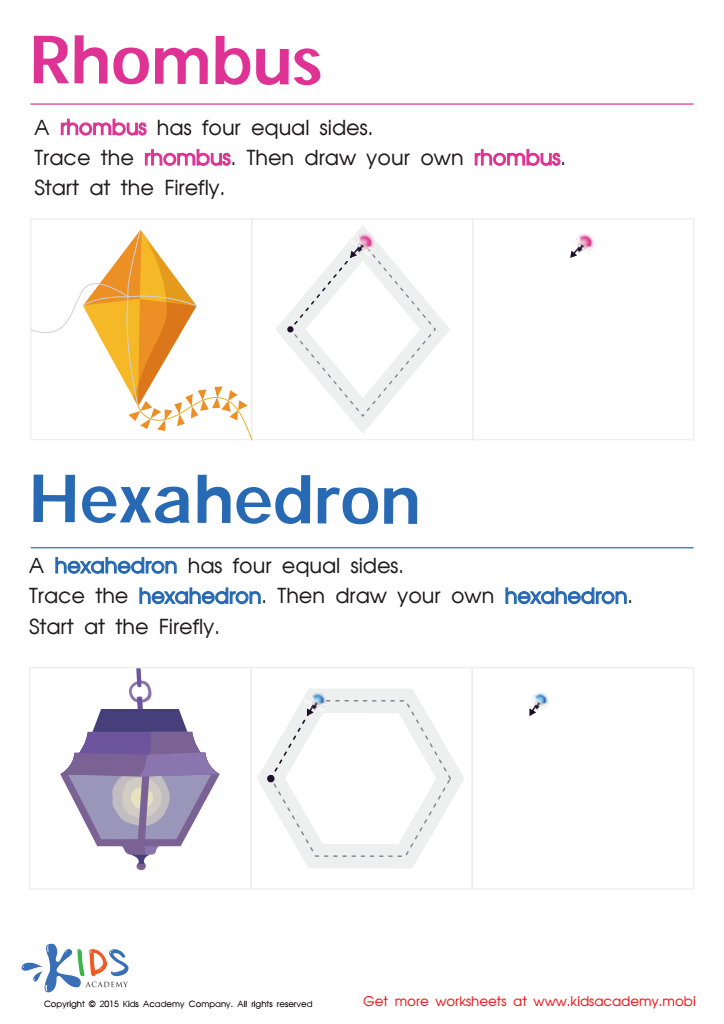
Draw a Rhombus And a Hexahedron Printable
Trace, draw and recognize shapes like rhombus, hexahedron and more! Start with the firefly to trace a rhombus, then use the yellow kite to remember the shape. Use the light to trace and draw a hexahedron. Learn with the best!
 Assign to My Students
Draw a Rhombus And a Hexahedron Printable
Worksheet
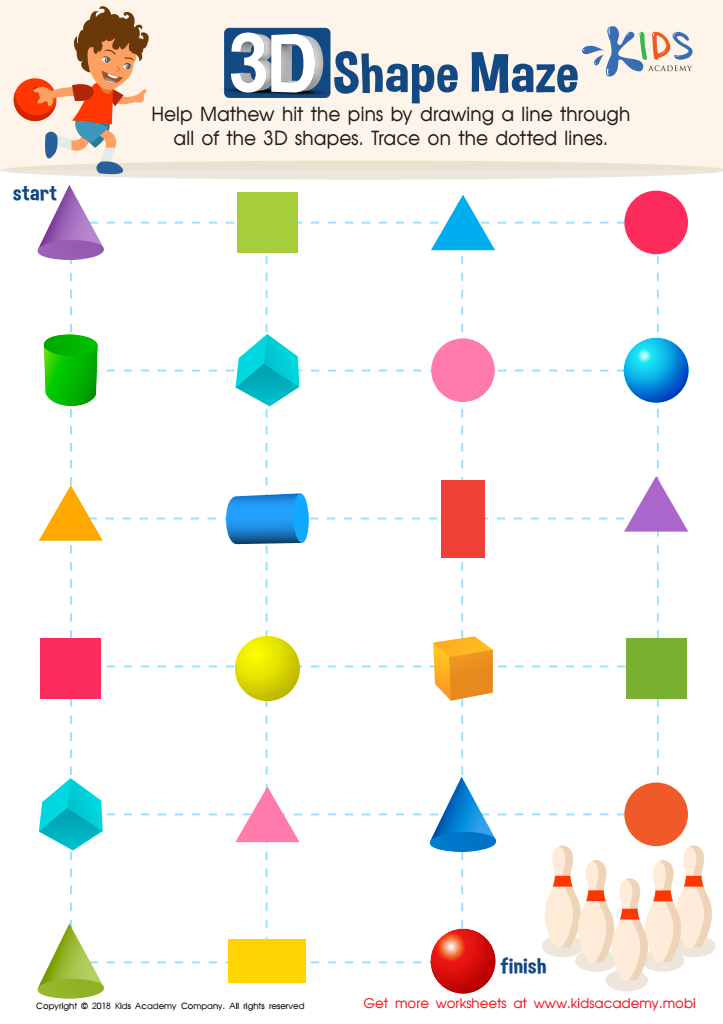
Shapes Maze Geometry Worksheet
Boost your child's geometry skills with this shapes maze worksheet! Help Matthew bowl a strike by guiding him through the maze to draw a line through every 3D shape. It's a fun and challenging way to practice foundational math skills!
Shapes Maze Geometry Worksheet
Worksheet
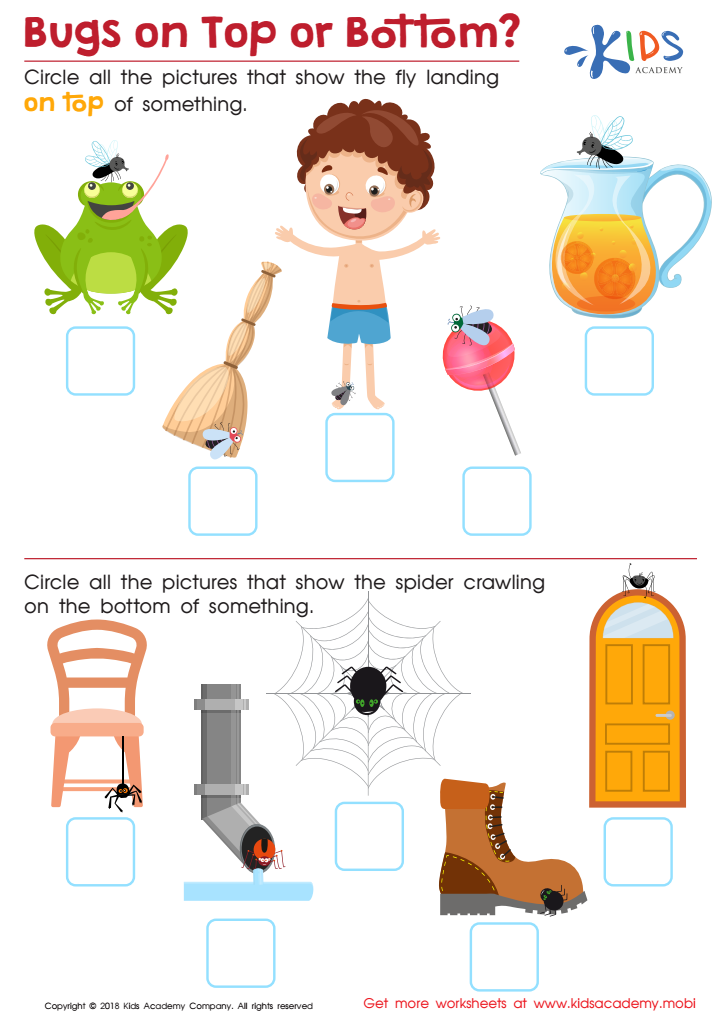
Bugs on Top or Bottom? Worksheet
Preschoolers need to learn directional skills such as top and bottom. This PDF worksheet helps them recognize bugs on the top or bottom using fun visuals. It builds their spatial reasoning while teaching prepositional words in an engaging way.
Bugs on Top or Bottom? Worksheet
Worksheet
Join Kids Academy for Free
Who is primarily going to use this learning content?





Spatial reasoning is the ability to visualize and manipulate objects and shapes in one's mind. For children aged 5-8, developing spatial reasoning skills is critical for various academic and everyday life tasks. Parents and teachers should care about fostering these skills because they significantly influence children's mathematical abilities. Spatial reasoning helps children understand and solve problems related to geometry, measurement, and even simple arithmetic. For example, recognizing how shapes fit together enhances a child's grasp of geometric concepts, while visualizing quantities supports their number sense.
Beyond mathematics, spatial reasoning is linked to enhanced abilities in areas like reading and writing, as it aids in understanding the spatial relationship between letters and words. It also supports problem-solving skills and creativity, encouraging children to think logically and envision multiple solutions to a given problem.
Integrating spatial reasoning tasks, such as puzzles, building blocks, and drawing, into early education provides a holistic approach to learning. Activities that promote these skills can be enjoyable and engaging, making learning fun and effective. By prioritizing spatial reasoning alongside more traditional math instruction, parents and teachers lay a strong foundation for children's future academic success and cognitive development.








