
Spatial awareness Normal Geometry Worksheets for 5-Year-Olds
5 filtered results
Difficulty Level
Grade
Age
-
From - To
Subject
Activity
Standards
Enhance your child's spatial awareness with our engaging Normal Geometry Worksheets designed specifically for 5-year-olds! These worksheets introduce essential concepts of shape recognition, spatial relationships, and basic geometry through fun and interactive activities. Kids will enjoy identifying shapes, understanding their properties, and exploring the space around them. Our thoughtfully crafted exercises promote critical thinking and improve problem-solving skills, laying a strong foundation for future math learning. Perfect for homeschooling, classroom activities, or supplementary practice, these worksheets make learning geometry an enjoyable experience for young learners. Download now and watch your child's confidence soar as they discover the world of shapes!
Favorites
With answer key
Interactive
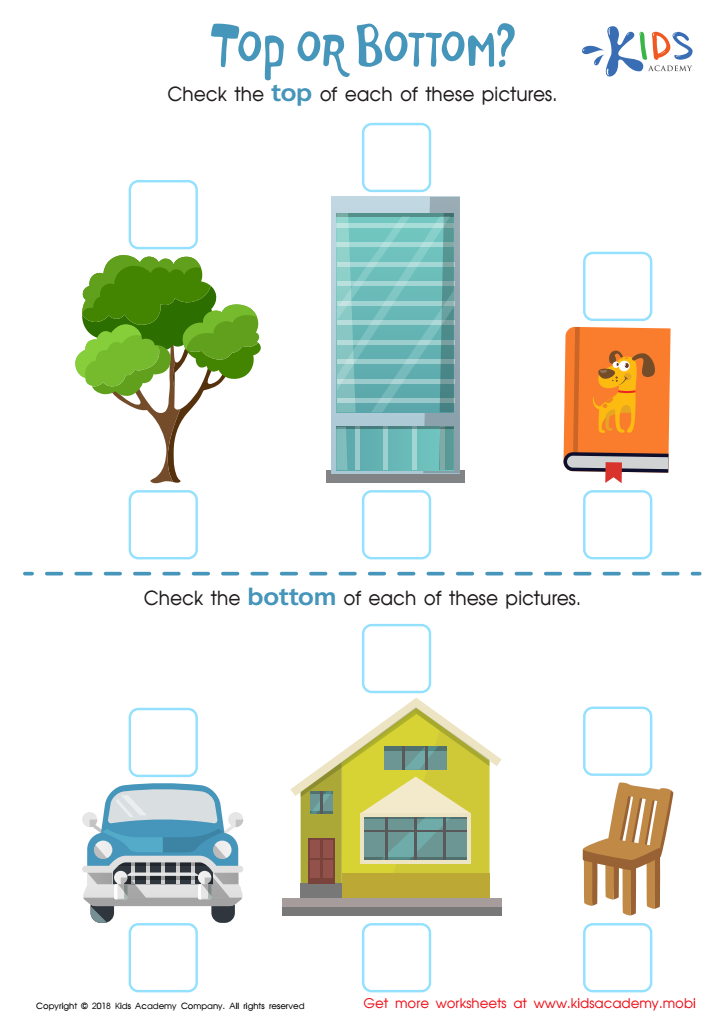
Top or Bottom Worksheet
Help your toddler master orientation and early geometry skills with this free printable worksheet. It tasks children with identifying the top and bottom of familiar images, like cars, to help build their mental map of objects. It may be simple for adults and older kids, but toddlers must learn the words to describe objects and their physical orientation.
 Assign to My Students
Top or Bottom Worksheet
Worksheet











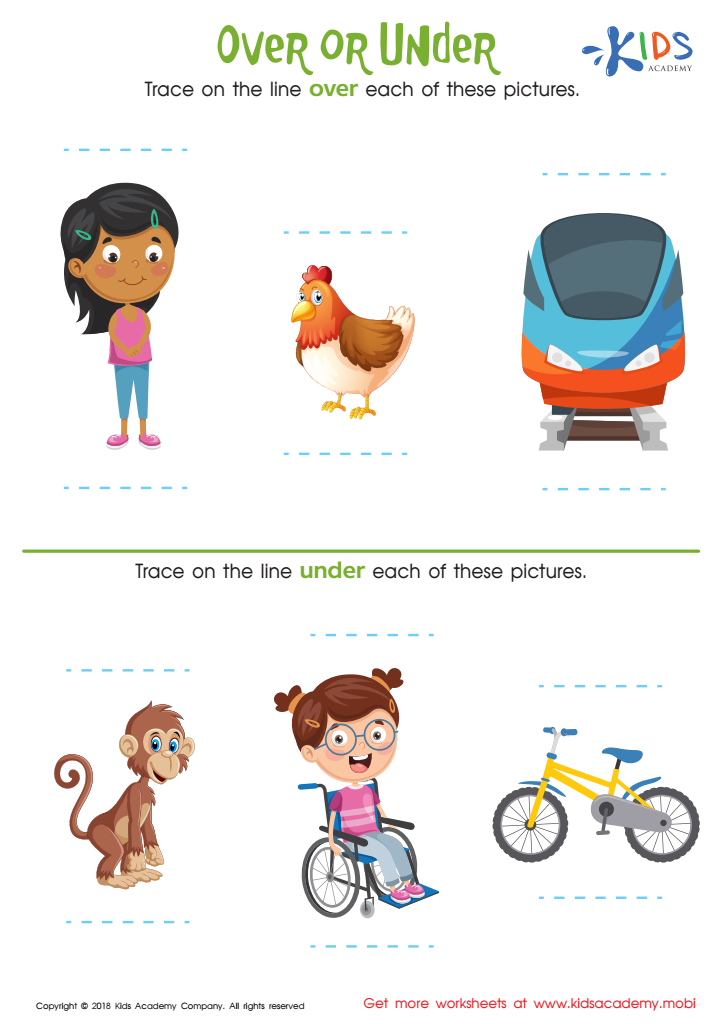
Over or Under Worksheet
Help your toddler grasp prepositions like "over" and "under" with this fun worksheet. Have them trace lines over the pictures on one half and under the pictures on the other, thus practicing basic communication and math concepts. Strengthen your child's understanding and communication skills with this activity.
Over or Under Worksheet
Worksheet
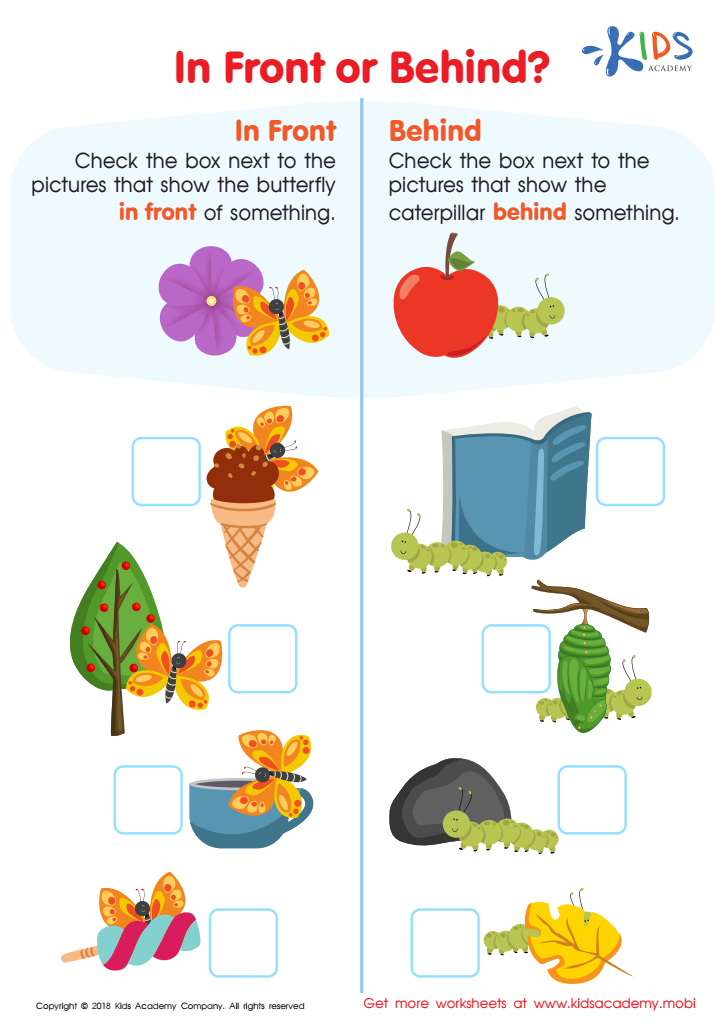
In Front or Behind Worksheet
Hone your child's spatial skills with 'in front' and 'behind'! This knowledge is essential for communication and study. Get them started with this free PDF worksheet - check off the pictures that show the butterfly in front and caterpillar behind!
In Front or Behind Worksheet
Worksheet
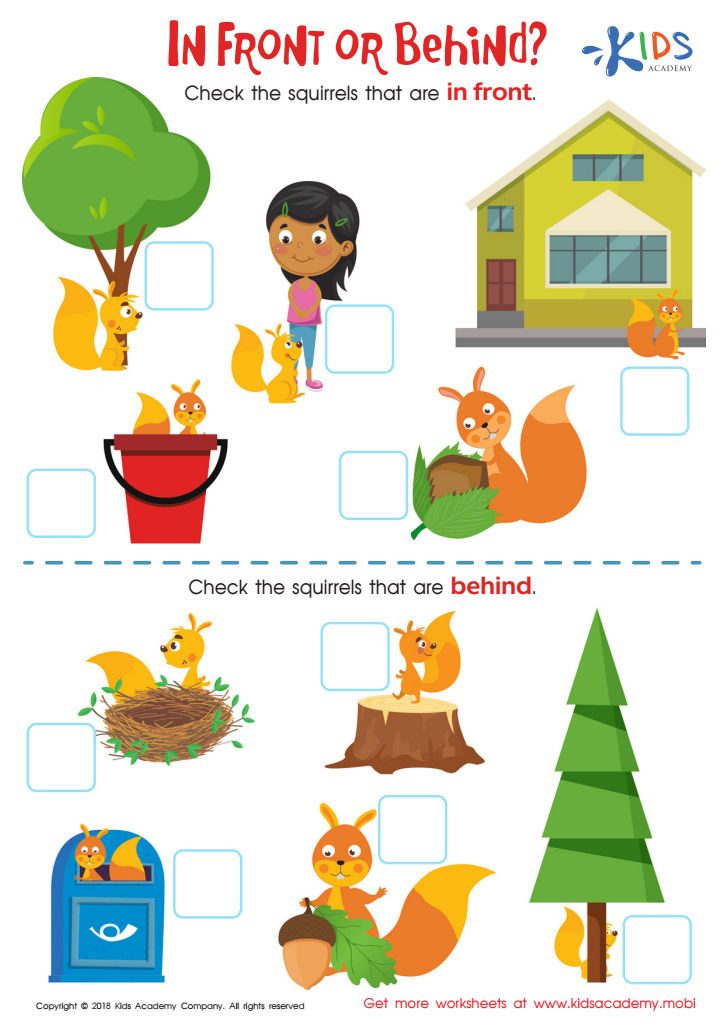
In Front or Behind: Part 2 Worksheet
Teach positional words "front" and "behind" with this fun worksheet! Students identify where the squirrel is in relation to the object - in front or behind. It's a great exercise to practice early geometry skills and understanding object movement.
In Front or Behind: Part 2 Worksheet
Worksheet
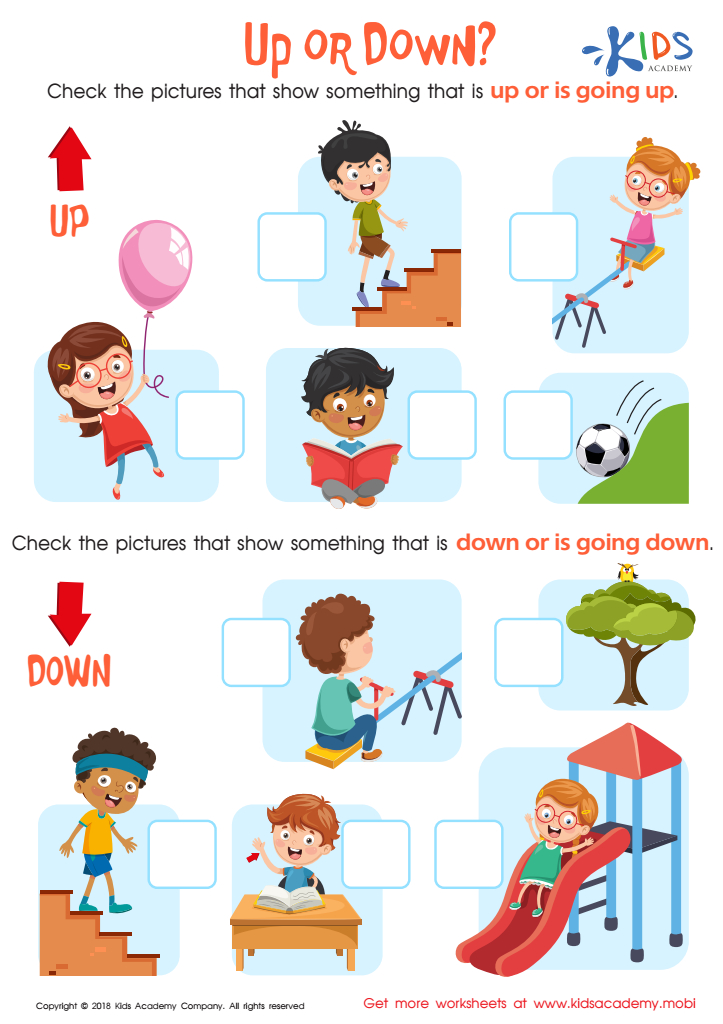
Up or Down Worksheet
Teach your toddlers the concepts of up and down with Kids Academy's vivid worksheet! Use the seesaw analogy to reinforce this language with them and build a strong foundation for future learning. Show them how a balloon can float up but must come back down too.
Up or Down Worksheet
Worksheet
Join Kids Academy for Free
Who is primarily going to use this learning content?








Spatial awareness and basic geometry are crucial for the development of 5-year-olds, as they lay the foundation for critical thinking and problem-solving skills. Understanding spatial relationships helps children navigate their environment more effectively, improving their ability to reproduce shapes, understand directions, and recognize patterns. These skills not only support learning in mathematics but are also integral to subjects like science and art.
Parents and teachers should care about spatial awareness because it enhances children's cognitive abilities. Engaging activities such as building with blocks, completing puzzles, or participating in scavenger hunts can strengthen these skills while making learning fun. Early introduction to geometric concepts through play helps children visualize and manipulate shapes, which becomes vital as they tackle more complex math problems in later grades.
Additionally, strong spatial reasoning is linked to success in STEM (science, technology, engineering, and mathematics) fields, which are increasingly important in our technology-driven society. By nurturing spatial awareness from a young age, parents and teachers can foster curiosity, creativity, and a confident approach to learning, giving children a head start in facing future educational challenges. Therefore, prioritizing spatial awareness and geometry fosters not only academic success but also essential life skills.








