
Basic subtraction skills Normal Worksheets for Ages 6-7
3 filtered results
Difficulty Level
Grade
Age
-
From - To
Subject
Activity
Standards
Help your 6-7 year olds master essential math skills with our "Basic Subtraction Skills" worksheets from Kids Academy! Designed to make learning subtraction fun and engaging, these expertly crafted worksheets build foundational arithmetic understanding through age-appropriate activities and colorful illustrations. Perfect for use at home or in the classroom, each worksheet offers a variety of subtraction problems that help reinforce counting, number recognition, and problem-solving skills. Support your child's math journey and boost their confidence with our entertaining and educational subtraction worksheets, tailored specifically for young learners. Explore more today at Kids Academy!
Favorites
With answer key
Interactive
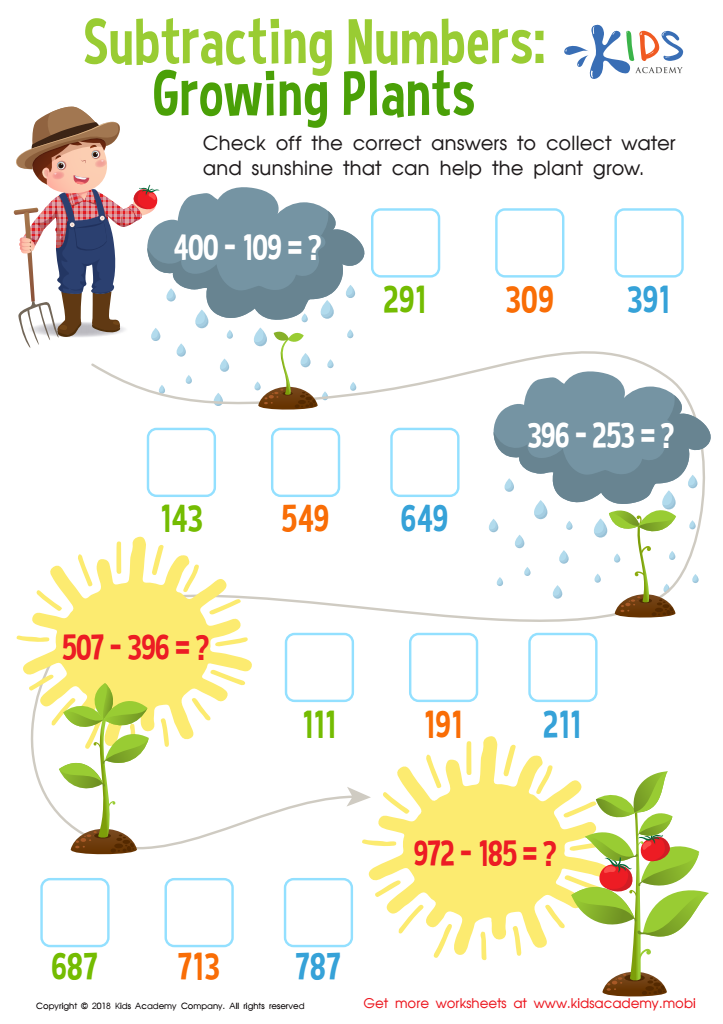
Subtracting Numbers: Growing Plants Worksheet
Farmers plant and nurture crops for us to eat. To help them, check off the items a plant needs to survive: water and sunshine. Ask your child to explain more!
 Assign to My Students
Subtracting Numbers: Growing Plants Worksheet
Worksheet
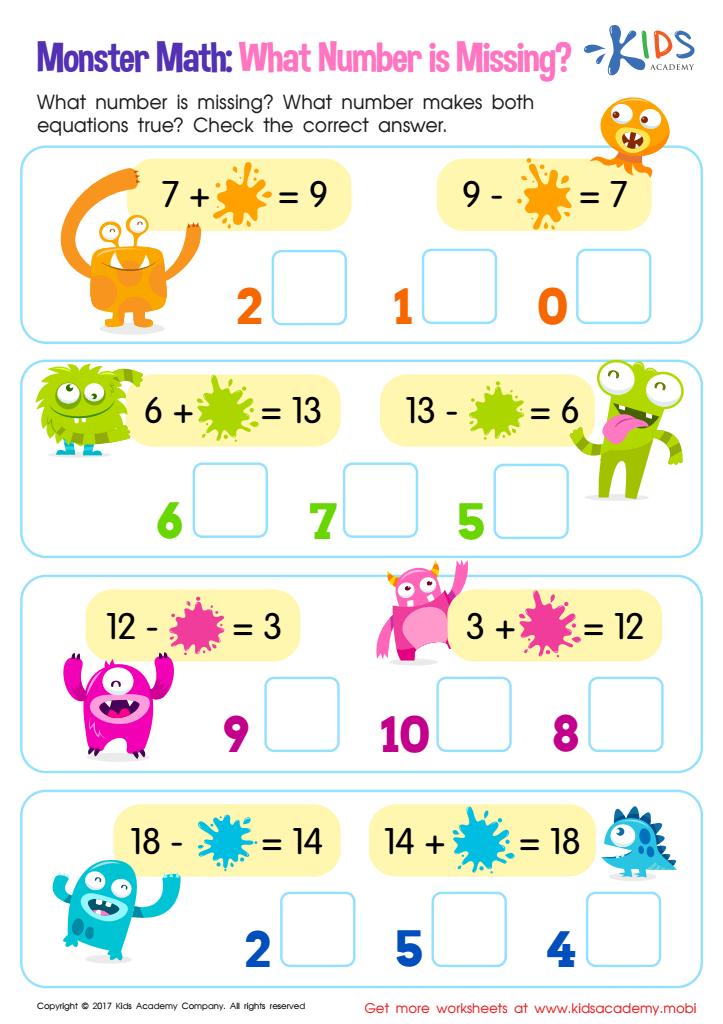
Missing Number: Monster Math Worksheet
Engage your child in monster math fun with a worksheet! They'll need to use their counting, addition and subtraction skills to solve equations on both sides. On the left side, they must complete an addition problem and on the right, the equation is in subtraction form. Assist them in selecting the right number out of the given options to make both equations true.
Missing Number: Monster Math Worksheet
Worksheet
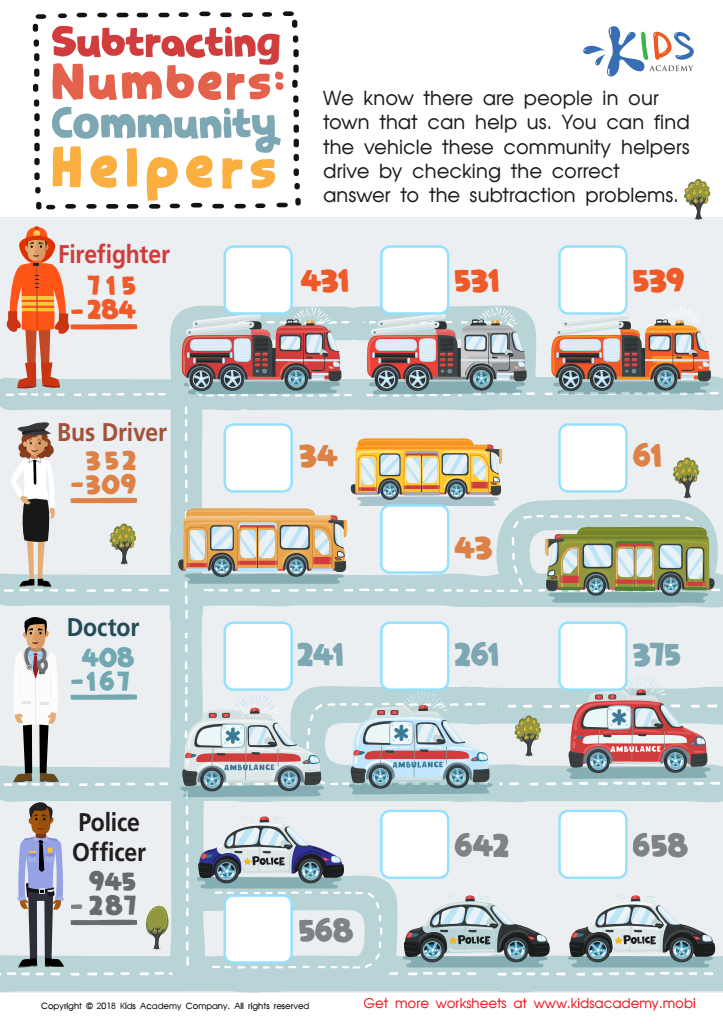
Subtracting Numbers: Community Helpers Worksheet
A community is an area of different people, buildings and other elements. People in a community have varied roles and work together to make it thrive. Ask your child what community helpers they know and how they help. Match the helpers to their vehicles by solving subtraction problems!
Subtracting Numbers: Community Helpers Worksheet
Worksheet
Join Kids Academy for Free
Who is primarily going to use this learning content?








Basic subtraction skills are fundamental for children aged 6-7, forming the cornerstone for their future academic success and daily life functionality. For parents and teachers, caring about these skills ensures that children build a solid mathematical foundation, critical for more complex problem-solving and logical thinking. At this age, children are developing cognitive abilities and number sense, and mastering subtraction enhances these capabilities.
Subtraction is not just about getting the right answer; it improves a child's understanding of relationships between numbers, helping them grasp the concept of quantity and exchange. Strong subtraction skills also translate to enhanced confidence in math, reducing anxiety associated with the subject and fostering a positive attitude towards learning.
In everyday life, subtraction is a practical skill used in various scenarios—like handling money, measuring objects, or keeping track of time—which makes it essential outside the classroom too. The ability to subtract can empower kids to make better decisions and understand the world around them more accurately.
Therefore, both educators and parents have a vital role in supporting and encouraging the development of basic subtraction skills through engaging activities, real-life applications, and consistent practice. This investment in the early stages reaps long-term benefits, ensuring children have the tools needed for academic achievements and daily tasks.








