
Improving mental arithmetic Normal Worksheets for Ages 6-9
3 filtered results
Difficulty Level
Grade
Age
-
From - To
Subject
Activity
Standards
Discover our engaging "Improving Mental Arithmetic Worksheets" designed specifically for children aged 6-9! These worksheets help boost essential math skills through fun and interactive exercises, perfect for young learners eager to enhance their mental arithmetic abilities. With a variety of challenges that promote quick thinking and problem-solving, students will gain confidence in their math skills while enjoying colorful and appealing designs. Ideal for classroom use or at-home practice, our worksheets cater to diverse learning styles and encourage mastery of foundational arithmetic concepts. Support your child's math journey today with printable worksheets that make learning math fun and effective!
Favorites
With answer key
Interactive
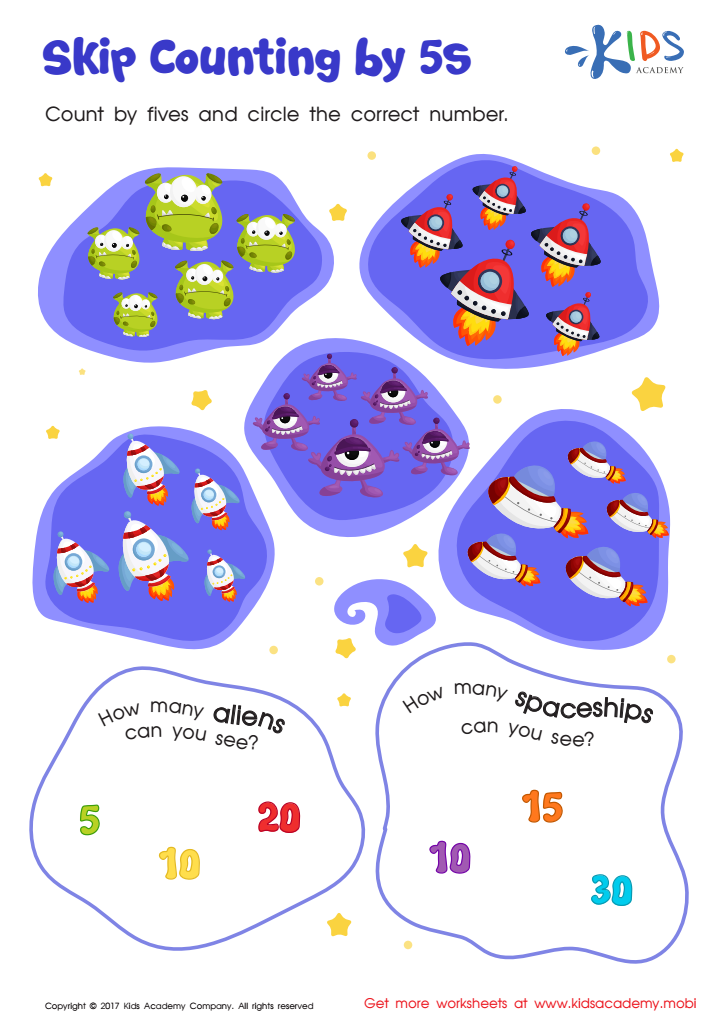
Skip Counting by 5s: Aliens and Spaceships Printable
Your child will love taking an intergalactic adventure as they practice skip counting by 5's with this worksheet! It'll help them identify and recognize large groups of numbers, categorize objects to count them, and prepare them for math concepts like multiplication. And with silly space graphics, they'll be motivated for more practice!
 Assign to My Students
Skip Counting by 5s: Aliens and Spaceships Printable
Worksheet
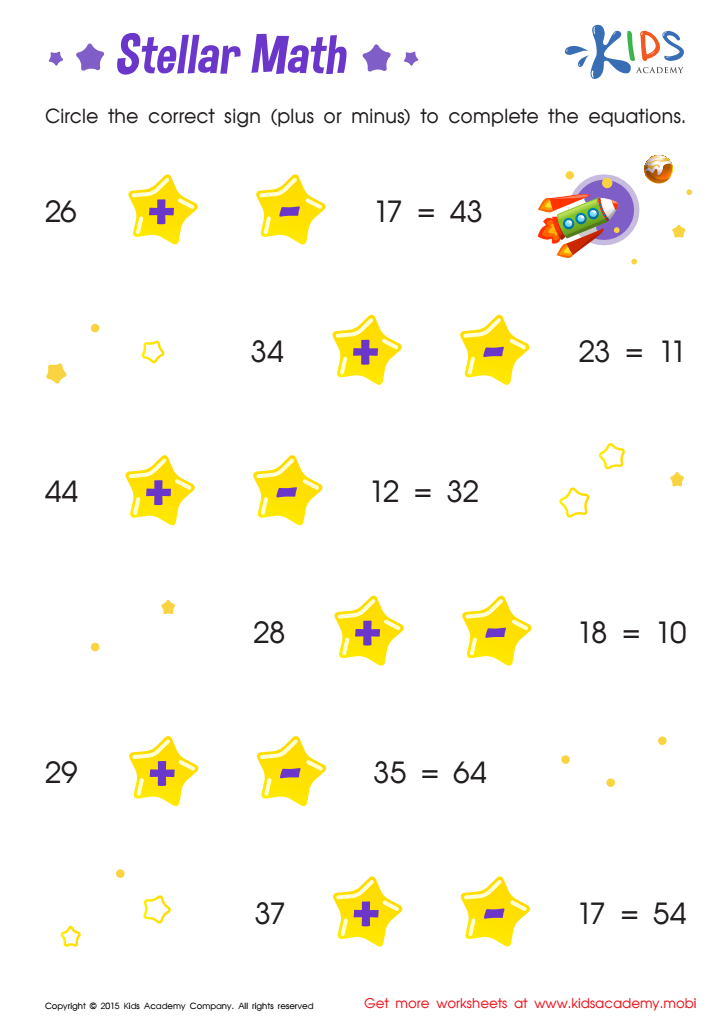
Stellar Math Substraction Worksheet
This worksheet offers more than just subtraction- your little learner can practice addition too! It will help them use number sense and mental math, as well as logical reasoning strategies, to complete the equations. With this worksheet, they'll use higher level thinking skills to determine which sign (plus or minus) is needed. Plus, they'll improve their cognitive skills too! Check out our rich collection of math worksheets for a fun and exciting math experience.
Stellar Math Substraction Worksheet
Worksheet
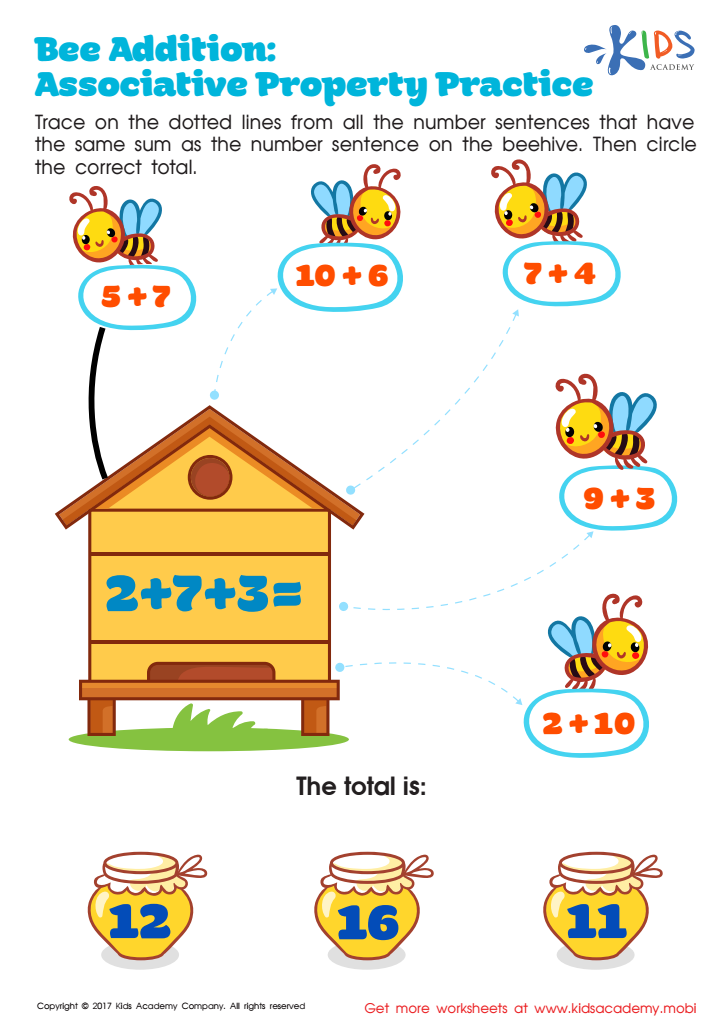
Bee Addition: Associative Property Practice Worksheet
Come to the beehive to practice the associative property of addition! This worksheet will help your child better understand addition facts. Compare equations to the 3-digit problem in the hive, solve each to find the correct answers, and trace the dotted line to show the worker bees home. Complete the sheet to find all the matching equations!
Bee Addition: Associative Property Practice Worksheet
Worksheet
Learning Skills
Join Kids Academy for Free
Who is primarily going to use this learning content?





Improving mental arithmetic for children aged 6-9 is crucial for several reasons. Firstly, this foundational skill fosters a strong understanding of numbers and mathematical concepts. As children learn to perform calculations mentally, they develop number sense, which enhances their ability to understand more complex math topics later on. Mental arithmetic encourages cognitive flexibility, allowing kids to approach problems from different angles and develop critical thinking skills.
Additionally, mental arithmetic promotes confidence and independence in young learners. When children can solve problems without relying solely on calculators or written methods, they become more self-assured in their abilities. This, in turn, cultivates a positive attitude towards math, helping to alleviate math anxiety that may develop in later years.
Moreover, practicing mental arithmetic encourages concentration and memory retention, as children must visualize calculations and hold numbers in their minds. This aligns with their developmental stage, where cognitive abilities are rapidly expanding.
Parents and teachers play a vital role in supporting mental arithmetic development through engaging activities and encouraging practice in everyday situations. By prioritizing this aspect of math education, they prepare children not just for academic success, but also for practical decision-making in real life, ultimately setting the stage for lifelong learning.








