
Spatial awareness Normal Geometry Worksheets for Ages 6-9
5 filtered results
Difficulty Level
Grade
Age
-
From - To
Subject
Activity
Standards
Enhance your child's spatial awareness with our engaging Normal Geometry Worksheets, designed for ages 6-9. These printable activities from Kids Academy help kids develop critical thinking and problem-solving skills by recognizing shapes, understanding their properties, and identifying their positions. Each worksheet is thoughtfully crafted to make learning fun and interactive, ensuring students feel confident navigating their geometric world. Ideal for both classroom use and at-home practice, these exercises support foundational math skills crucial for future success. Equip your young student with the tools they need to excel in geometry and build strong spatial reasoning abilities today!
Favorites
With answer key
Interactive
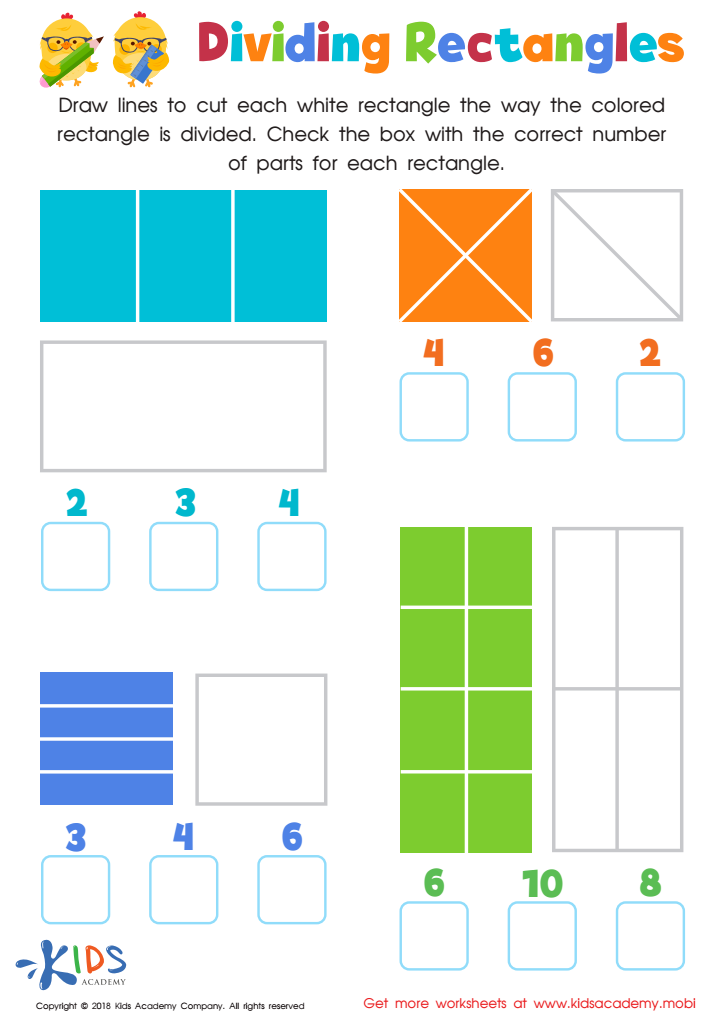
Dividing Rectangles Worksheet
Ask your child to draw lines to divide the white rectangles like the colored ones. Then, have them count the parts in each and choose the correct number. This worksheet will help them practice counting and dividing.
 Assign to My Students
Dividing Rectangles Worksheet
Worksheet











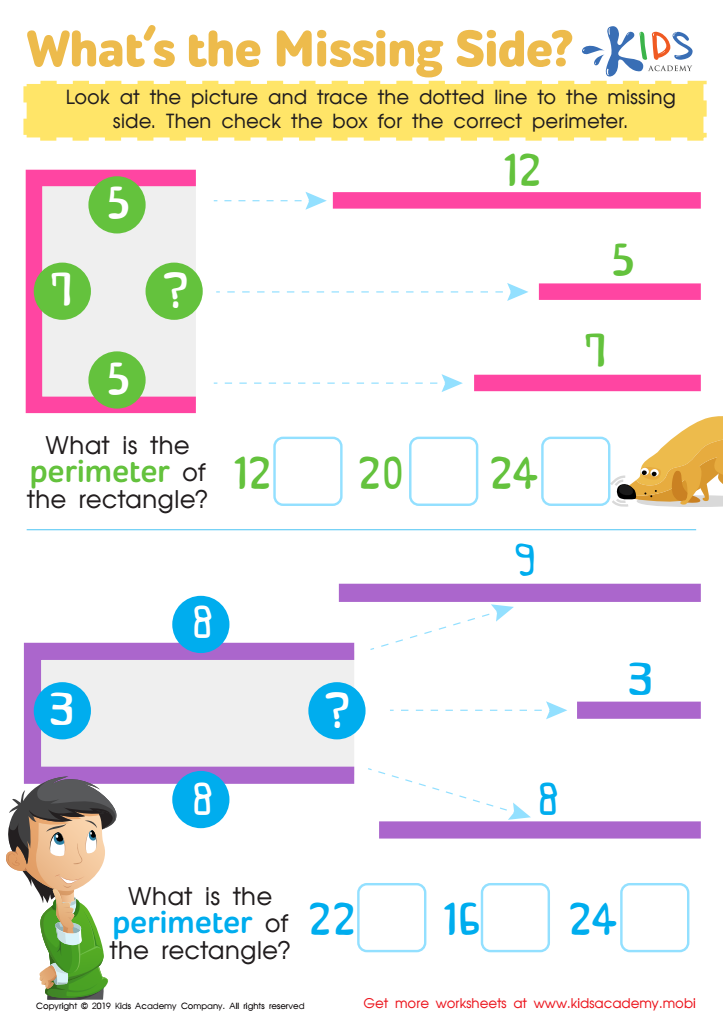
What's the Missing Side Worksheet
Assist your pupils in improving math skills with fun exercises like the tracing sheet. Show them the picture and guide them to trace the missing side. Ask them to check the box of the right perimeter afterwards. Doing this regularly can help them to enjoy and appreciate the subject more.
What's the Missing Side Worksheet
Worksheet
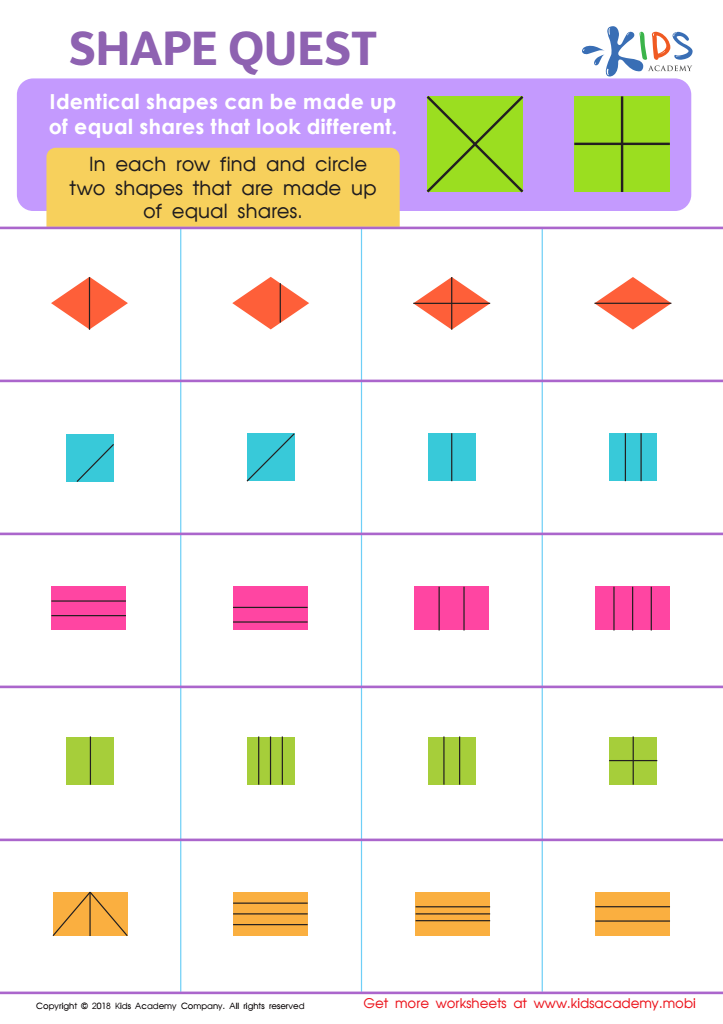
Shape Quest Worksheet
Help your child identify shapes by having them find shapes made up of equal parts. This colorful worksheet challenges them to look through each row and circle two matching shapes. It's a great way to teach them the unique features of each shape, while also helping them understand that identical shapes can look different.
Shape Quest Worksheet
Worksheet
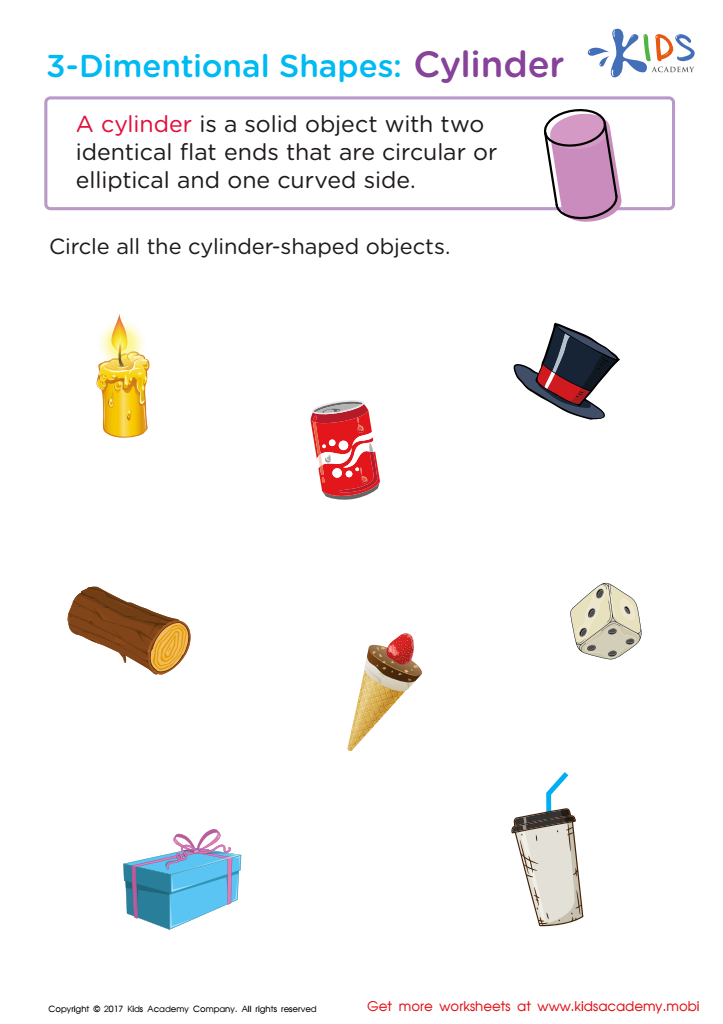
Three–Dimensional Shapes: Cylinder Worksheet
Introduce your toddler to geometry and 3D cylinders with this printable and watch their knowledge grow. It will help them recognize, define, and identify cylinders, as well as differentiate between 3D objects.
Three–Dimensional Shapes: Cylinder Worksheet
Worksheet
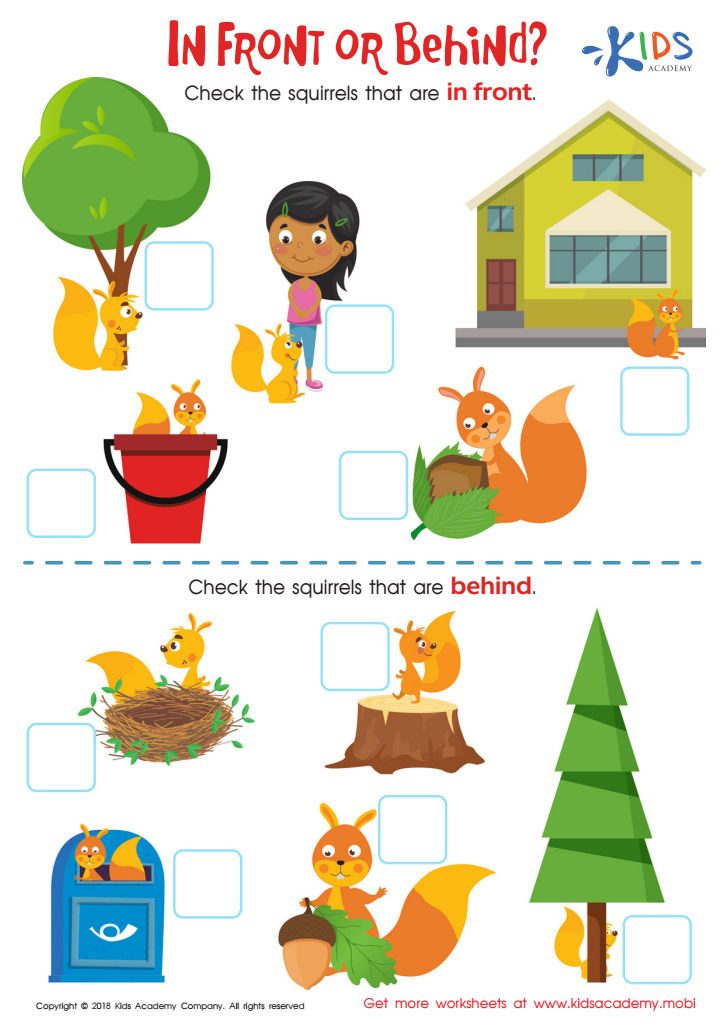
In Front or Behind: Part 2 Worksheet
Teach positional words "front" and "behind" with this fun worksheet! Students identify where the squirrel is in relation to the object - in front or behind. It's a great exercise to practice early geometry skills and understanding object movement.
In Front or Behind: Part 2 Worksheet
Worksheet
Join Kids Academy for Free
Who is primarily going to use this learning content?








Spatial awareness is an essential skill for children to develop, and normal geometry plays a significant role in fostering this ability in ages 6-9. During these formative years, kids are developing crucial cognitive and motor skills that will serve as the foundation for more complex thinking and learning in the future. Understanding spatial relationships helps children make sense of the world around them, enhancing their problem-solving and critical-thinking capabilities.
For parents and teachers, investing time in developing a child's spatial awareness and geometry skills is beneficial for several reasons. Firstly, it enhances their ability to navigate and understand their physical environment. Skills such as puzzle-solving, building with blocks, and recognizing shapes contribute directly to better hand-eye coordination and fine motor skills.
Secondly, spatial skills are closely linked to success in STEM (Science, Technology, Engineering, and Mathematics) fields, which are increasingly important in today’s technology-driven world. Mastery of geometric concepts enables children to visualize and think in three-dimensional terms, providing a foundation for subjects like physics and engineering.
Lastly, developing spatial awareness through normal geometry nurtures a child's creativity and artistic abilities. Activities like drawing, modeling, and mapping not only make learning fun but also enhance a child's ability to express themselves and understand abstract concepts.
Overall, nurturing spatial awareness in early childhood sets the stage for lifelong learning and success.








