
Counting skills Normal Addition Facts Worksheets for 6-Year-Olds
5 filtered results
Difficulty Level
Grade
Age
-
From - To
Subject
Activity
Standards
Enhance your child's counting skills with our engaging Normal Addition Facts Worksheets designed specifically for 6-year-olds! These worksheets provide a fun and interactive way to strengthen foundational math skills, focusing on addition and recognizing number patterns. Each worksheet is thoughtfully crafted to challenge young learners, helping them build confidence in their ability to compute and solve problems. With colorful designs and varying difficulty levels, children will enjoy the process of mastering normal addition facts. Perfect for home or classroom use, these resources aim to support educators and parents in fostering a love for math from an early age. Start building counting skills today!
Favorites
With answer key
Interactive
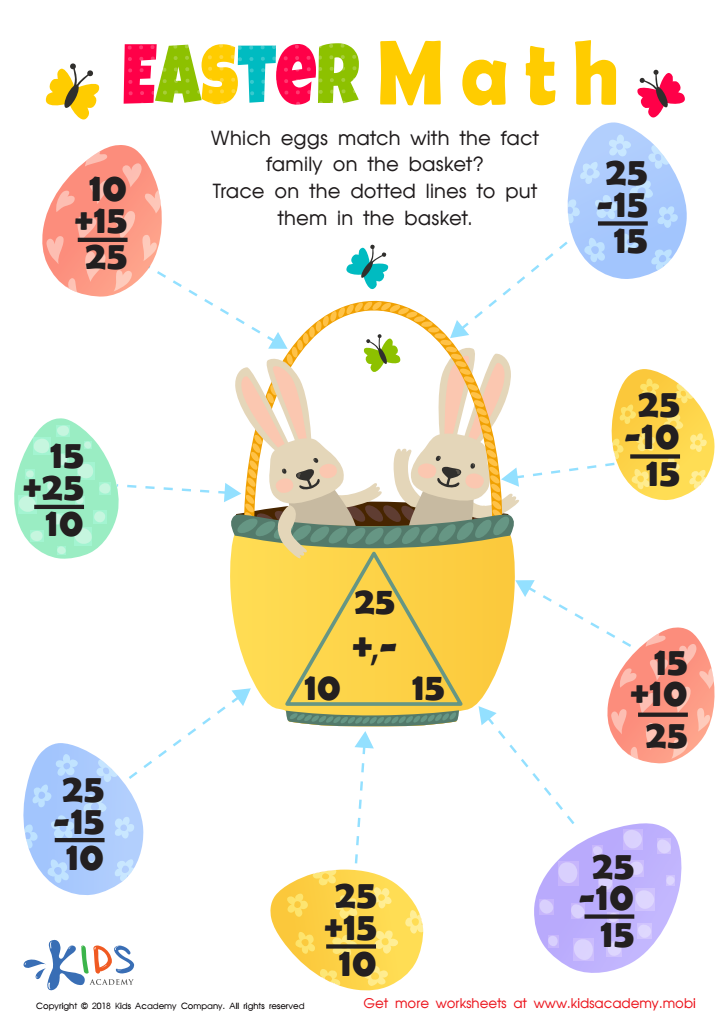
Fact Families: Easter Math Worksheet
Kids will love this vibrant PDF packed with Easter math fun! Match facts with the colorful eggs, add and subtract multiples of five to boost automaticity, and have a blast with the bunny friends!
 Assign to My Students
Fact Families: Easter Math Worksheet
Worksheet
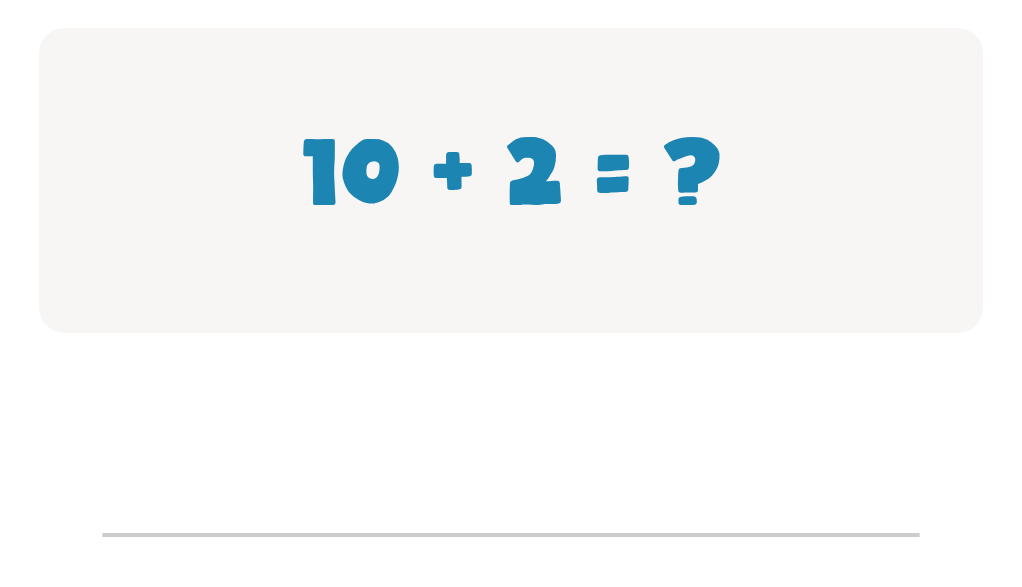

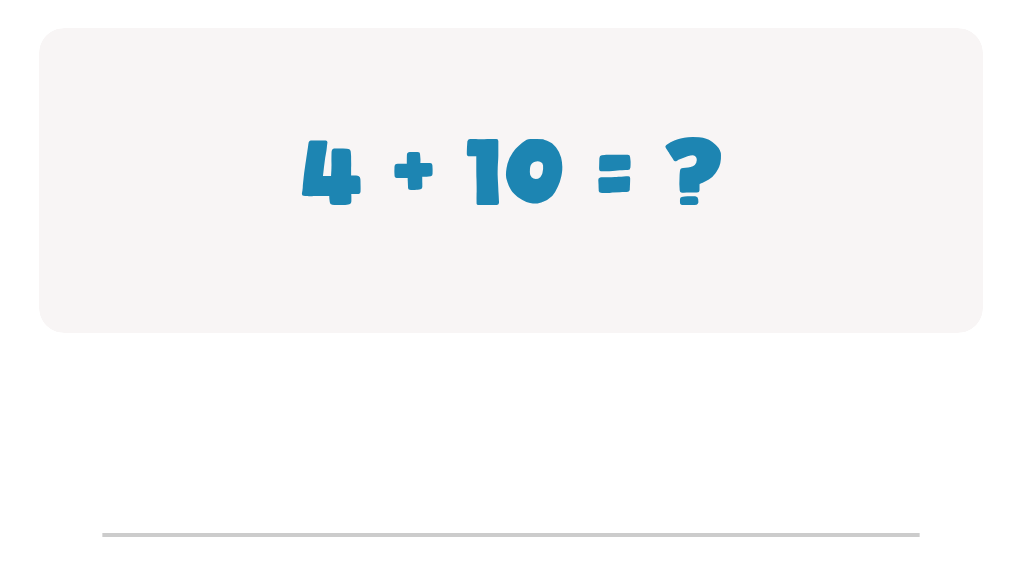
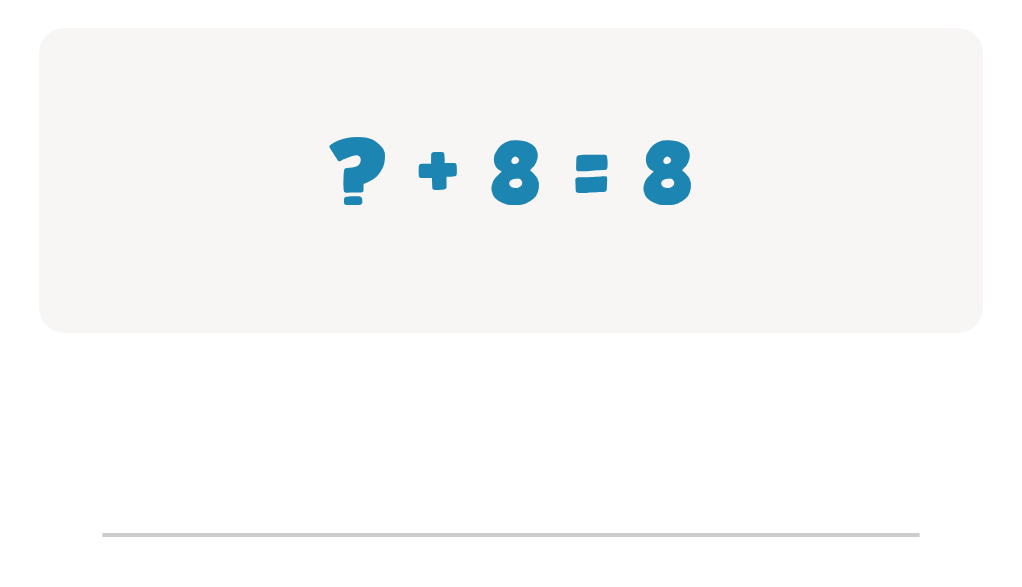

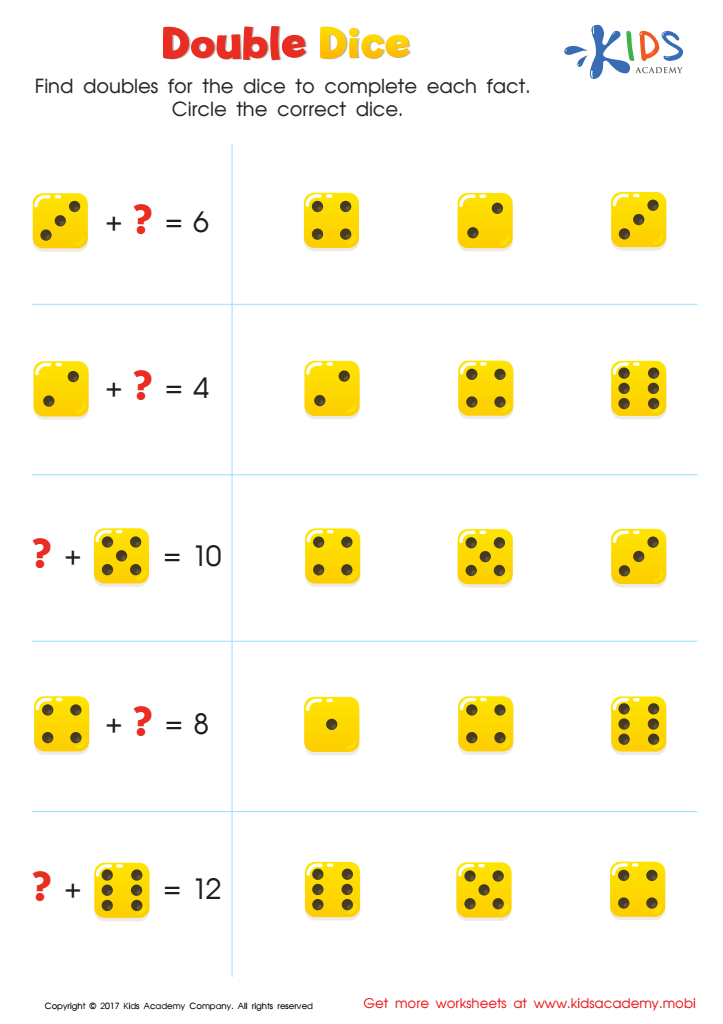
Addition Facts: Double Dice Worksheet
Are you looking for ways to make maths more engaging for kids? Maths can be a bore, but by teaching kids from an early age that it can be fun, they won't struggle with it. This worksheet is a great way to start: your child needs to identify the number on the left dice and find its double on the right. The sum of the two dice is also given.
Addition Facts: Double Dice Worksheet
Worksheet
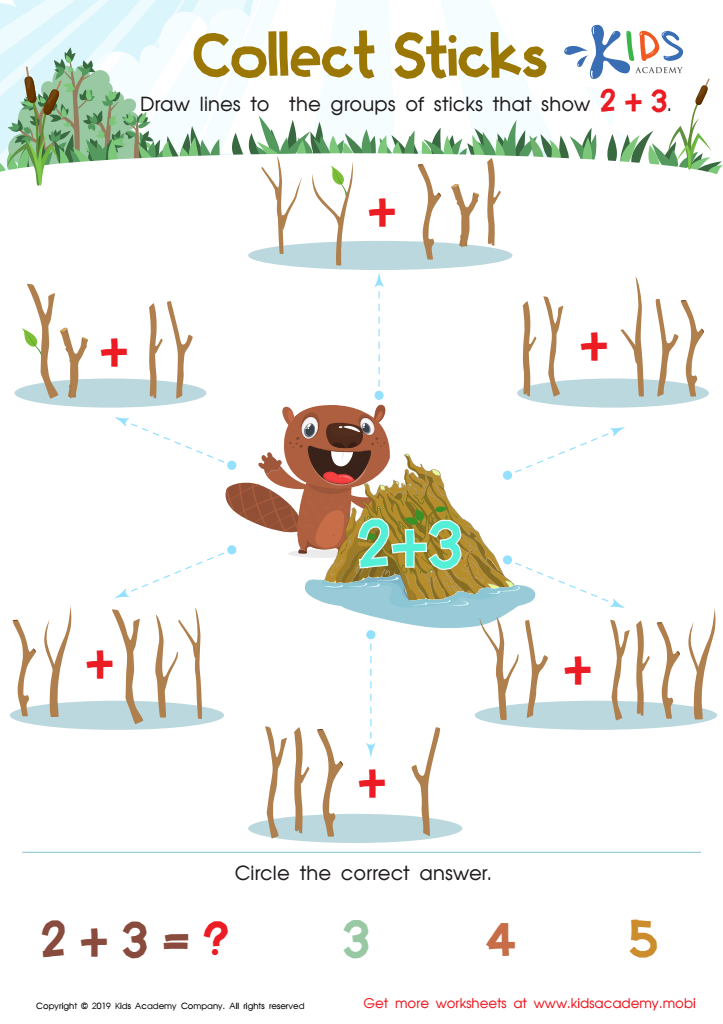
Collect Sticks Worksheet
Let math be fun for your kids with a simple and colorful worksheet exercise. Addition and subtraction can be daunting, but you can make it enjoyable with exercises like this one. Get them to draw lines to the groups of sticks that show 2+3 and watch them light up.
Collect Sticks Worksheet
Worksheet
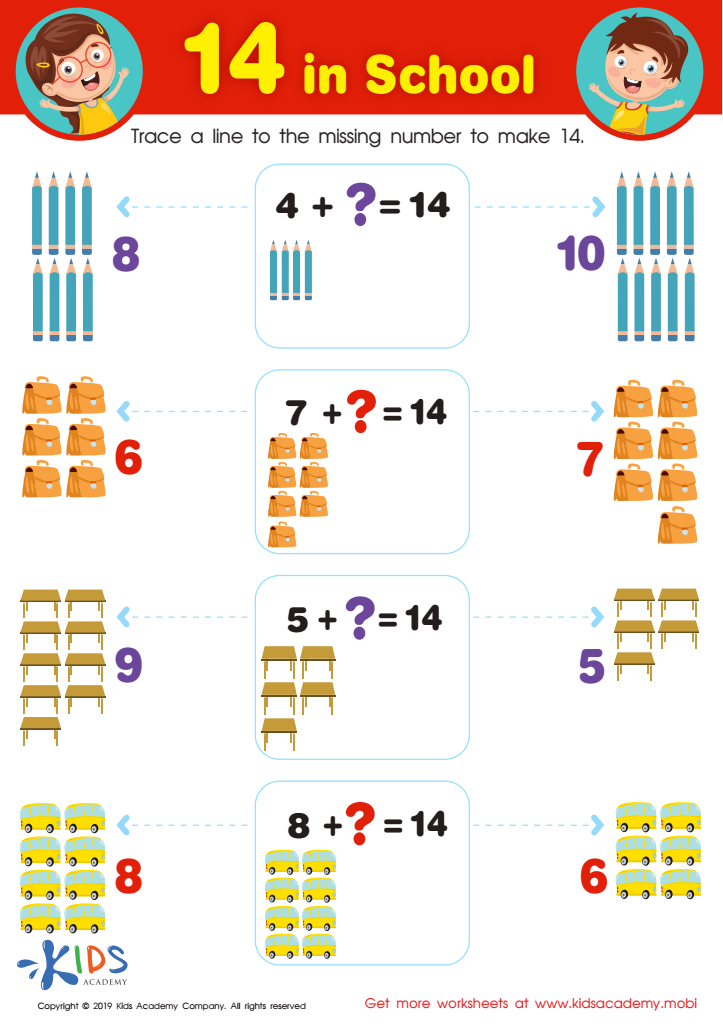
14 in School Worksheet
Remind your kids that adding different sets of numbers can give the same total (e.g. 2+3=5, 4+1=5). Ask them for more examples. Afterwards, work through the exercise. Help them count the objects and trace a line to the missing number that makes the total 14.
14 in School Worksheet
Worksheet
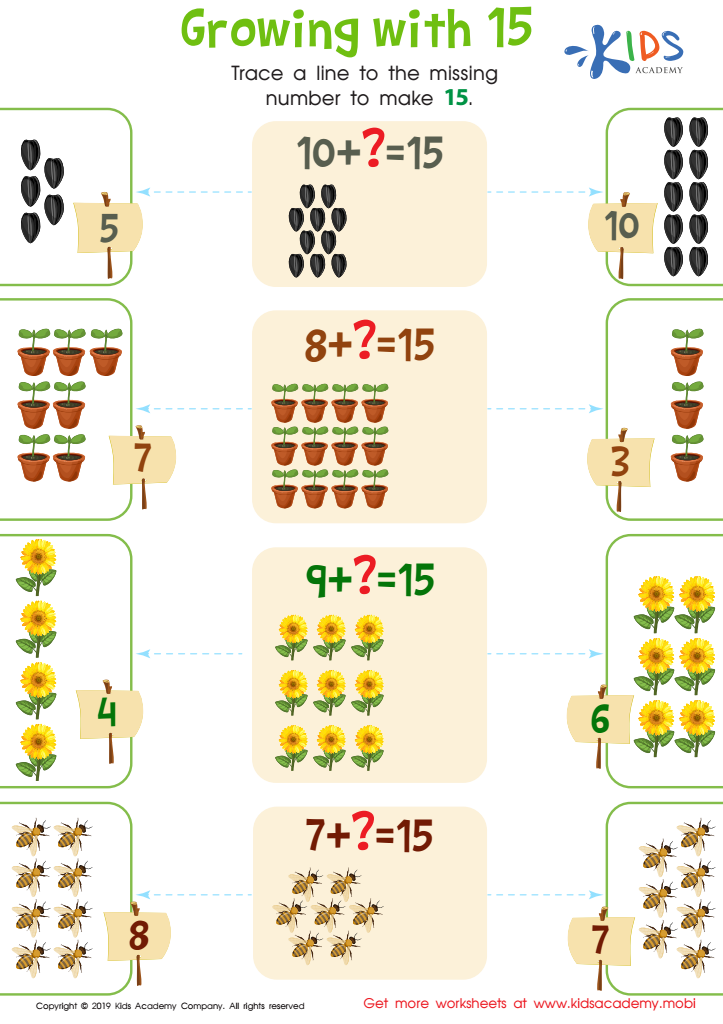
Growing with 15 Worksheet
Remind your kids that adding different sets of numbers can give the same total (e.g. 2+3=5, 4+1=5). Test their understanding by asking them for more examples. Move onto the worksheet: count objects, then trace the line to the number making a total of 15.
Growing with 15 Worksheet
Worksheet
Join Kids Academy for Free
Who is primarily going to use this learning content?








Counting skills and mastering normal addition facts are crucial for 6-year-olds as they form the foundation for effective math learning. At this age, children transition from concrete operational thought to more abstract reasoning, making the understanding of numbers essential.
First, counting skills enhance a child's ability to recognize and manipulate numbers. When children can count confidently, they develop a sense of quantity and can easily compare numbers, which is fundamental for addition and subtraction. Mastery of normal addition facts—such as sums of numbers from 1 to 10—promotes fluency in basic math, allowing for quick problem-solving in more complex scenarios later on.
Additionally, strong counting and addition skills contribute to a child's overall cognitive development. Engaging with numbers boosts memory, reinforces pattern recognition, and fosters critical thinking. These math competencies are closely tied to success in other subjects and everyday life.
Finally, a solid grasp of these skills builds a child’s confidence in mathematics, reducing math anxiety as they progress in their education. Parents and teachers who emphasize counting and addition empower children to embrace learning, laying the groundwork for future academic achievements. Prioritizing these skills sets children on a path towards lifelong learning and competency in mathematics.








