Understanding fact families Normal Addition & Subtraction Worksheets
3 filtered results
-
From - To
Discover the educational benefits of our "Understanding Fact Families: Normal Addition & Subtraction" worksheets. Designed for young learners, these engaging resources help students grasp the concept of fact families, enhancing their math skills in a fun way. Each worksheet focuses on showing how addition and subtraction are interconnected, solidifying foundational math knowledge. By practicing with these worksheets, children will improve their ability to recognize relationships between numbers, fostering critical thinking and problem-solving skills. Ideal for both classroom and home use, these printable worksheets promote a clear understanding of essential math concepts. Start your child’s journey to math mastery today!
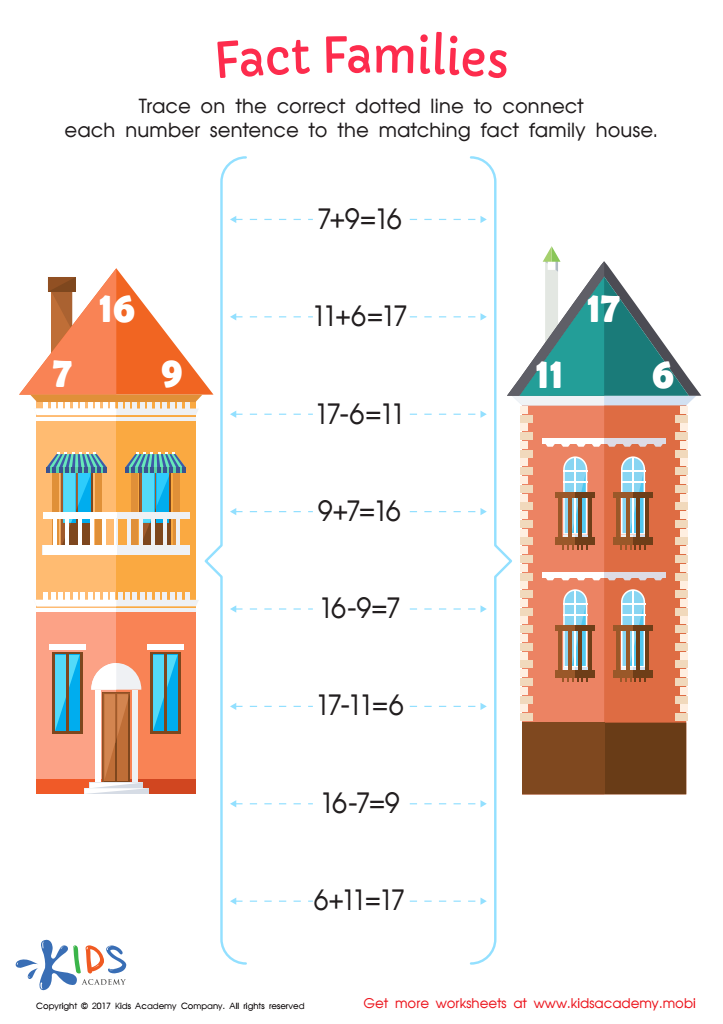
Fact Families — Add and Subtract Worksheet
 Assign to My Students
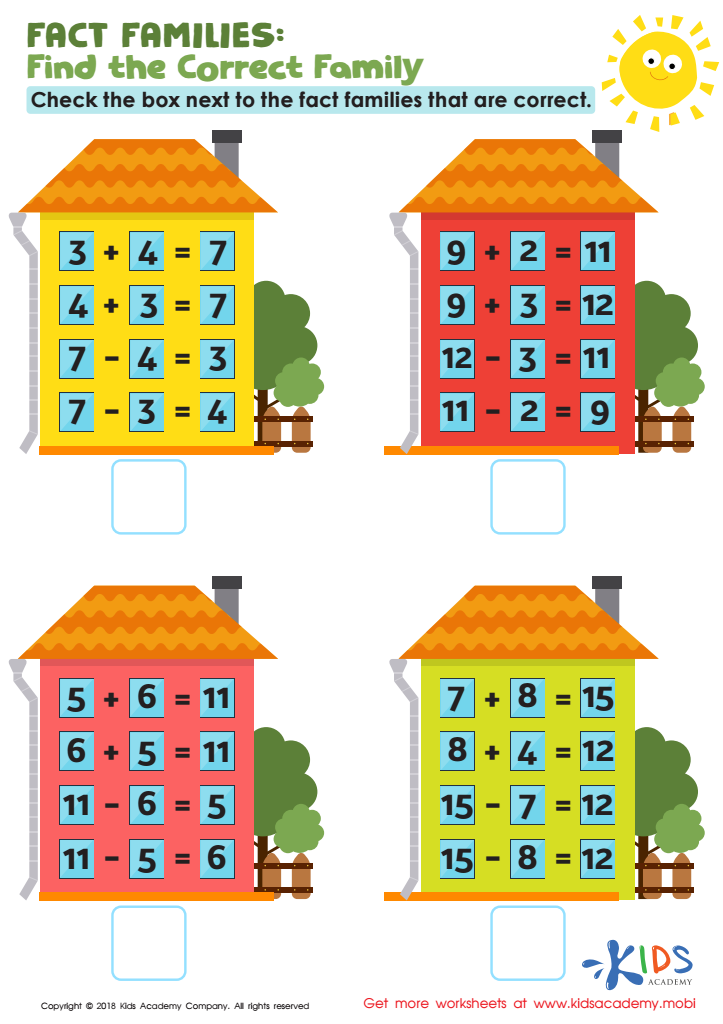
Fact Families: Find Correct Family Worksheet
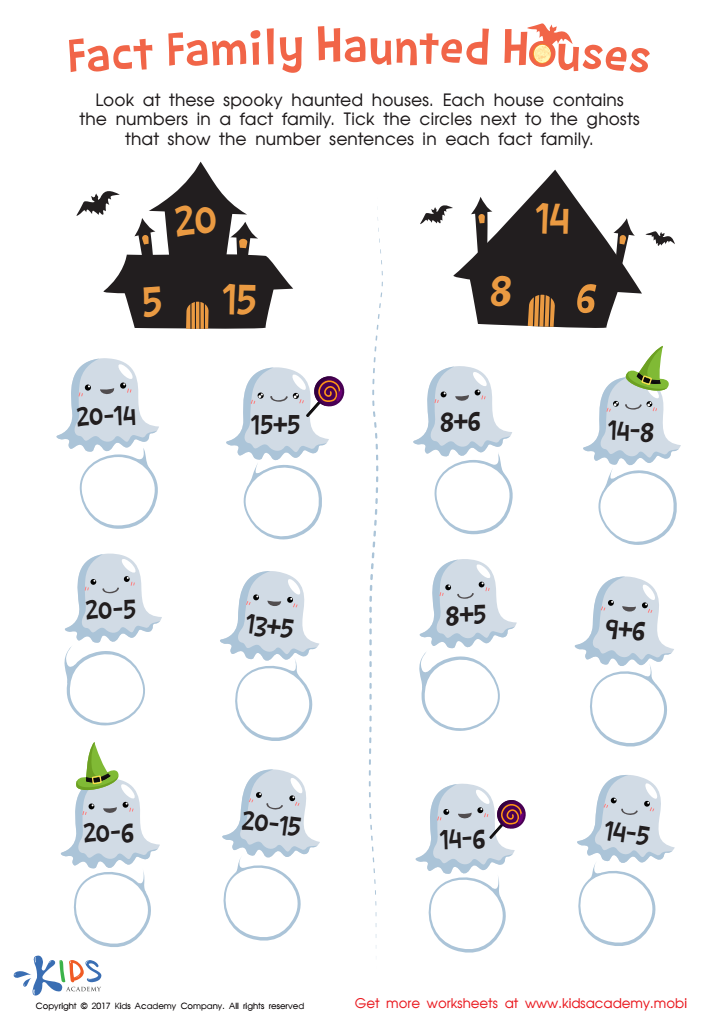








Understanding fact families in normal addition and subtraction is crucial for both parents and teachers as it lays the foundational skills for children's mathematical reasoning. Fact families are a set of related number sentences that illustrate the relationship between addition and subtraction. For example, from the numbers 3, 4, and 7, we can create the equations 3 + 4 = 7 and 7 - 4 = 3.
By focusing on fact families, children develop a deeper comprehension of how numbers interact, enhancing their problem-solving skills and promoting flexibility in thinking. This understanding encourages them to see relationships rather than merely memorizing arithmetic facts. It supports the transition from concrete arithmetic knowledge to more abstract mathematical concepts, gears them towards algebraic thinking, and boosts overall confidence in mathematics.
Moreover, when parents and teachers emphasize fact families, they create a consistent approach to teaching math, facilitating clear communication and understanding for students. It also opens opportunities for discussions about mathematical patterns and helps children recognize that subtraction is simply the inverse of addition, enriching their overall numerical literacy. Ultimately, mastering fact families empowers students, enabling them to tackle more complex math challenges successfully in the future.








