
Rhyming worksheets activities for Ages 5-6
1 filtered results
Difficulty Level
Grade
Age
-
From - To
Subject
Activity
Standards
Dive into the rhythmic world of language with our captivating Rhyming Worksheets Activities! Designed to engage and educate, these activities are perfect for young learners eager to explore the magic of rhymes. Through a series of thoughtfully crafted worksheets, children will embark on a delightful journey, enhancing their phonemic awareness, vocabulary, and reading skills. Each activity is tailored to spark creativity, boost memory, and foster a love for reading and poetry. Whether used in the classroom or at home, our Rhyming Worksheets Activities promise a fun and enriching experience, paving the way for linguistic proficiency and a lifelong appreciation for the beauty of words.
Favorites
With answer key
Interactive
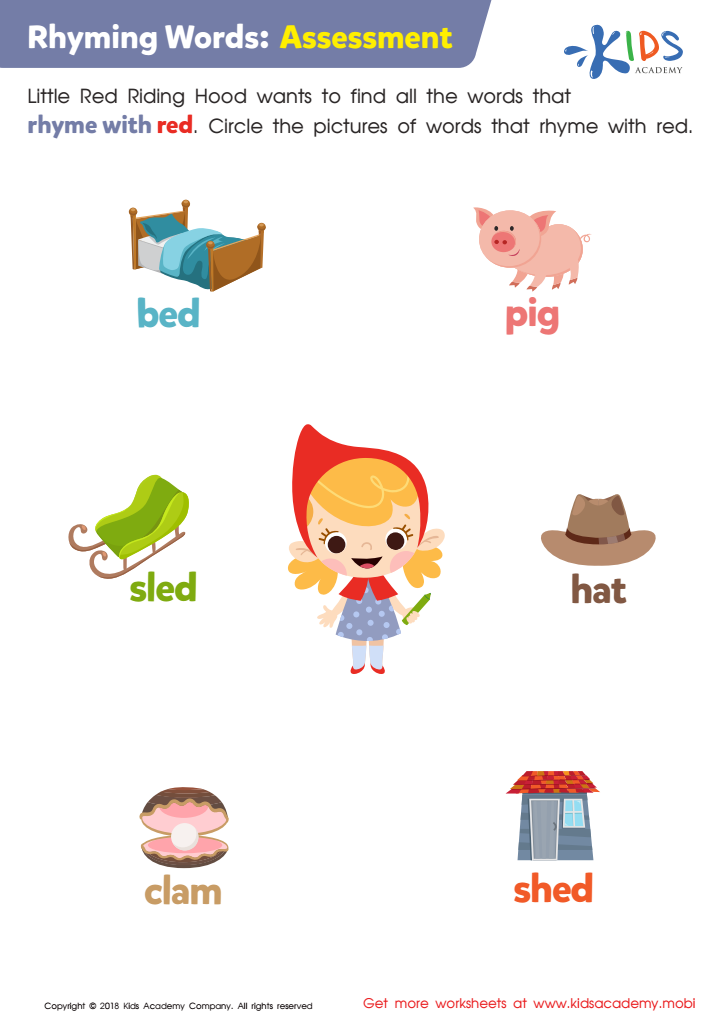
Rhyming Words: Assessment Worksheet
Help Little Red Riding Hood find rhyming words with "red". Download and print this worksheet. Have your child circle the rhyming words and pictures. Get them to say each word out loud and compare it to the word "red". When they're done, review the answers and talk about any words that don't rhyme.
 Assign to My Students
Rhyming Words: Assessment Worksheet
Worksheet
Learning Skills
Join Kids Academy for Free
Who is primarily going to use this learning content?







Rhyming worksheets activities are a fundamental tool in the development of early literacy skills in children. These engaging and interactive exercises not only make learning fun but also reinforce the understanding of sounds and word patterns. Rhyming, a critical phonological awareness skill, is essential in preparing young learners for successful reading and writing.
One of the key reasons Rhyming worksheets activities are incredibly useful is their ability to enhance a child's phonemic awareness. Through these activities, children learn to identify and produce words that have the same ending sounds. This skill is vital as it lays the groundwork for decoding words, which is crucial for reading. When children engage in Rhyming worksheets activities, they become more adept at recognizing sound patterns, an ability that significantly aids in the acquisition of reading skills.
Moreover, Rhyming worksheets activities boost memory and cognitive development. Rhymes are easier to remember because the repetition of sounds creates a pattern that is more likely to stick in our minds. This aspect of rhyme makes it an excellent tool for improving memory, as children are more likely to recall words, phrases, and eventually, entire reading concepts when they are presented in a rhyming format.
Additionally, these activities foster creativity and imagination. Rhyming encourages children to explore language in playful and inventive ways. As they search for words that sound alike, they delve into a vast array of vocabulary, often encountering new words and meanings. This exploration not only expands their lexicon but also stimulates their creative thinking processes.
Finally, Rhyming worksheets activities promote engagement and enjoyment in learning. The fun and interactive nature of rhyming make it an appealing activity for children, keeping them motivated and interested in their literacy journey.
In conclusion, Rhyming worksheets activities are an invaluable resource in early childhood education. By enhancing phonemic awareness, boosting memory, fostering creativity, and ensuring engagement, they lay a solid foundation for successful reading and language skills development.








