Easy Phonics worksheets activities for 3-Year-Olds
1 filtered results
-
From - To
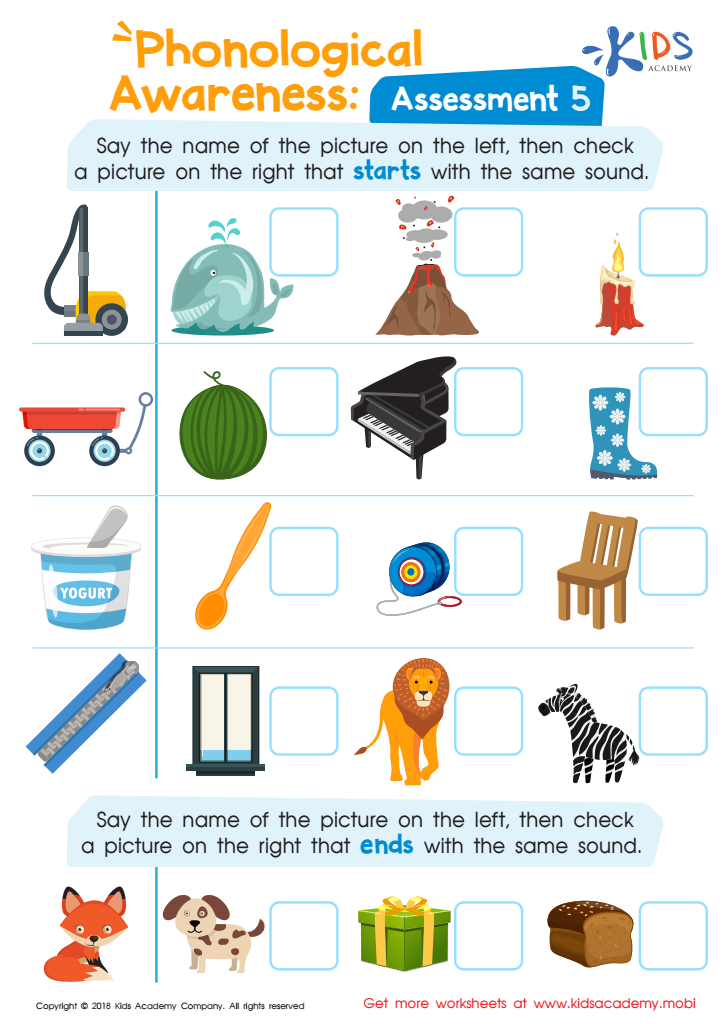
Phonological Awareness: Assessment 5 Worksheet
 Assign to My Students



.jpg)



Easy Phonics worksheets activities play a pivotal role in laying a solid foundation for reading and writing success in young learners. These engaging and accessible tools are invaluable in teaching children the relationship between letters and sounds, a fundamental skill for decoding words and developing fluency in reading. Here’s why Easy Phonics worksheets activities are so useful in early education:
Interactive Learning: Phonics worksheets designed with easy-to-understand activities make learning interactive and fun. Children are more likely to engage with material that doesn't intimidate them, encouraging a positive attitude towards learning to read and write.
Foundational Skills: Easy Phonics worksheets activities focus on foundational skills, such as identifying letter sounds, blending sounds to form words, and distinguishing between similar sounds. These skills are crucial for reading proficiency and are best developed with targeted practice.
Customizable Difficulty: The adaptability of Phonics worksheets allows educators and parents to tailor the difficulty level to match the learner's current ability. This customization ensures that children are neither overwhelmed by complexity nor bored by simplicity, maintaining an optimal learning curve.
Reinforcement and Practice: Regular practice with these worksheets reinforces what is learned in more formal settings. Repetition is a key learning tool, especially for young minds, and Phonics worksheets provide ample opportunities for reinforcing learned concepts.
Independence: Easy Phonics worksheets activities often encourage independent learning. Children can complete these activities with minimal supervision, fostering a sense of achievement and self-reliance that can transfer to other areas of learning.
Visual and Auditory Learning: These activities cater to both visual and auditory learners by combining visual cues with sound association. This dual approach can enhance phonemic awareness more effectively than techniques that focus on only one sensory pathway.
In conclusion, Easy Phonics worksheets activities are a cornerstone of early literacy education. They offer a balanced mix of interactive learning, foundational skill-building, and opportunities for reinforcement and independent learning. By integrating these activities into the learning process, educators and parents can provide children with the tools they need for reading success, setting the stage for lifelong learning.








