Easy Sorting worksheets activities for 3-Year-Olds
1 filtered results
-
From - To
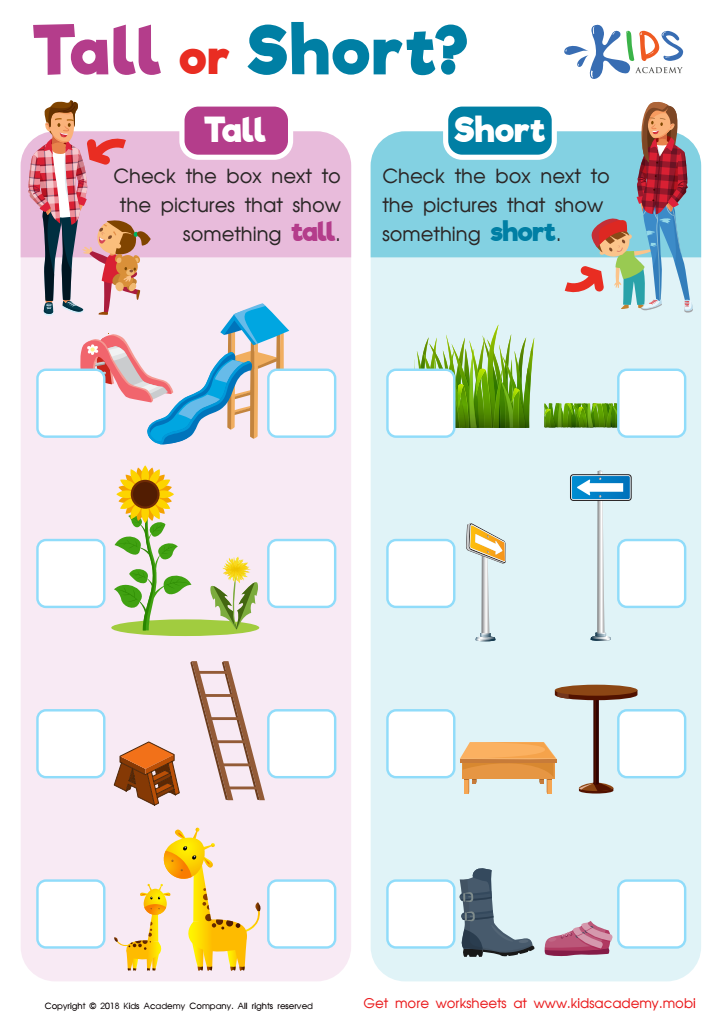
Tall or Short? Worksheet
 Assign to My Students







Easy Sorting worksheets activities are a fundamentally engaging and educational tool that serve a crucial role in early childhood development and learning. These activities are designed not only to entertain but also to enhance cognitive abilities, improve critical thinking, and develop fine motor skills in young learners. Let’s delve into why Easy Sorting worksheets activities are invaluable.
Firstly, these worksheets introduce children to the concept of categorization— a key skill in understanding the world around them. By engaging in Easy Sorting worksheets activities, children learn to identify similarities and differences among objects, which is a foundational step in logical thinking and problem-solving. This skill is not only pivotal in academic settings but also in everyday decision-making and organization.
Moreover, Easy Sorting worksheets activities are designed to be accessible and enjoyable. The simplicity of these activities ensures that children are not overwhelmed, making the learning process enjoyable and effective. By starting with easy tasks, children gradually build confidence in their abilities, which is crucial for their academic and personal development.
Additionally, these worksheets are versatile teaching tools that can be adapted to various learning styles and subjects. Whether it’s sorting by color, shape, size, or category, Easy Sorting worksheets can be tailored to reinforce various concepts, from basic math to science and language arts. This adaptability makes them an invaluable resource for educators and parents alike.
Furthermore, engaging in these sorting activities can significantly enhance a child’s fine motor skills. As they manipulate objects to sort them according to different criteria, they develop hand-eye coordination and dexterity, which are essential for writing and other daily tasks.
In conclusion, Easy Sorting worksheets activities are not just another educational resource; they are a crucial tool in developing a wide range of skills in young learners. From fostering logical thinking to improving fine motor skills, these activities prepare children for academic success and everyday challenges, making them an indispensable part of early education.








