Length and Mass Word Problems Worksheets for 5-Year-Olds
1 filtered results
-
From - To
Introduce your five-year-old to the basics of measurement with our Length and Mass Word Problems worksheets! These educational homework sheets are thoughtfully designed to engage young learners in the concepts of measuring and comparing different lengths and weights through fun, age-appropriate problems. With colorful illustrations and clear, simple instructions, these worksheets make learning feel like play. Ideal for home use or as a classroom resource, these sheets help lay a strong foundation in early math skills, encouraging curiosity and critical thinking. Watch your child develop confidence in handling real-world math scenarios with ease!
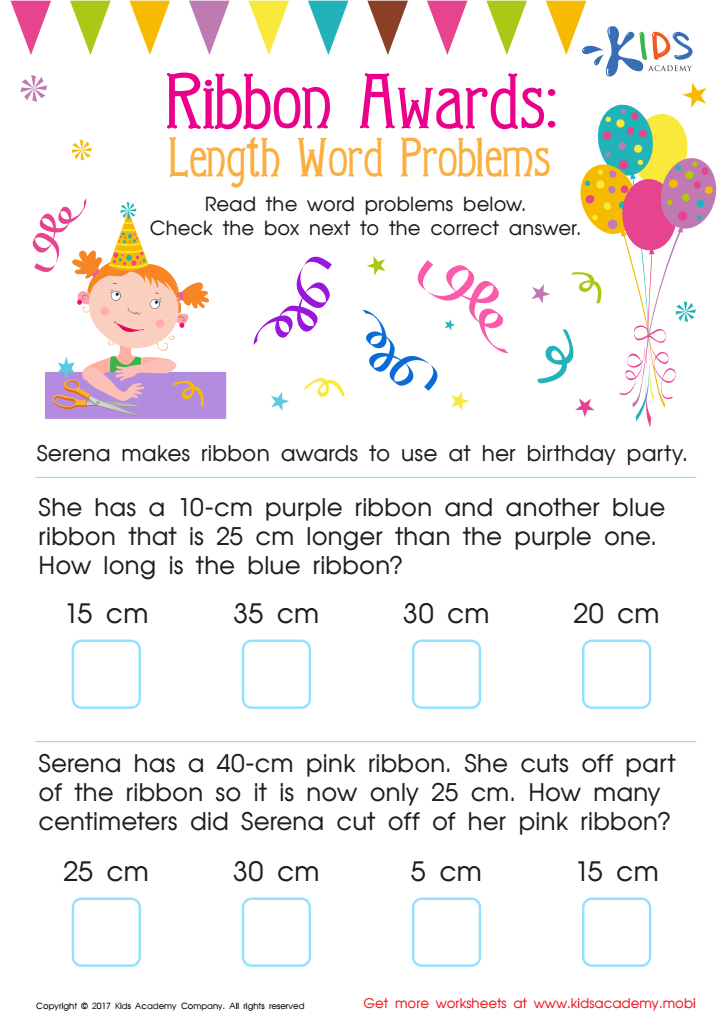
Length Word Problems Worksheet
 Assign to My Students


The Value of School Worksheets on Length and Mass Word Problems for Five-Year-Olds
Introducing young learners to fundamental concepts in mathematics is crucial for their cognitive development, and school worksheets on length and mass word problems can play a pivotal role. Specifically designed for children around five years old, these worksheets are not just educational tools but stepping stones that bridge early learning and practical understanding of the physical world.
Engaging Early Learners
At the age of five, children are naturally curious, constantly exploring and trying to make sense of the world around them. School worksheets focused on length and mass word problems cater to this inquisitiveness by framing learning in the context of real-world scenarios. Whether it's measuring ingredients for a simple recipe or comparing the heights of different family members, these worksheets make abstract concepts tangible and comprehensible.
Building a Foundation for Future Math Skills
Mathematics is a cumulative subject where early fundamentals set the stage for more complex concepts. By using school worksheets that introduce length and mass through word problems, children can begin to understand measurement and comparison. These are not only key skills in math but also essential for daily life activities. Such foundational knowledge in measurement contributes to a child’s ability to perform tasks ranging from simple sorting and organizing to understanding quantities and spatial awareness.
Developing Critical Thinking and Problem-Solving Skills
Word problems are particularly effective because they require more than rote calculation; they demand understanding, reasoning, and application of the correct method to arrive at a solution. For five-year-olds, school worksheets that incorporate stories or familiar scenarios with questions about length and mass encourage children to think critically and solve problems. This not only enhances their math skills but also boosts their overall intellectual growth and ability to focus.
Enhancing Language and Reading Comprehension
Working with school worksheets on length and mass word problems also inadvertently supports language development. As children read through the problems, they practice their reading skills and learn new vocabulary related to measurement. This integration of math and language learning reinforces comprehension and allows for a more holistic educational experience.
Encouraging Independent Learning and Confidence
For young learners, the sense of achievement that comes with successfully solving a word problem on their own is invaluable. School worksheets provide a structured yet flexible framework that allows children to work at their own pace, explore solutions, and learn from mistakes. The encouragement of independent work helps build self-confidence and resilience, qualities that are beneficial well beyond the mathematics class.
Tools for Parents and Educators
Finally , school worksheets on length and mass word problems are incredibly beneficial for parents and educators who are guiding the learning process. These resources allow adults to track a child's progress, identify areas of strength and weakness, and tailor instruction to meet each learner's needs. For educators, these worksheets provide a standardized measure of assessing developmental milestones and curriculum alignment, while for parents, they serve as easy-to-use tools for engaging children in learning activities at home.
Making Learning Enjoyable
An often-overlooked advantage of using school worksheets is that they can make learning fun. Designers of educational material for young children often incorporate colorful graphics, engaging characters, and interactive elements that can turn a routine learning activity into a delightful experience. When children enjoy the process, their engagement levels increase, along with their retention of the information being taught. School worksheets on length and mass can include puzzles, matching games, and cut-and-paste activities that are perfectly suited for young learners.
Adaptable to Various Learning Styles
Children at the age of five can exhibit a wide range of learning styles—some may learn better through visual means, others through tactile activities, and still others through auditory instructions. School worksheets can be adapted to suit different learning preferences, making them a versatile tool in the educational toolkit. For instance, worksheets can be used alongside physical rulers and scales for hands-on learners, or they can be read aloud for those who benefit from auditory learning cues.
Cultivating Parent-Child Interaction
Another significant benefit of these worksheets is the opportunity they provide for parent-child interaction. Engaging together in solving word problems can not only help reinforce learning outcomes but also strengthen the bonds between parent and child. It becomes an activity that supports social and emotional development as much as it does educational growth.
Conclusion
In conclusion, school worksheets on length and mass word problems are more than just paper and pencil exercises. They are a dynamic educational resource that caters to the developmental needs of five-year-olds by promoting numerical literacy, problem-solving skills, and a love for learning. Through these worksheets, young children not only learn to measure and compare physical quantities but also gain the confidence to navigate the world around them with curiosity and intelligence. For parents and educators, they are invaluable tools that support and enrich the educational journey of their young learners.