
Logical thinking development Science Worksheets
3 filtered results
Difficulty Level
Grade
Age
-
From - To
Subject
Activity
Standards
Enhance your child's logical thinking skills with our engaging Science Worksheets designed specifically for young learners. These worksheets integrate fun activities and fundamental scientific concepts, allowing kids to practice critical thinking, problem-solving, and reasoning. Our printable resources encourage exploration and curiosity while promoting essential cognitive skills that lay a strong foundation for future learning. From puzzles to challenging questions, each worksheet provides an exciting way to discover the wonders of science. Perfect for classroom settings or home learning, these interactive materials are tailored to foster creativity and confidence in young thinkers. Explore our collection and support your child's journey towards logical reasoning today!
Favorites
With answer key
Interactive
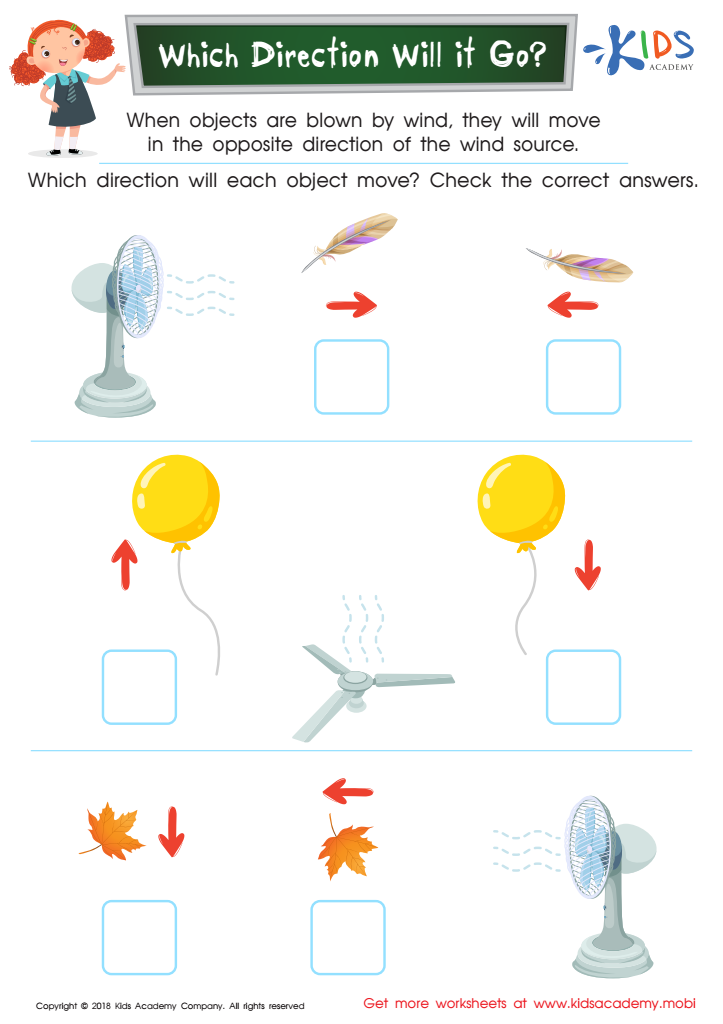
Which Direction Will it Go? Worksheet
Explain to your students: when objects are blown by wind, they will move in the opposite direction. In the worksheet, there are pictures of wind sources and objects being blown by the wind. Ask your child to identify and check the direction each object will move.
 Assign to My Students
Which Direction Will it Go? Worksheet
Worksheet
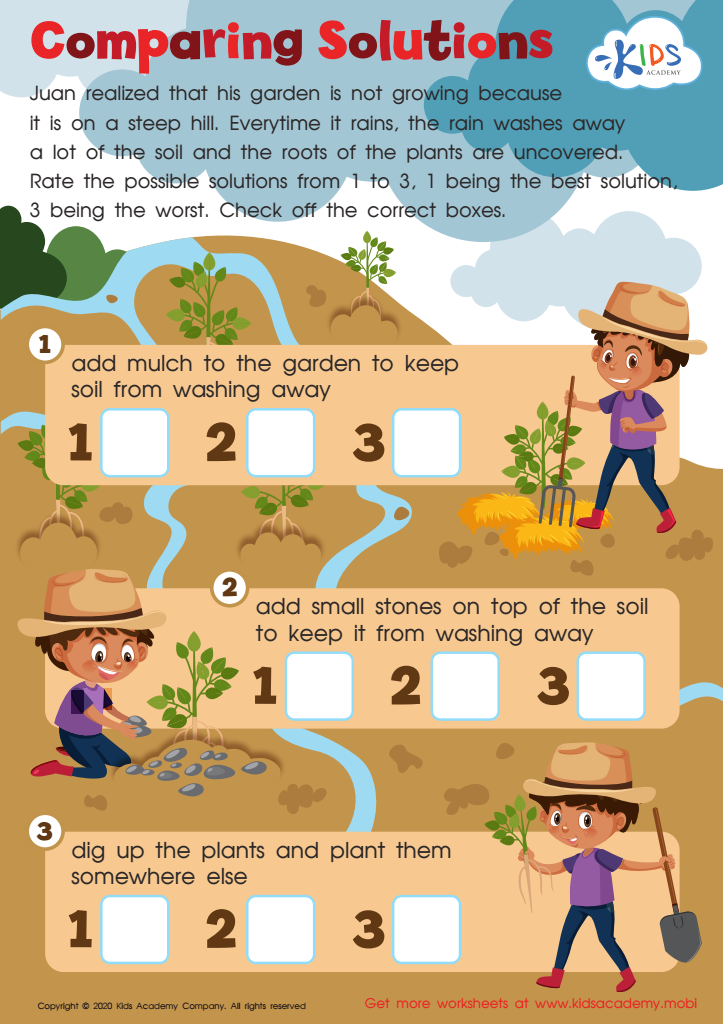
Comparing Solutions Worksheet
Juan can't get his veg garden growing as he'd like, planted on a steep hill. Help your child practice problem-solving by comparing solutions and rating them from most to least effective. With this thought-provoking worksheet, learners can hone the important skill of finding the best solution from a range of options.
Comparing Solutions Worksheet
Worksheet
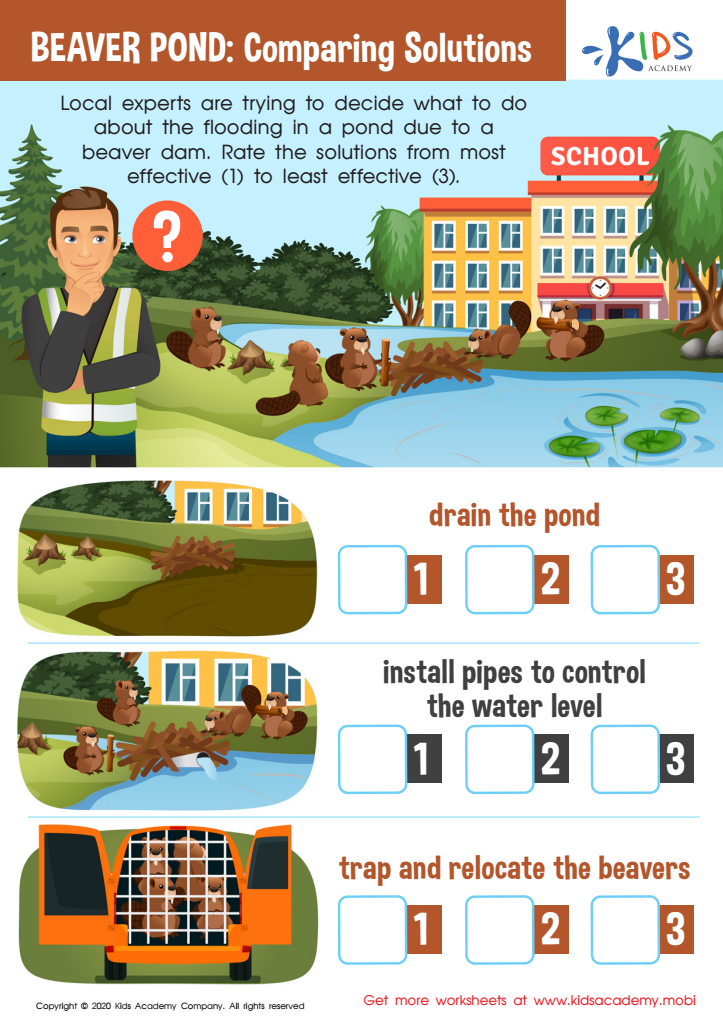
Beaver Pond: Comparing Solutions Worksheet
Got a problem? This science worksheet is great for helping your child compare solutions and pick the best one. Kids get to rate each option's effectiveness by ticking off boxes, from most to least. It's a great way to encourage problem-solving skills, while having fun!
Beaver Pond: Comparing Solutions Worksheet
Worksheet
Join Kids Academy for Free
Who is primarily going to use this learning content?








Logical thinking is a crucial cognitive skill that lays the foundation for problem-solving and effective decision-making. Parents and teachers should prioritize its development, especially in science education, because it fosters a child’s ability to analyze information, identify patterns, and draw accurate conclusions.
In science, children are encouraged to experiment, observe, and inquire. These activities not only enhance their understanding of scientific concepts but also cultivate a logical thought process. When students engage in scientific exploration, they learn to ask questions, formulate hypotheses, and conduct investigations—core components of logical reasoning.
Moreover, strong logical thinking skills benefit children beyond science; they enhance their performance in mathematics, reading comprehension, and real-life situations where critical thinking is required. As these skills develop, children become more adept at navigating complex scenarios, leading to better academic outcomes and informed decision-making in everyday life.
Furthermore, nurturing logical thinking empowers students to become independent thinkers and lifelong learners, essential traits in an increasingly complex world. Therefore, parents and teachers should care about logical thinking development in science to prepare children for future challenges, as well as to inspire a love for learning that extends far beyond the classroom.







