Identify colors Grade 2 Worksheets
3 filtered results
Difficulty Level
Grade
Age
-
From - To
Subject
Activity
Standards
Explore our engaging "Identify Colors Grade 2 Worksheets" designed to enhance your child's understanding of colors! These printable resources offer a variety of interactive activities, allowing students to identify, match, and categorize different colors while developing essential cognitive skills. Perfect for in-class or at-home learning, our worksheets are aligned with Grade 2 standards, ensuring they meet educational needs. Each worksheet features vibrant illustrations and straightforward instructions, making learning fun and accessible. Help your child gain confidence in their color recognition abilities with our comprehensive worksheets that promote creativity and critical thinking. Download today and watch their color identification skills flourish!
Favorites
With answer key
Interactive
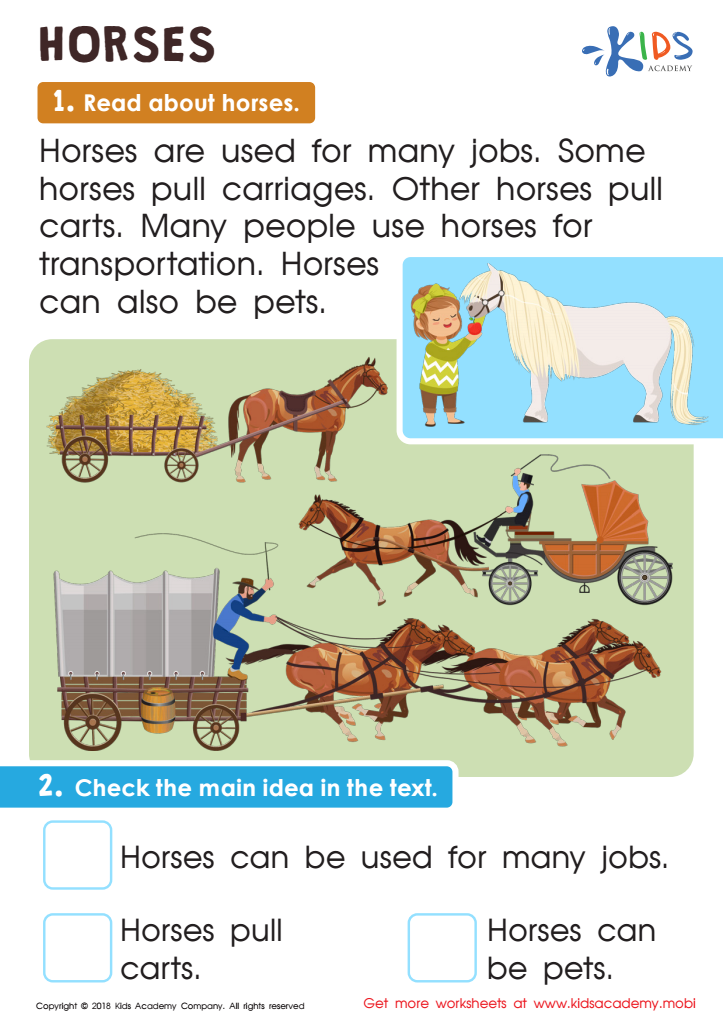
Horses Worksheet
Help your little reader differentiate between details and the main idea with this fun worksheet about horses. Kids will be excited to learn about the different roles horses play. To ensure they understand the overall concept, discuss it before having them choose the right statement at the end.
 Assign to My Students
Horses Worksheet
Worksheet
Join Kids Academy for Free
Who is primarily going to use this learning content?






Identifying colors is an essential skill for second-grade students that goes beyond mere aesthetic appreciation; it lays the groundwork for cognitive development, language acquisition, and social interaction. Parents and teachers play a crucial role in nurturing this skill, as it is tied to critical thinking and creativity. Understanding colors helps children categorize and differentiate objects, enhancing their observational skills and fostering a sense of organization.
Moreover, discussing colors expands vocabulary and enhances communication skills. When children learn to describe their world in terms of color, they start to articulate their thoughts and feelings better. For example, differentiating between 'light blue' and 'dark blue' invites them to express variations in emotion and mood, fostering emotional intelligence.
Additionally, colors often carry cultural significance and can be a gateway to discussions on diversity and inclusion. Recognizing colors can support children in expressing their identity and appreciating others' backgrounds.
In summary, fostering the ability to identify colors serves as a multifunctional tool, helping second graders enhance their cognitive, social, and emotional development. Investing in this skill creates a solid foundation for lifelong learning and understanding in an increasingly colorful and diverse world.