Comparing Fractions Grade 3 Math Worksheets
21 filtered results
Difficulty Level
Grade
Age
-
From - To
Subject
Activity
Standards
Explore our engaging "Comparing Fractions Grade 3 Math Worksheets" designed to enhance your child's understanding of fractions! Tailored specifically for third graders, these worksheets offer a variety of fun activities that strengthen critical skills in comparing fractions using visual models. Students will learn to determine which fraction is greater, understanding concepts such as numerator and denominator. With easy-to-follow instructions, our worksheets promote independent learning while providing ample opportunities for practice. Perfect for classroom or home use, our resources aim to boost confidence and improve mathematical proficiency in a supportive and colorful environment. Start comparing fractions today for a brighter math future!
Favorites
With answer key
Interactive
Fractions: Assessment 1 Worksheet
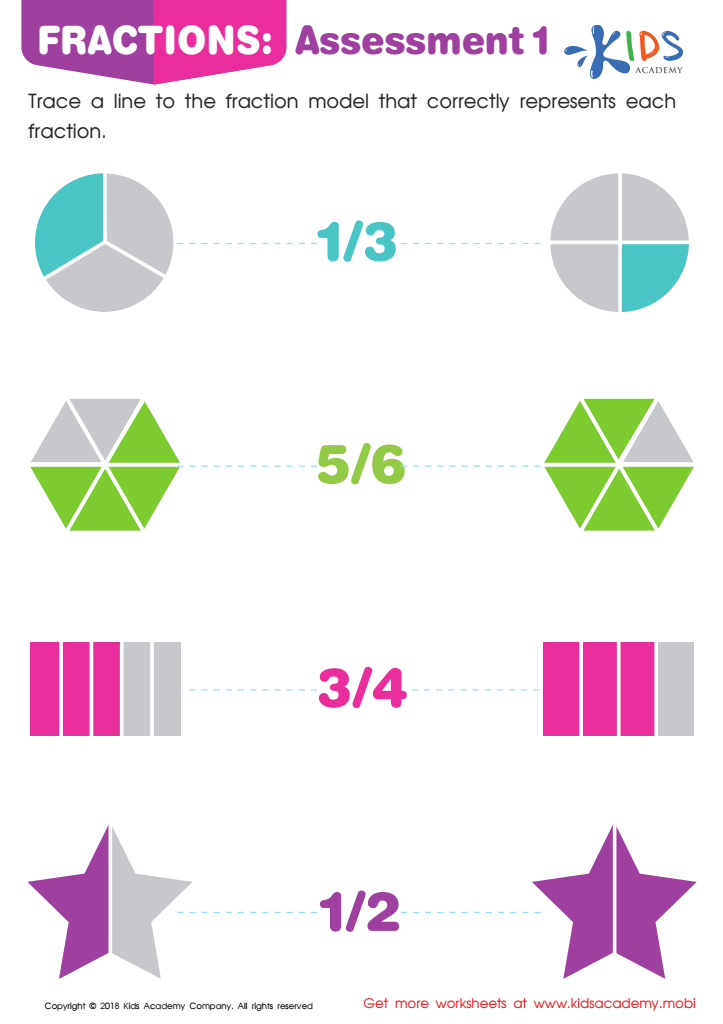
Master fractions easily with this worksheet! It has four sets of fraction models and fraction equations with two models each. Guide your kids to trace a line to the correct fraction model for each equation.
 Assign to My Students
Fractions: Assessment 1 Worksheet
Worksheet
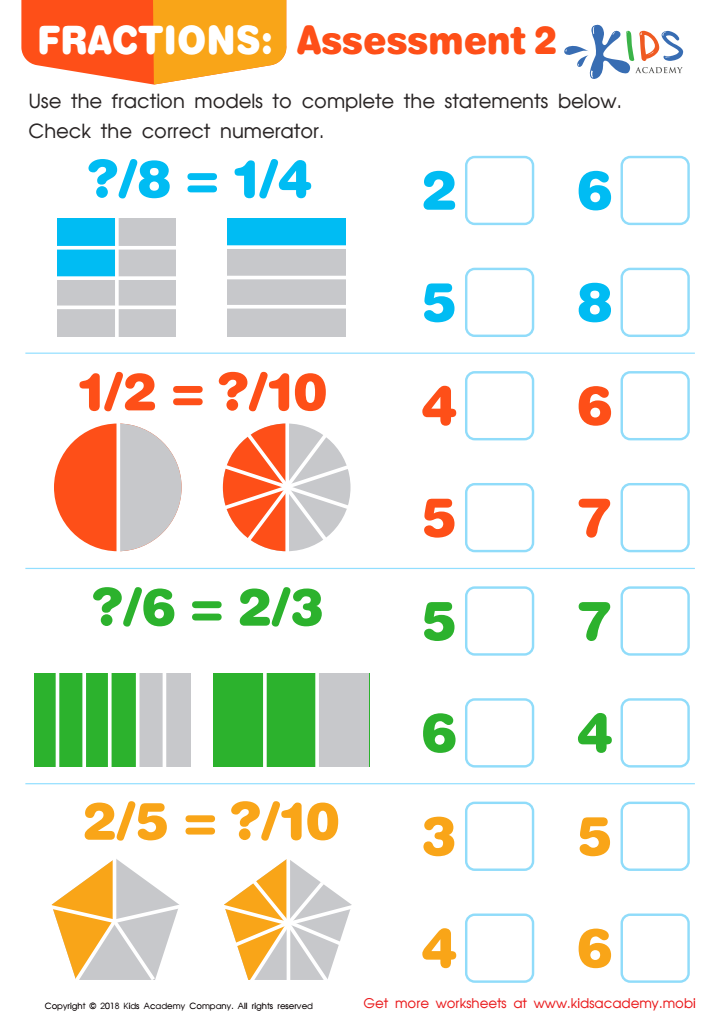
Fractions: Assessment 2 Worksheet
Help your kids understand fractions better with this worksheet. Ask them to complete the fraction statements using the fraction models on the left and then check the correct numerators. This can help clear up any confusion they may have with fractions and fraction models.
Fractions: Assessment 2 Worksheet
Worksheet
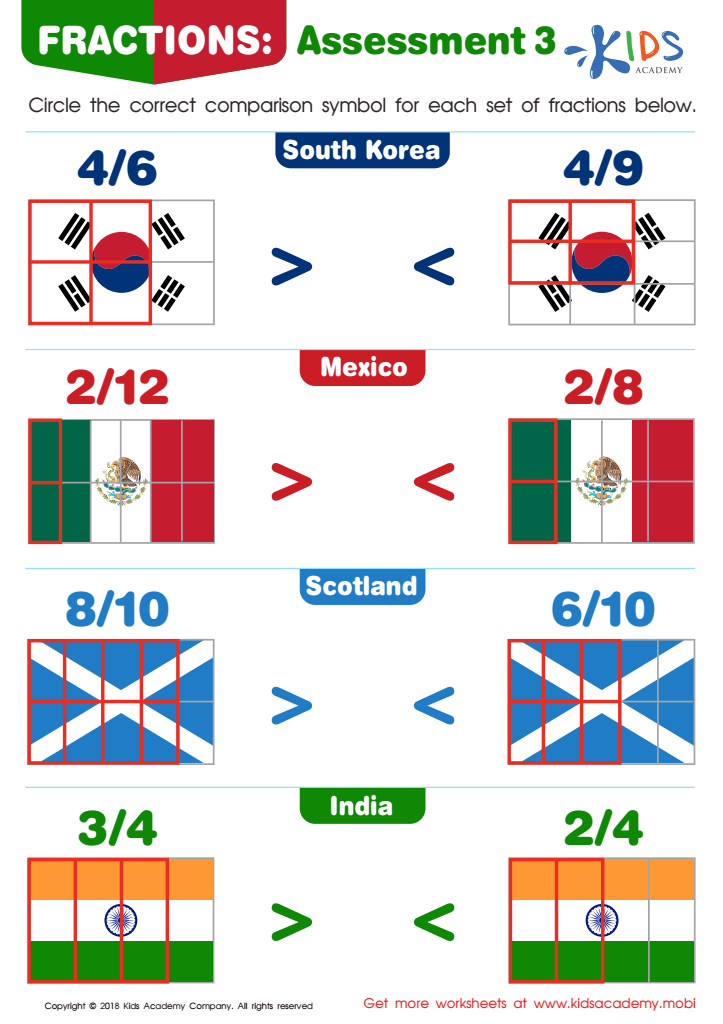
Fractions: Assessment 3 Worksheet
This worksheet helps teach kids about fractions and introduces them to countries and their flags. Have them read the country names and point to the flags. Then help them assess the fractions, and ask them to circle the symbol that shows their values.
Fractions: Assessment 3 Worksheet
Worksheet
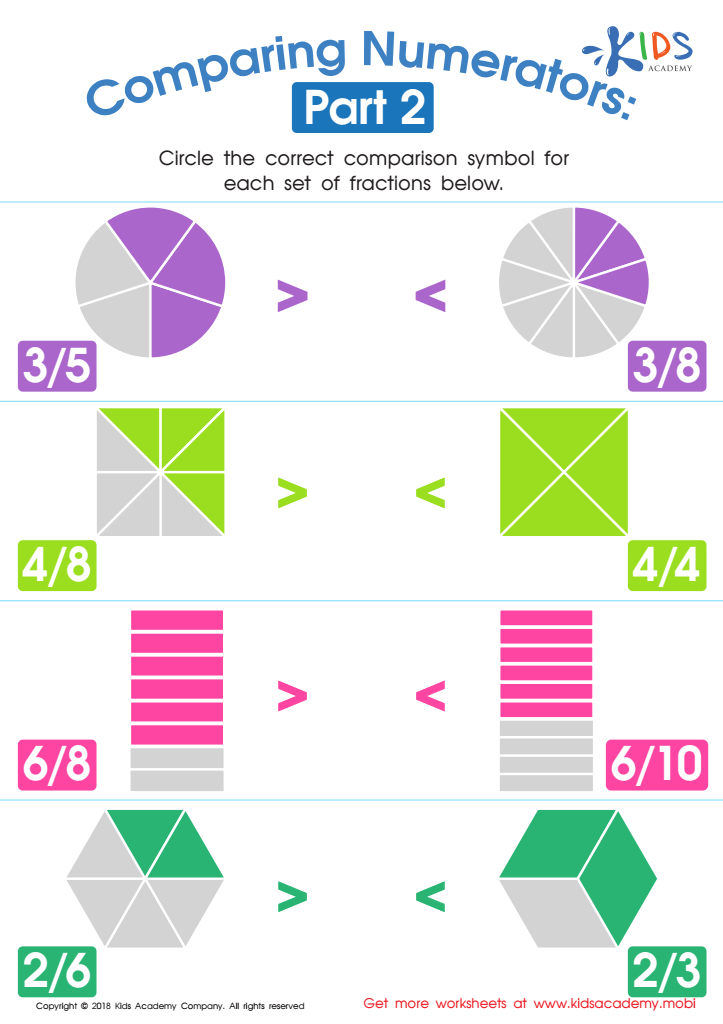
Comparing Numerators Part 2 Worksheet
Before beginning this exercise, your child should have knowledge of fractions, including counting and identifying them in shaded areas of shapes. In the pdf, they must compare two fractions in each set and circle the symbol for the larger fraction. Help them as needed.
Comparing Numerators Part 2 Worksheet
Worksheet
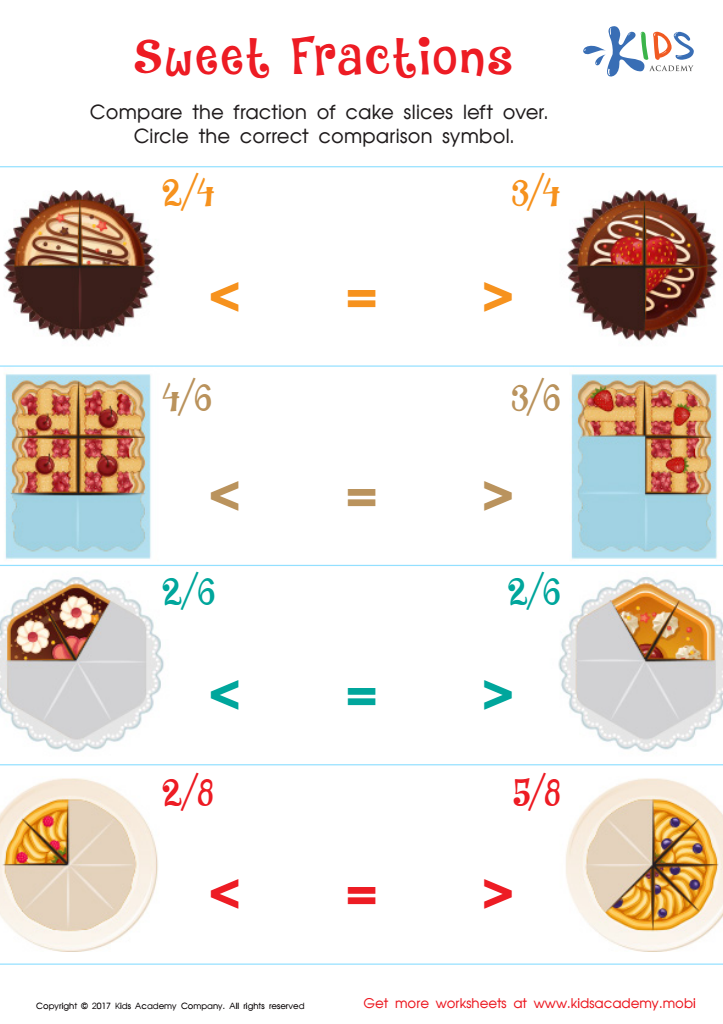
Compare Fractions Worksheet
This compare fractions worksheet is great for 3rd graders to learn and understand fractions in a fun way. Let them explore fractions visually with the help of sweet treats!
Compare Fractions Worksheet
Worksheet
Join Kids Academy for Free
Who is primarily going to use this learning content?






Understanding how to compare fractions is fundamental for third graders as it lays the groundwork for critical mathematical concepts. Parents and teachers should care about this topic because it fosters not only arithmetic skills but also enhances students' overall problem-solving abilities. Comparing fractions helps children develop a strong number sense, which is essential for handling more complex mathematical operations and concepts in later grades, such as addition, subtraction, and ratios.
By mastering fraction comparison, students learn to analyze and interpret quantitative relationships, a skill that extends beyond math. It teaches them to think logically and reason through different scenarios in everyday life. For example, they may encounter situations like cooking, budgeting, or understanding portions.
Additionally, fractions are often visualizable, making them a suitable avenue for enhancing comprehension through visual aids and manipulatives. Engaging children in activities and discussions about dividing, sharing, and measuring promotes collaborative learning and enhances communication skills.
Fostering a strong understanding of comparing fractions can also be a confidence booster. When children succeed in this area, they gain the motivation to tackle more difficult math problems and may develop a lifelong interest in mathematics. Thus, investing time and resources into teaching fractions allows both parents and educators to enrich students' academic experiences.