Filters

12 filtered results

Clear all filters
Favorites
With answer key
Interactive

12 filtered results

Difficulty Level

Grade


Subject

    Discover a treasure trove of engaging and educational Elementary Phonics worksheets designed specifically for children ages 3-8. Our collection features fun activities that help young learners master phonics skills, enhancing their reading and writing abilities. From colorful letter tracing to interactive sound-matching games, each worksheet fosters critical language development in an enjoyable way. Perfect for classroom activities or at-home learning, these resources are aligned with early literacy standards and cater to various learning styles. Empower your child’s love for reading with exciting phonics challenges that make learning delightful! Explore our printable worksheets today and watch their confidence soar!

    Check out this FREE Elementary Phonics Trial Lesson for age 3-8!

    Matching Initial Letter Sounds

    Favorites
    With answer key
    Interactive
    • Elementary Phonics
    • 3-8
    Words: Assessment 2 Worksheet
    Words: Assessment 2 Worksheet

    Words: Assessment 2 Worksheet

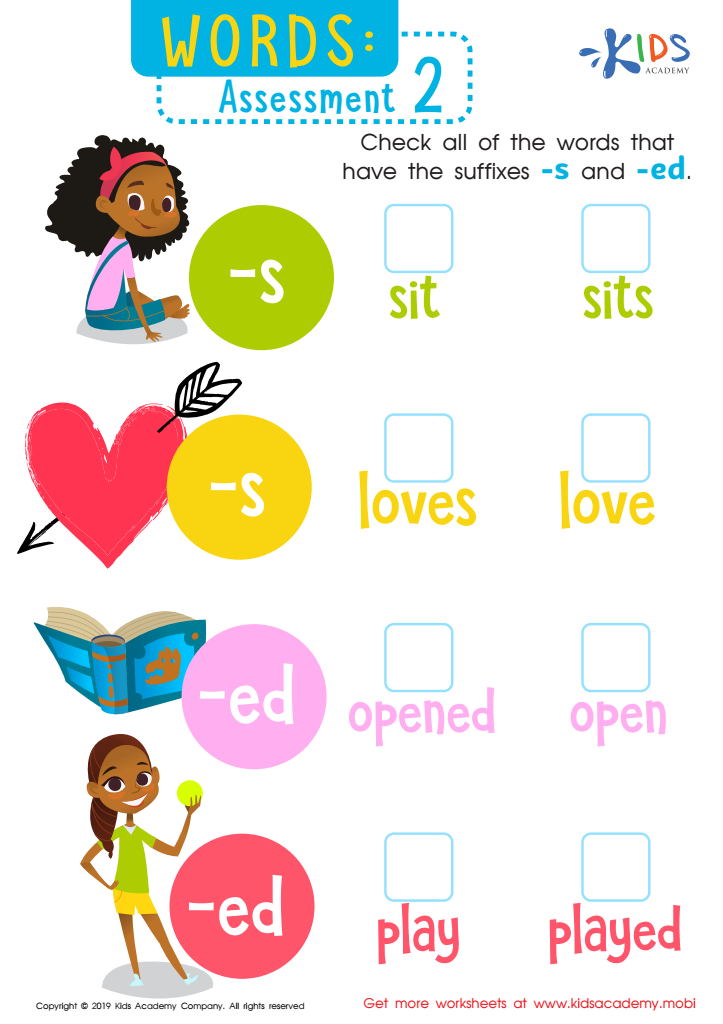
    Test your child’s knowledge of -s and -ed word endings with this fun worksheet! They'll look at images and read the words, then choose the correct suffix to finish each one. Vivid illustrations make this an enjoyable learning experience!
    Words: Assessment 2 Worksheet
    Worksheet
    Phonological Awareness: Assessment 2 ELA Worksheet
    Phonological Awareness: Assessment 2 ELA Worksheet

    Phonological Awareness: Assessment 2 ELA Worksheet

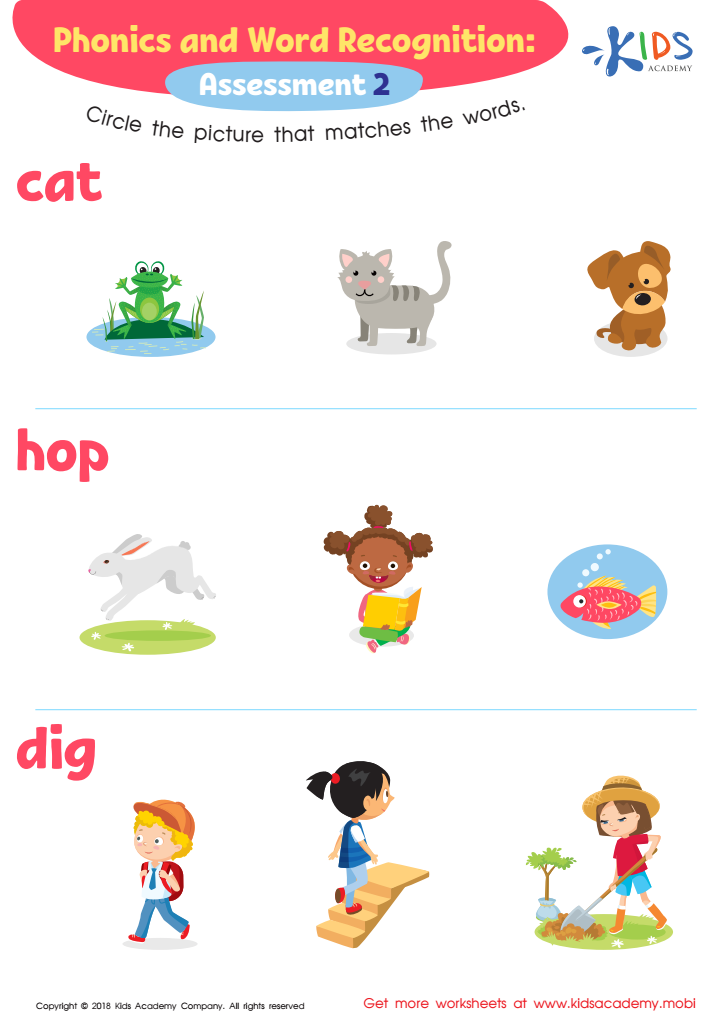
    This free worksheet assesses your emerging reader's ability to decode and match closed-syllable high-frequency words to the appropriate picture. The pictures are cheery and easy to identify, so your child will have fun and find success with decoding and matching.
    Phonological Awareness: Assessment 2 ELA Worksheet
    Worksheet
    Words: Asessment 3 Worksheet
    Words: Asessment 3 Worksheet

    Words: Asessment 3 Worksheet

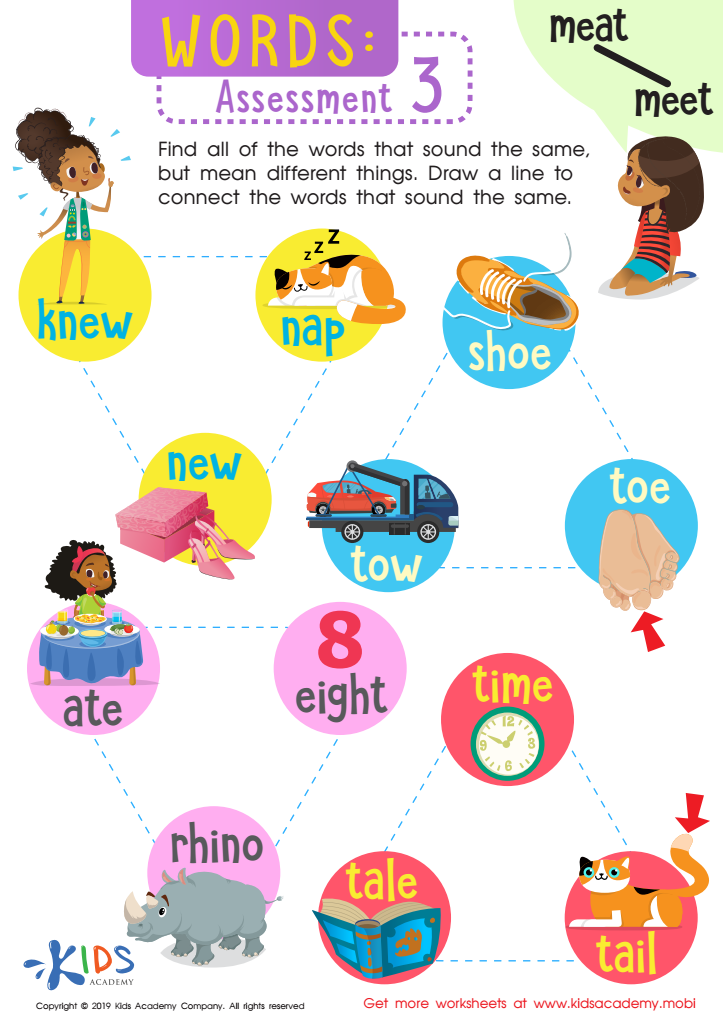
    Assess your child's knowledge of homonyms with words like "toe" and "tow". This fun worksheet helps find words that sound the same but have different meanings and spellings. Use it to introduce homographs--words spelled the same with different meanings!
    Words: Asessment 3 Worksheet
    Worksheet
    Words: Assessment 4 Worksheet
    Words: Assessment 4 Worksheet

    Words: Assessment 4 Worksheet

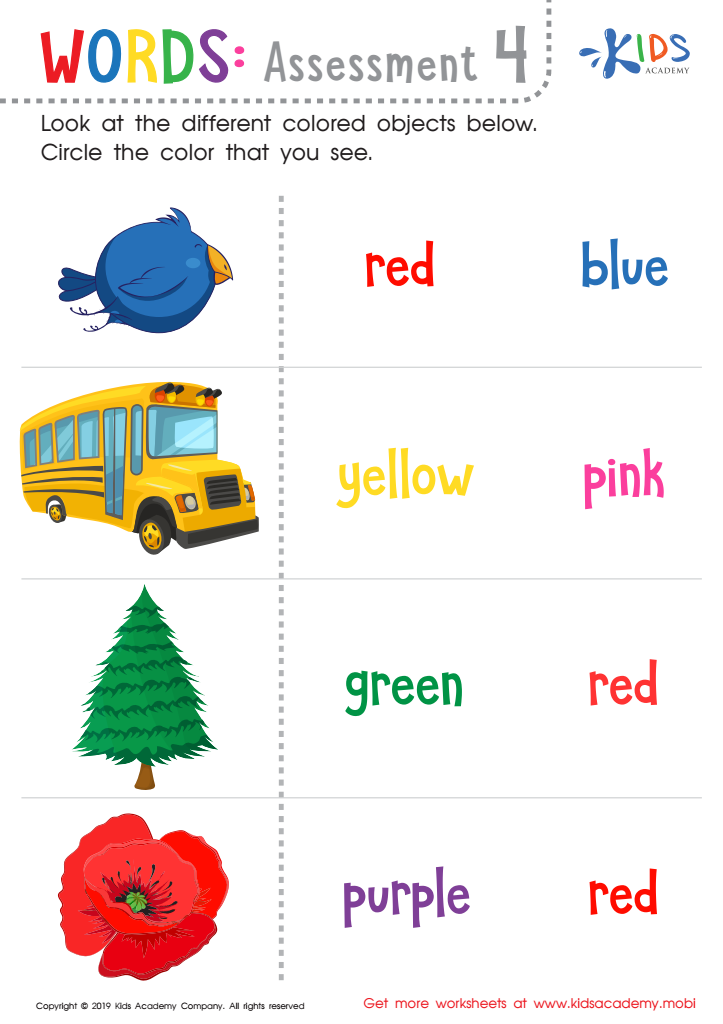
    Look at the pictures and have your child circle the color they see. This free worksheet is great for assessing their knowledge of vocabulary words. It offers familiar images with words for kids to read and match with the colors. Help your child build their reading and understanding skills with this fun activity!
    Words: Assessment 4 Worksheet
    Worksheet
    Phonological Awareness: Assessment 2 Worksheet
    Phonological Awareness: Assessment 2 Worksheet

    Phonological Awareness: Assessment 2 Worksheet

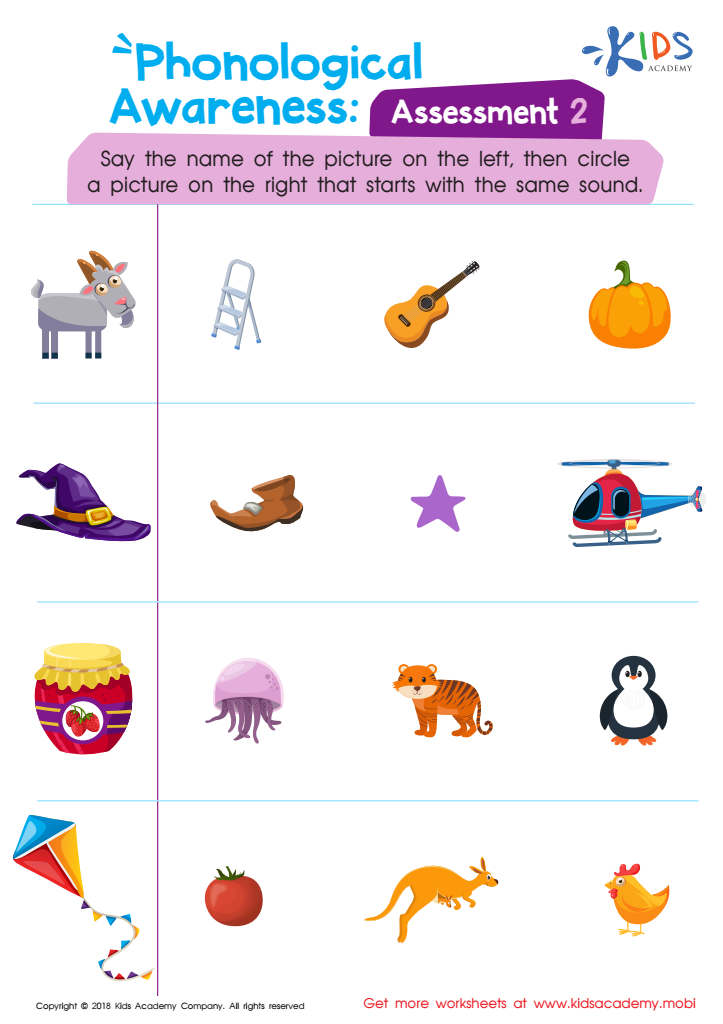
    Test your child’s phonological awareness and reading readiness with this charming worksheet! Perfect for K-1, it assesses if they can name a picture aloud, listening for the starting sound and matching it to another word. Watch as they think deeply and listen to the sounds as they name each picture. Determine if your child is ready to sound out words or needs more phonics practice.
    Phonological Awareness: Assessment 2 Worksheet
    Worksheet
    Phonological Awareness: Assessment 4 Worksheet
    Phonological Awareness: Assessment 4 Worksheet

    Phonological Awareness: Assessment 4 Worksheet

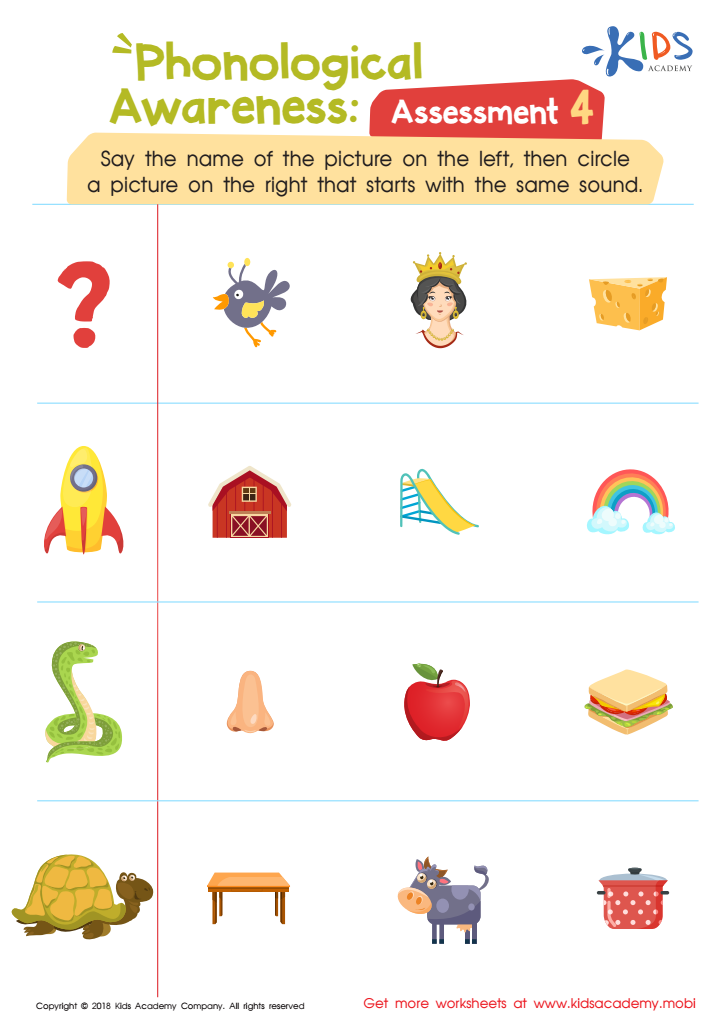
    It can be tricky for young readers to differentiate between sounds in words. Make it fun with this downloadable worksheet! Ask your child to name each picture on the left and match the starting sound with an image on the right. This helps assess their phonics skills and make learning enjoyable.
    Phonological Awareness: Assessment 4 Worksheet
    Worksheet
    Phonological Awareness: Assessment 3 ELA Worksheet
    Phonological Awareness: Assessment 3 ELA Worksheet

    Phonological Awareness: Assessment 3 ELA Worksheet

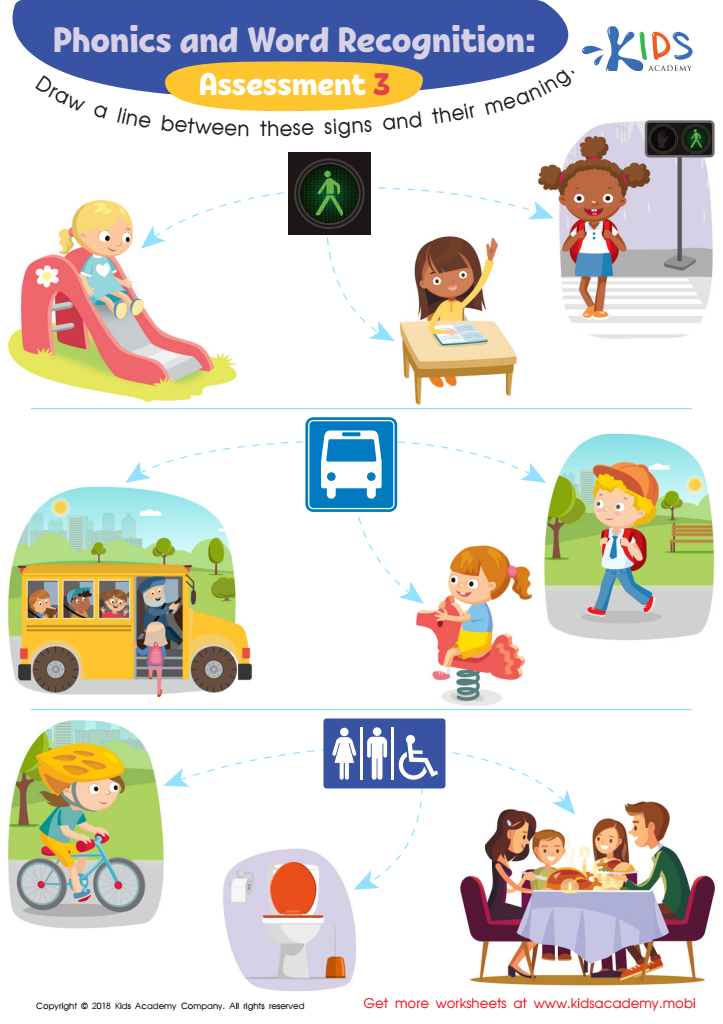
    Want to test your preschooler's language skills, phonetic decoding and word recognition? This worksheet uses their knowledge of community helpers to match signs with depictions. It also works on fine motor skills, a key pre-reading skill.
    Phonological Awareness: Assessment 3 ELA Worksheet
    Worksheet
    Phonics and Word Recognition: Assessment 1 Worksheet
    Phonics and Word Recognition: Assessment 1 Worksheet

    Phonics and Word Recognition: Assessment 1 Worksheet

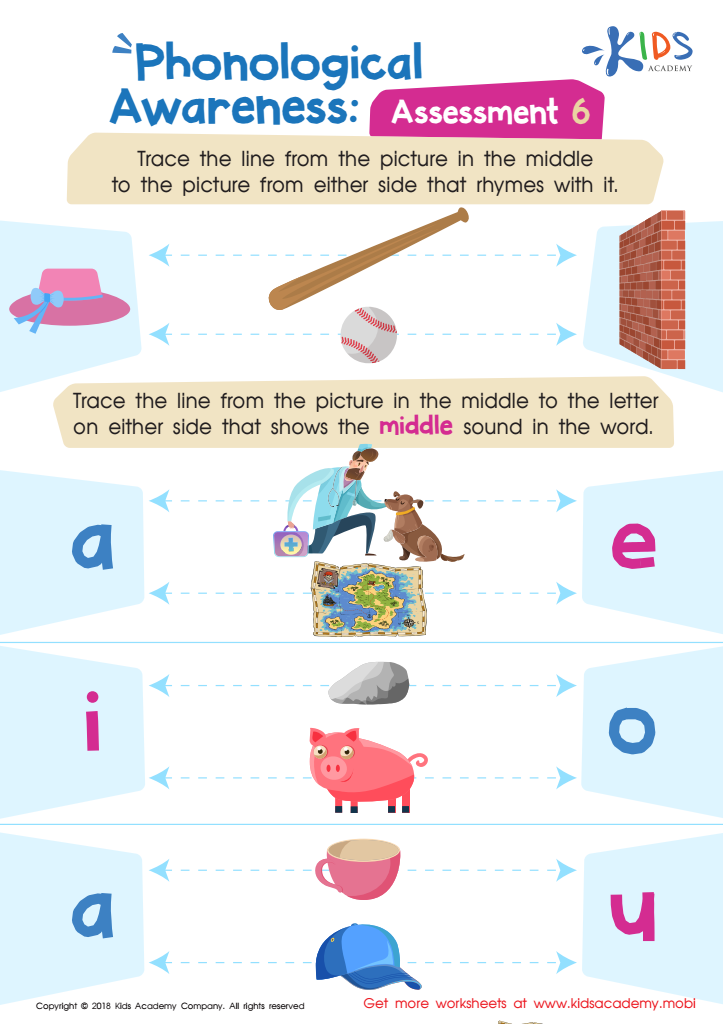
    Explain prefixes (words added to start of another word to give it a new meaning) and suffixes (added to end of word to change its meaning) to your kids with examples like 'unhappy' (prefix) and 'forgetful' (suffix). Now, help your child complete this worksheet, including circling words and checking boxes.
    Phonics and Word Recognition: Assessment 1 Worksheet
    Worksheet
    Phonological Awareness: Assessment 6 Worksheet
    Phonological Awareness: Assessment 6 Worksheet

    Phonological Awareness: Assessment 6 Worksheet

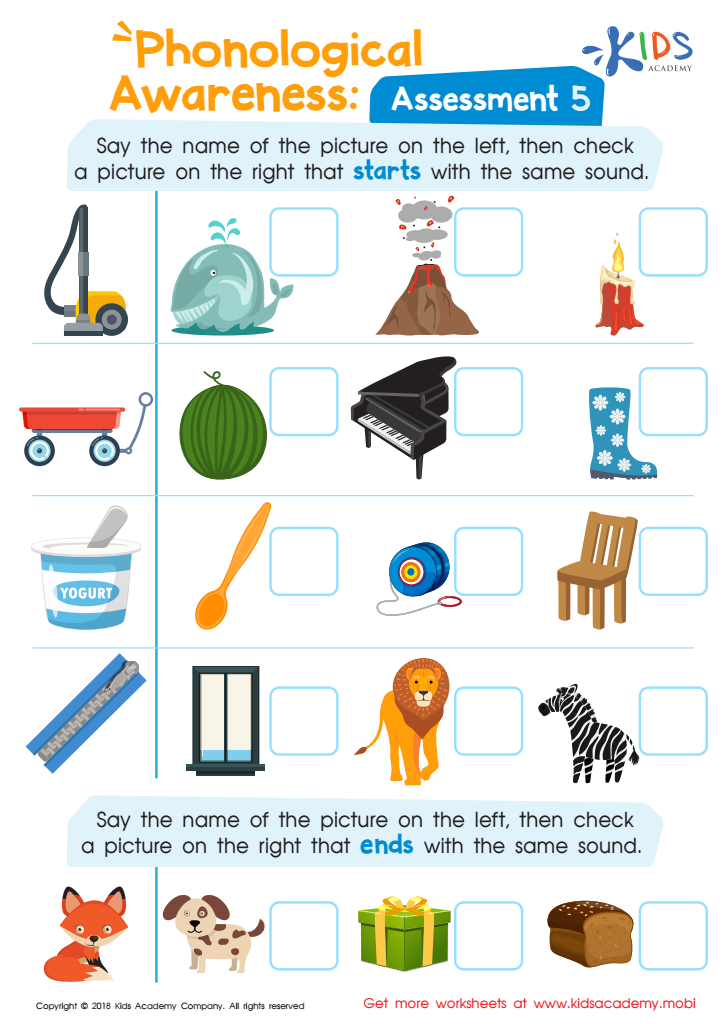
    Check your child's ability to recognize middle word sounds using this free worksheet. Help them learn phonics by practicing with rhyming. Trace the line from the image to its rhyming match then encourage them to name each image aloud to identify which letter matches the sound. It's a great way to assess letter and sound recognition.
    Phonological Awareness: Assessment 6 Worksheet
    Worksheet
    Phonological Awareness: Assessment 5 Worksheet
    Phonological Awareness: Assessment 5 Worksheet

    Phonological Awareness: Assessment 5 Worksheet

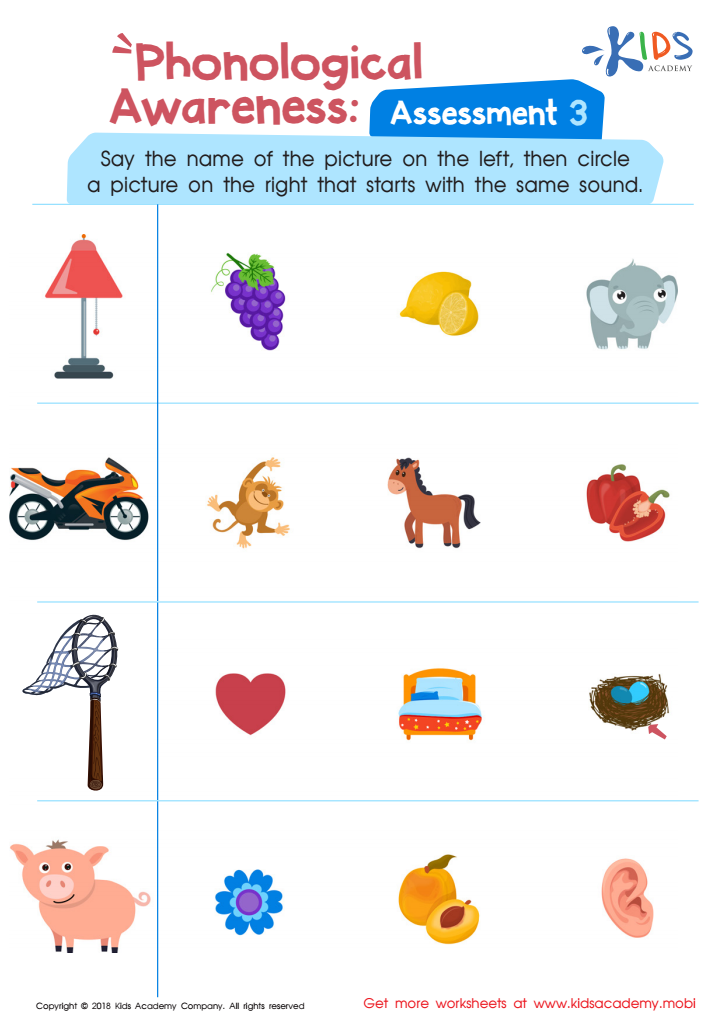
    Repetition is key to success! This worksheet tests kids' ability to match beginning and ending sounds in words. Instruct them to say each word and listen closely to the sounds they make. Focus on the starting sounds for the first four pics, then the last one to hear ending sounds and find the right match!
    Phonological Awareness: Assessment 5 Worksheet
    Worksheet
    Phonological Awareness: Assessment 3 Worksheet
    Phonological Awareness: Assessment 3 Worksheet

    Phonological Awareness: Assessment 3 Worksheet

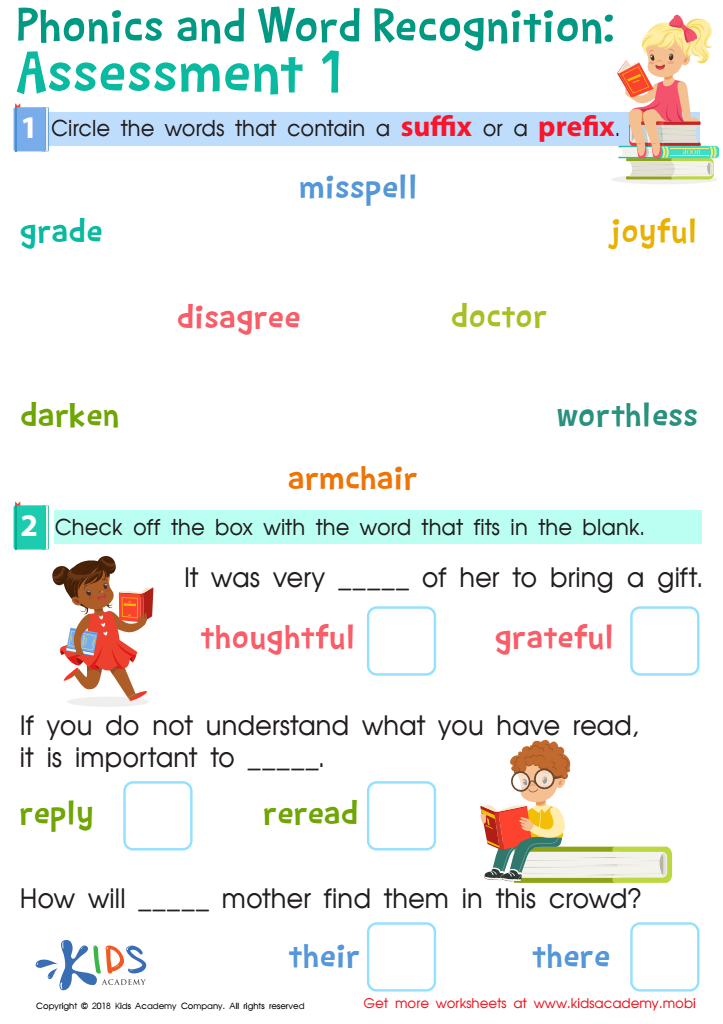
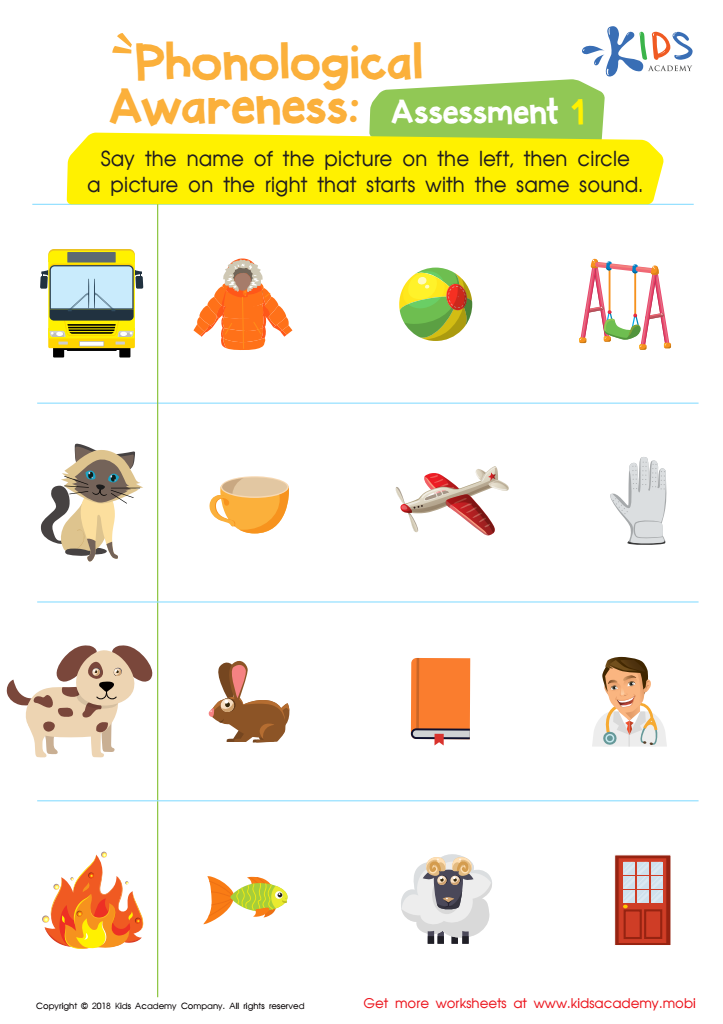
    Test kids' reading readiness with a phonological awareness worksheet! With this PDF exercise, encourage children to name each picture aloud and match left to right. Help them learn to recognize word sounds at the start, middle and end of words. They'll be sure to remember that lamp doesn't sound like elephant!
    Phonological Awareness: Assessment 3 Worksheet
    Worksheet
    Phonological Awareness: Assessment 1 Worksheet

    Phonological Awareness: Assessment 1 Worksheet

    Phonological Awareness: Assessment 1 Worksheet
    This worksheet helps kids build key phonics skills for pre-reading. They say each picture name aloud, focusing on the starting sound. Then, they match the sound with an image in the same row. Use as a checkpoint for kindergarten or grade 1 phonics readiness.
    Phonological Awareness: Assessment 1 Worksheet
    Worksheet


    Elementary phonics activities for ages 3-8 are crucial in laying the foundation for a child’s literacy development. During these formative years, children are developing essential skills that will support their future reading and writing abilities. Phonics—understanding the relationship between sounds and letters—helps children decode words, which is vital for reading fluency.

    Parents and teachers should care about phonics activities because they directly influence a child’s confidence and enthusiasm toward learning. Engaging activities, such as rhyming games, letter-sound matching, and interactive storytelling, create a fun and stimulating environment that fosters a love for reading. When children master phonics, they are better equipped to tackle more complex texts by recognizing phonetic patterns and improving their spelling abilities.

    Moreover, early phonics instruction can help identify and address potential learning challenges. By monitoring progress through these activities, parents and teachers can provide tailored support, ensuring that each child develops at their own pace. Ultimately, effective phonics education not only enhances literacy but also paves the way for academic success, social growth, and cognitive development, reinforcing the importance of investing time and resources in these activities during the early years.