
Basic subtraction skills Worksheets for Ages 3-5
3 filtered results
Difficulty Level
Grade
Age
-
From - To
Subject
Activity
Standards
Welcome to our Basic Subtraction Skills Worksheets for Ages 3-5! Designed specifically for young learners, these engaging worksheets introduce the core concept of subtraction in a fun and interactive way. Through coloring, counting, and visual aids, children will develop essential math skills while enjoying hands-on activities. Our worksheets cater to various skill levels, ensuring that each child can learn at their own pace. Perfect for use at home or in the classroom, these printable resources will help your little ones build confidence in their mathematical abilities. Start your child's journey to mastering subtraction today with our delightful and educational worksheets!
Favorites
With answer key
Interactive
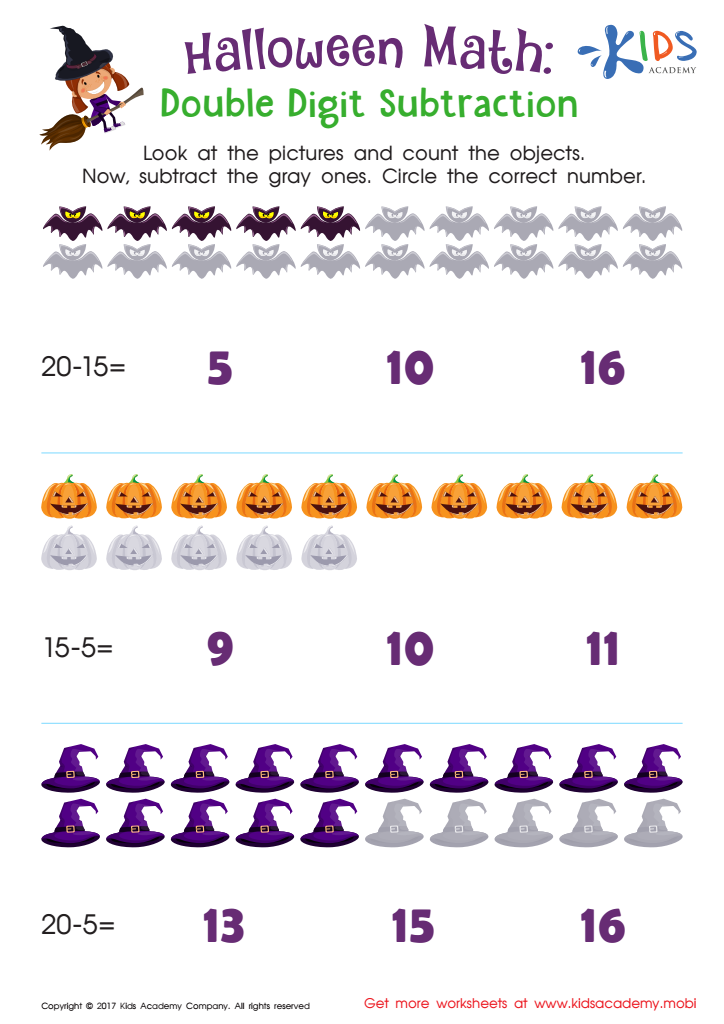
Halloween Math Subtraction Worksheet
Kids can easily understand subtraction by using the visuals provided in this worksheet. Get ready for some fun math!
This Halloween math worksheet uses spooky images to help kids understand subtraction. With it, they can count and solve double digit problems more easily. Get ready for some fun and engaging math practice!
 Assign to My Students
Halloween Math Subtraction Worksheet
Worksheet
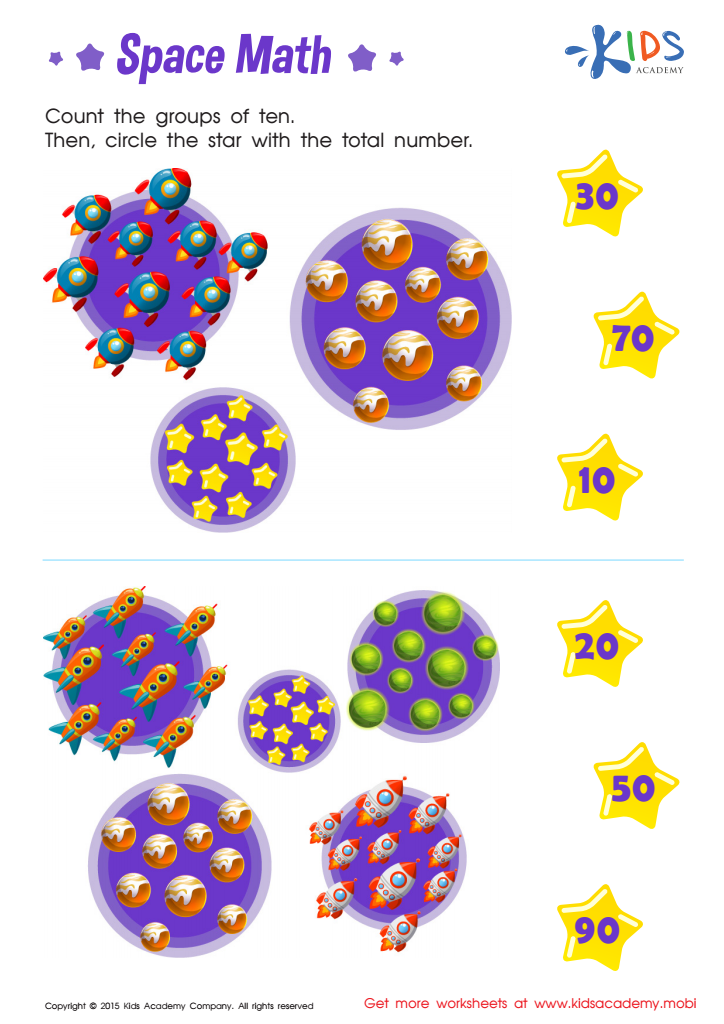
Learn dozens: Space math Worksheet
This worksheet uses Singapore Math's approach to help your child visually understand basic counting and math problems.
Learn dozens: Space math Worksheet
Worksheet
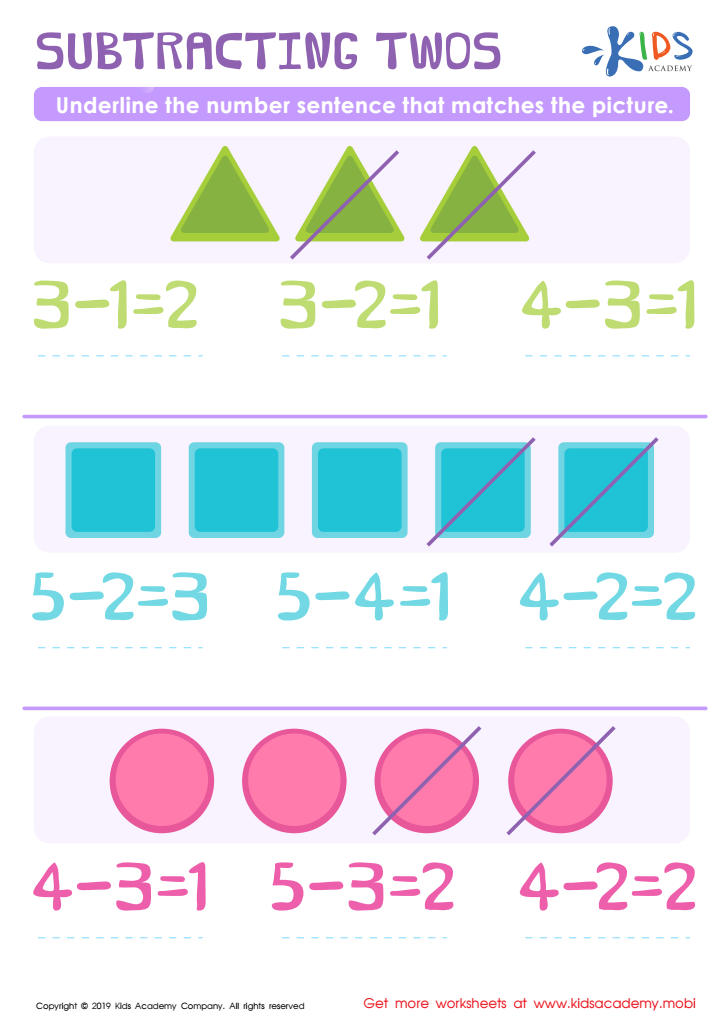
Subtracting Twos Worksheet
Help your children learn the basics of math with this worksheet. It has three number sentences they can match up with the pictures. Start by making math an enjoyable subject and help your kids underline the equation that matches up. This will give them a strong foundation to build on for the rest of their math journey.
Subtracting Twos Worksheet
Worksheet
Join Kids Academy for Free
Who is primarily going to use this learning content?








Basic subtraction skills for children ages 3-5 are crucial for several reasons. Firstly, early mathematical understanding provides a strong foundation for future learning. Subtraction teaches children the concept of "taking away," which is fundamental not only in math but also in everyday life situations, such as sharing or understanding quantities. At this stage, children are naturally curious, and engaging them in simple subtraction activities can turn learning into a fun and interactive experience.
Furthermore, developing subtraction skills enhances cognitive abilities. It encourages problem-solving, critical thinking, and boosts memory retention as children learn to manipulate numbers and understand relationships between them. Socially and emotionally, as children tackle simple subtraction problems, they experience a sense of achievement and boost their confidence when they succeed.
Moreover, supporting subtraction skills helps parents and teachers identify areas where additional support may be needed. With early intervention, any learning gaps can be addressed before they widen. Ultimately, nurturing basic subtraction skills not only prepares children for more complex mathematical concepts in later years but also fosters a lifelong love for learning and discovery. Thus, fostering early subtraction skills is an investment in a child's holistic development.








