Pattern recognition Geometry Worksheets for Ages 3-5
3 filtered results
-
From - To
Introduce your little one to the beautiful world of geometry with our Pattern Recognition Geometry Worksheets for ages 3-5! Perfectly designed to captivate young minds, these engaging worksheets help children identify and complete patterns using basic shapes and vibrant colors. By fostering early math and critical thinking skills, our exercises ensure your child experiences both fun and educational growth. Whether at home or in the classroom, these resources provide a solid foundation for future learning. Explore our collection at Kids Academy and watch as your child’s confidence and abilities flourish through the joy of patterns and geometry!
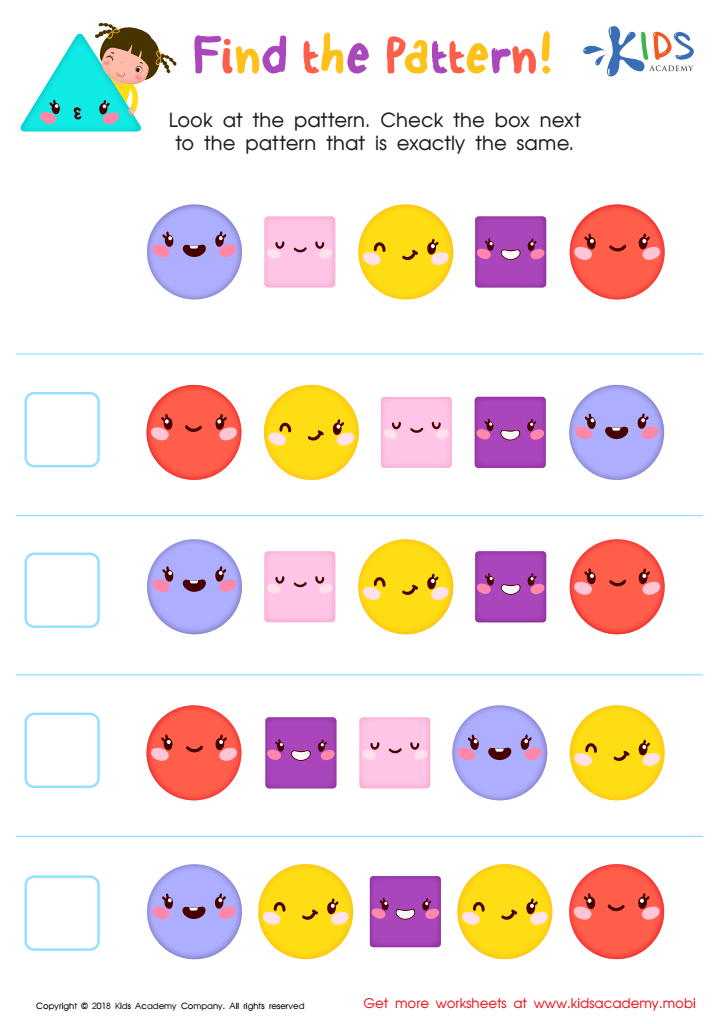
Find the Pattern Worksheet
 Assign to My Students











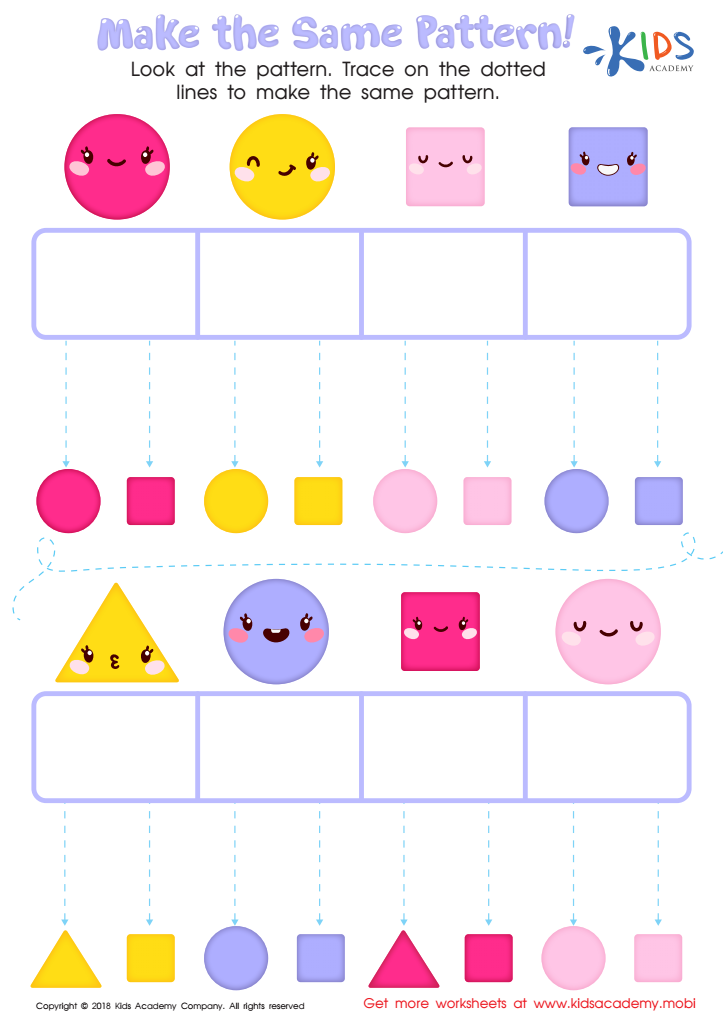
Make the Same Pattern Worksheet
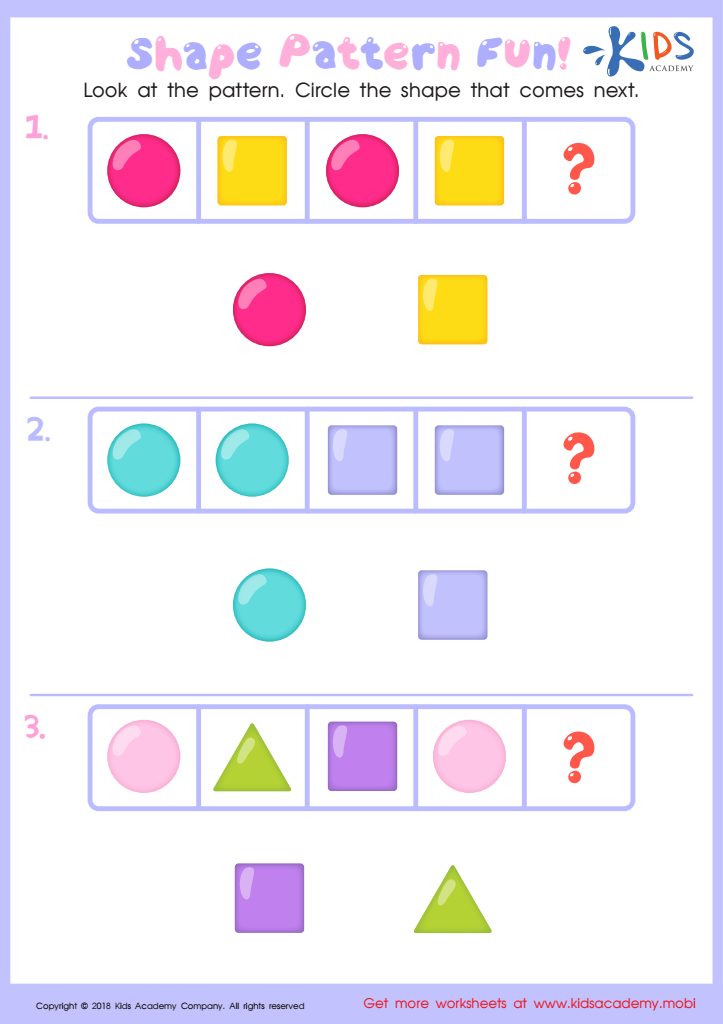
Shape Pattern Fun Worksheet








Pattern recognition and geometry play a crucial role in the cognitive and mathematical development of children aged 3-5. At this formative stage, helping children recognize patterns helps enhance their abilities to make predictions and understand sequences, foundational skills for algebraic thinking later on. Pattern recognition fosters critical thinking and problem-solving abilities, as children learn to identify, reproduce, extend, and create their own patterns.
Additionally, introducing geometric concepts allows children to begin comprehending shapes, sizes, positions, and spatial relationships. Recognizing shapes and understanding geometric properties lays the groundwork for more complex mathematical reasoning. When children explore geometry, they develop visual-spatial awareness, which is fundamental for subjects like math, science, engineering, art, and architecture.
Moreover, engaging with patterns and geometric concepts can enhance fine motor skills through activities that involve drawing shapes, fitting blocks together, or sorting objects. Such tasks also boost vocabulary as children learn terms related to shapes, positions, and pattern descriptions, thereby supporting their language development.
Overall, integrating pattern recognition and geometry into early childhood education cultivates a strong foundation for later academic success, nurtures problem-solving skills, and supports cognitive development, making it an essential focus for parents and teachers alike. By valuing these early mathematical experiences, adults help children build confidence and curiosity in exploring the world around them.








