
Visual perception improvement Geometry Worksheets for Ages 3-6
3 filtered results
Difficulty Level
Grade
Age
-
From - To
Subject
Activity
Standards
Enhance your child's visual perception skills with our engaging Geometry Worksheets, specifically designed for ages 3-6. These worksheets provide a fun and interactive way for young learners to explore shapes, patterns, and spatial awareness. By working on visual perception activities, children will develop crucial skills essential for math readiness and overall cognitive development. Our carefully crafted worksheets encourage creativity and critical thinking while supporting early math foundations. Discover a variety of exercises that promote recognition, discrimination, and organization of visual information. Set your child on the path to success in a playful and enriching way with our visual perception improvement resources!
Favorites
With answer key
Interactive
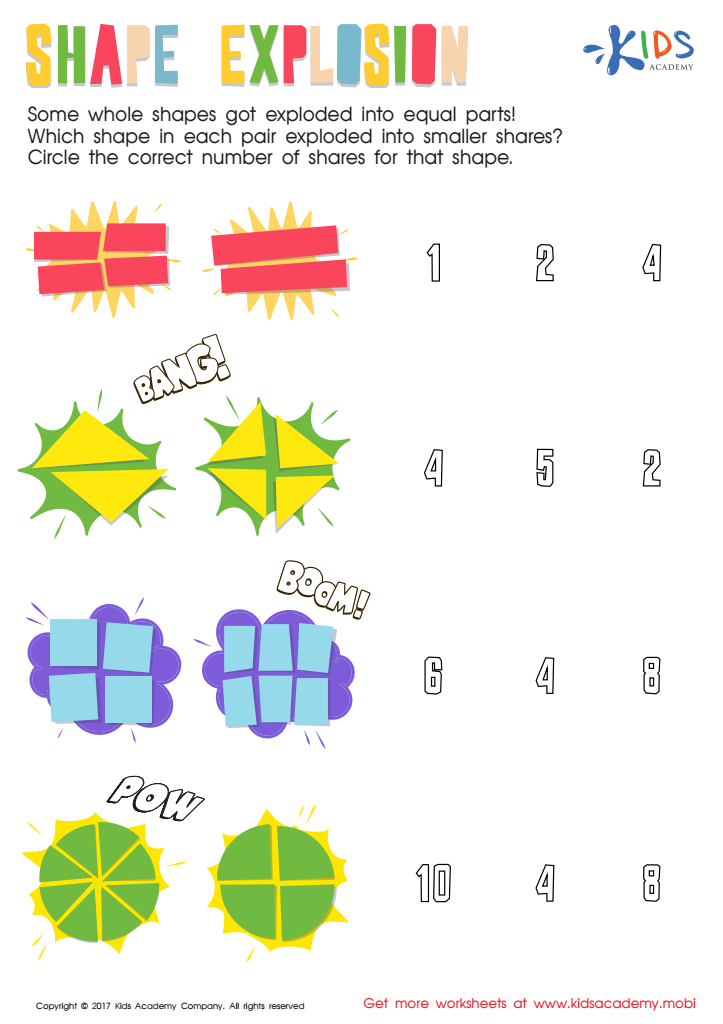
Shape Explosion Worksheet
This worksheet shows students how some shapes explode into two or more equal parts. On the left side are four shapes, each splitting into two or more parts. Ask your child to point out which shape has the smaller share, and help them circle the correct number of shares.
 Assign to My Students
Shape Explosion Worksheet
Worksheet











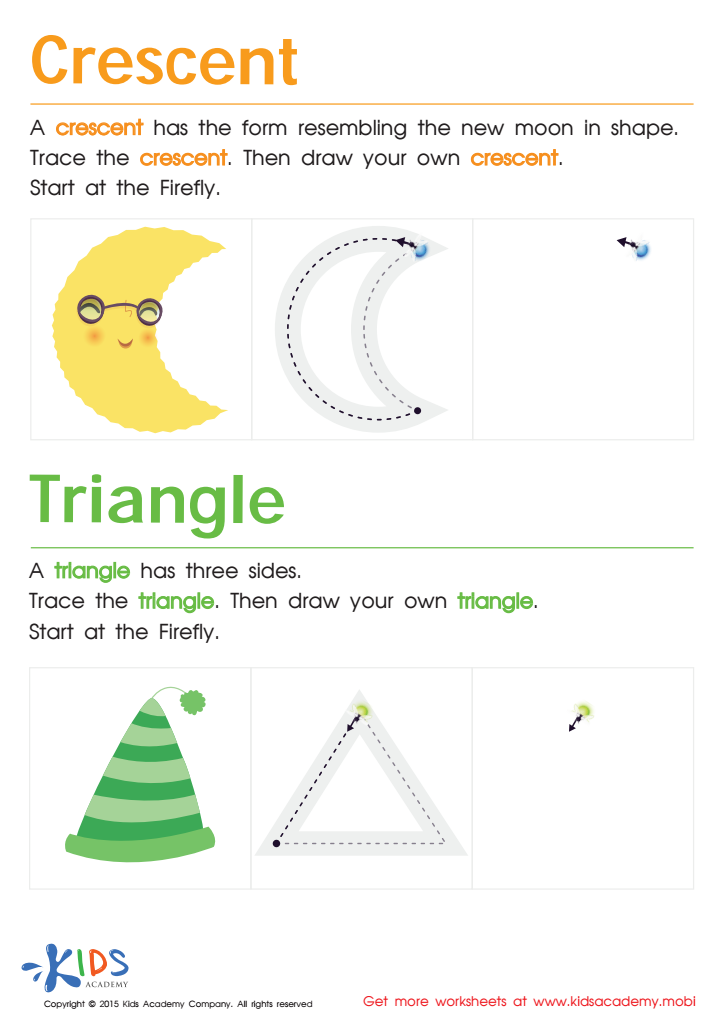
Learning to Draw Crescents And Triangles Worksheet
Help your kids draw a crescent and triangle with this free printable worksheet! Start by tracing a crescent in the form of the new moon, and then teach them that a triangle has three sides and looks like a hat. Find more geometry practice worksheets at Kids Academy!
Learning to Draw Crescents And Triangles Worksheet
Worksheet
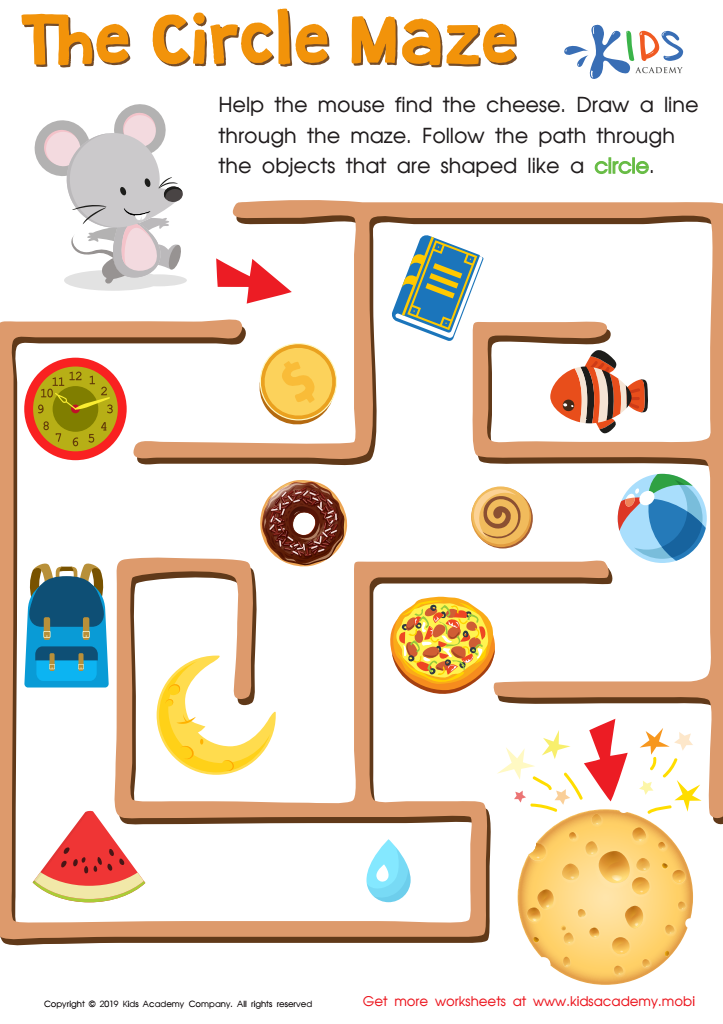
The Circle Maze Worksheet
Kids can have fun learning shapes with this maze worksheet. They can help the mouse find its cheese by tracing the path of a circle through the maze. This printable is great for classroom learning or as an activity at home.
The Circle Maze Worksheet
Worksheet
Join Kids Academy for Free
Who is primarily going to use this learning content?








Visual perception is foundational for young children, especially in geometry, as it forms the basis for understanding shapes, spatial relationships, and problem-solving. For children aged 3-6, enhancing visual perception through geometric activities not only supports cognitive development but also lays the groundwork for future mathematical skills. Improved visual perception enables children to recognize shapes and patterns, which is essential for early mathematical concepts like counting and basic operations.
Engaging children in geometry helps develop critical thinking and analytical skills, encouraging them to classify, compare, and manipulate objects. Active participation in geometrical tasks stimulates brain development and enhances fine motor skills, contributing to overall academic readiness.
Furthermore, visual perception influences children’s ability to follow directions, comprehend spatial language, and perform tasks requiring hand-eye coordination, all vital for their learning journey. By prioritizing activities that improve visual perception in geometry, teachers and parents foster a love for mathematics while promoting spatial awareness, problem-solving skills, and creativity.
Ultimately, investing time and resources to enhance visual perception skills helps children become confident learners, ready to tackle more complex academic challenges as they progress through their education. This early investment assures that they will be better prepared for future mathematical concepts and applications.








