
Fraction simplification Reading Worksheets for Ages 3-7
12 filtered results
Difficulty Level
Grade
Age
-
From - To
Subject
Activity
Standards
Discover our engaging Fraction Simplification Reading Worksheets designed specifically for ages 3-7! These interactive and colorful resources make learning about fractions simple and fun. Our worksheets encourage young learners to recognize and simplify fractions through enjoyable reading activities. With age-appropriate exercises tailored to foster early math skills, children will develop a strong foundational understanding of fractions while enhancing their reading abilities. Perfect for classroom settings or at-home learning, our worksheets promote critical thinking and problem-solving in young minds. Start your little ones on the path to math success with our Fraction Simplification Reading Worksheets today!
Favorites
With answer key
Interactive
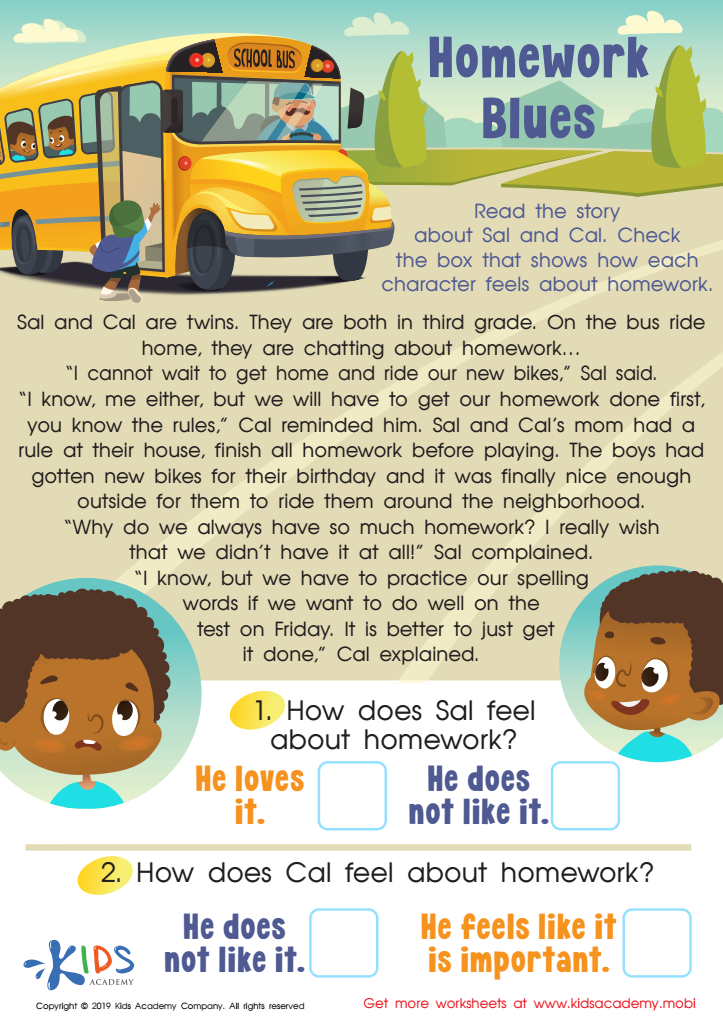
Homework Blues Worksheet
Cal and Sal don't love doing homework, just like your kids. Use this worksheet to help your children understand why homework is important. Read the passage together and then answer the questions at the bottom of the page. It's a fun way to learn together!
 Assign to My Students
Homework Blues Worksheet
Worksheet
Join Kids Academy for Free
Who is primarily going to use this learning content?







Fraction simplification at an early age serves as a crucial foundation for mathematical understanding and reasoning. For children aged 3-7, this concept introduces the idea of parts of a whole, nurturing a fundamental comprehension of numbers and their relationships. Parents and teachers should care because early mastery of fractions promotes critical thinking skills and enhances cognitive development.
At this age, children are naturally curious and open to exploring numerical concepts through play and interactive learning. Introducing fraction simplification can be both fun and educational, using tangible items like fruits or toys to visualize mathematical principles. This hands-on approach can make learning enjoyable while fostering an appreciation for math.
Moreover, understanding fractions sets the stage for more advanced mathematical concepts in later grades. It encourages children to recognize patterns, develop problem-solving strategies, and enhance their analytical thinking. Simplified fractions are especially relevant as they relate to everyday activities, from cooking to sharing.
Ultimately, engaging children with fractions early promotes a positive attitude towards mathematics, helps build confidence, and lays a strong groundwork for lifelong learning. By focusing on this foundational skill, parents and teachers empower children to explore and understand the world numerically.








