Pattern recognition Geometry Worksheets for Ages 4-5
3 filtered results
-
From - To
Discover our engaging Pattern Recognition Geometry Worksheets designed for children ages 4-5! These interactive worksheets make learning fun and provide young learners with the opportunity to explore shapes, colors, and patterns. Our carefully crafted activities support cognitive development and prepare preschoolers for future mathematical concepts. Children will practice identifying, extending, and creating patterns while enhancing their fine motor skills. With vibrant illustrations and simple instructions, these worksheets foster creativity and independent thinking. Perfect for both classroom settings and at-home learning, our Pattern Recognition Geometry Worksheets are an essential tool for nurturing early math skills in a playful environment. Start the adventure today!
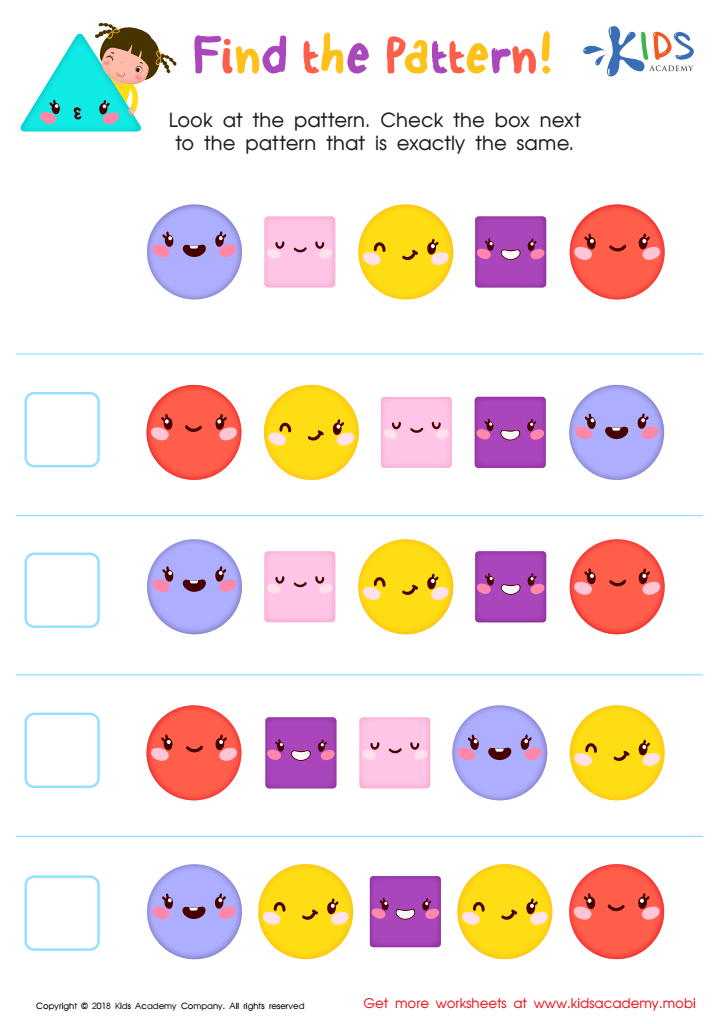
Find the Pattern Worksheet
 Assign to My Students











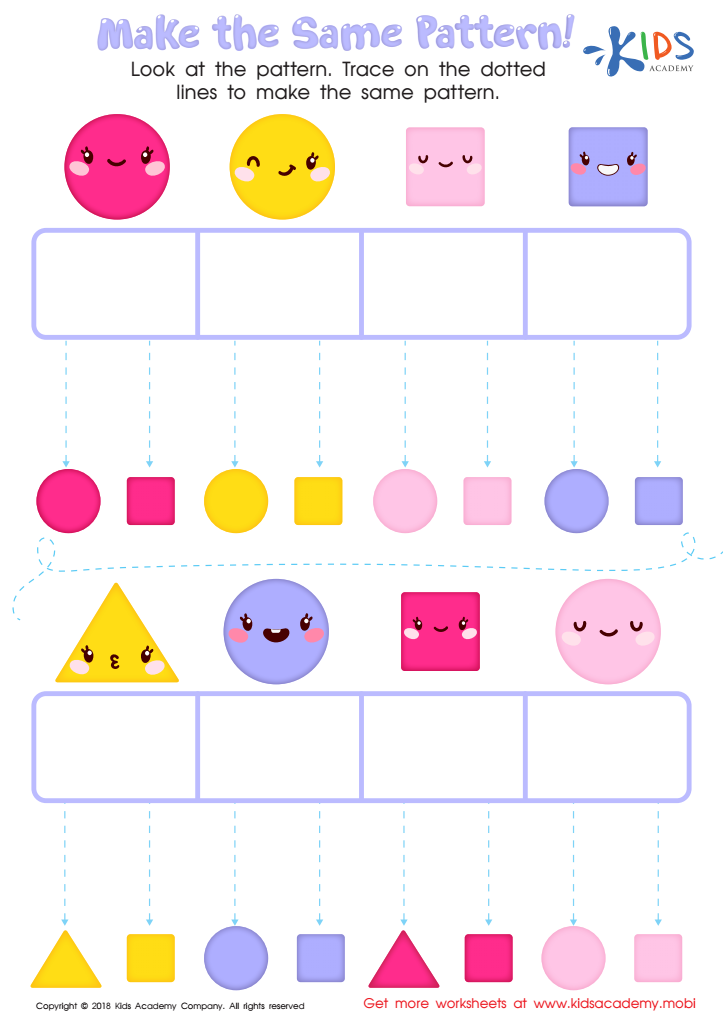
Make the Same Pattern Worksheet
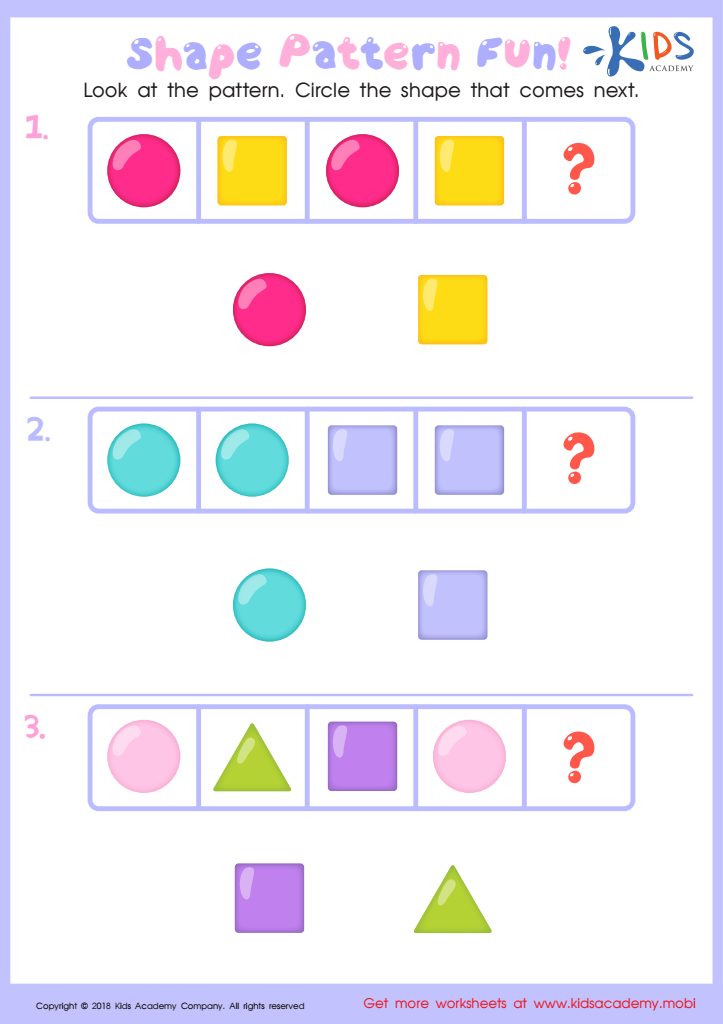
Shape Pattern Fun Worksheet








Pattern recognition in geometry is a critical skill for children ages 4-5 as it forms the foundation for more complex mathematical reasoning and problem-solving later in life. At this formative age, children are naturally curious and highly receptive to learning through play and exploration. Engaging them in pattern recognition helps develop their cognitive skills, enabling them to identify, predict, and create patterns using shapes, colors, and spatial relationships.
Understanding geometric patterns not only enhances children's math skills but also sharpens their critical thinking and observational skills. It encourages them to recognize relationships between objects, fostering an early appreciation for logic and structured thinking. This helps lay the groundwork for advanced concepts such as symmetry, sequencing, and even early algebraic thinking.
Furthermore, children's engagement in recognizing patterns can be bridged into multiple subjects, connecting math to art, music, and real-world problem-solving. Teachers and parents play a crucial role in nurturing this skill through supportive activities like sorting, building, and interactive games, creating a rich educational environment. Ultimately, fostering pattern recognition in young learners cultivates a love for learning and empowers them to tackle broader educational challenges in the future.








