
Spatial awareness Science Worksheets for Ages 4-5
3 filtered results
Difficulty Level
Grade
Age
-
From - To
Subject
Activity
Standards
Unlock the potential of your child's early math and science skills with our "Spatial Awareness Science Worksheets for Ages 4-5". Tailored to foster foundational geometric understanding, these engaging worksheets help young learners recognize shapes, patterns, and positional vocabulary in everyday scenarios. Featuring colorful illustrations and hands-on activities, they make spatial reasoning fun, promoting critical thinking and problem-solving abilities. Perfect for classrooms or at-home learning, our worksheets are a key resource in preparing kids for future academic success. Bring a world of discovery and excitement to your child's learning journey by exploring our spatial awareness worksheets today!
Favorites
With answer key
Interactive
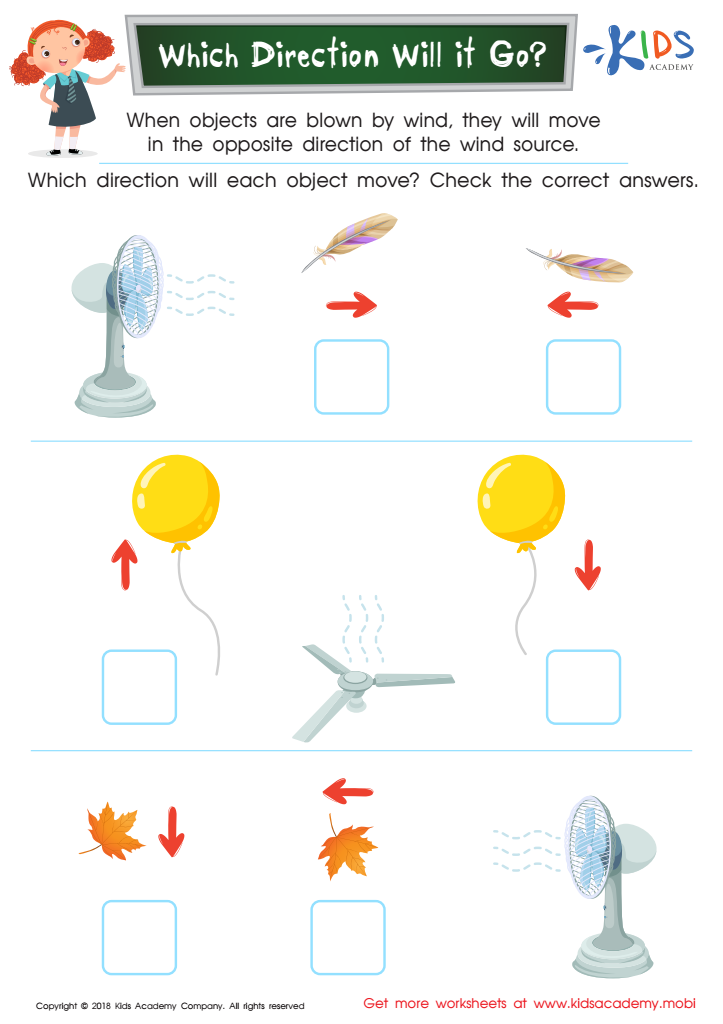
Which Direction Will it Go? Worksheet
Explain to your students: when objects are blown by wind, they will move in the opposite direction. In the worksheet, there are pictures of wind sources and objects being blown by the wind. Ask your child to identify and check the direction each object will move.
 Assign to My Students
Which Direction Will it Go? Worksheet
Worksheet
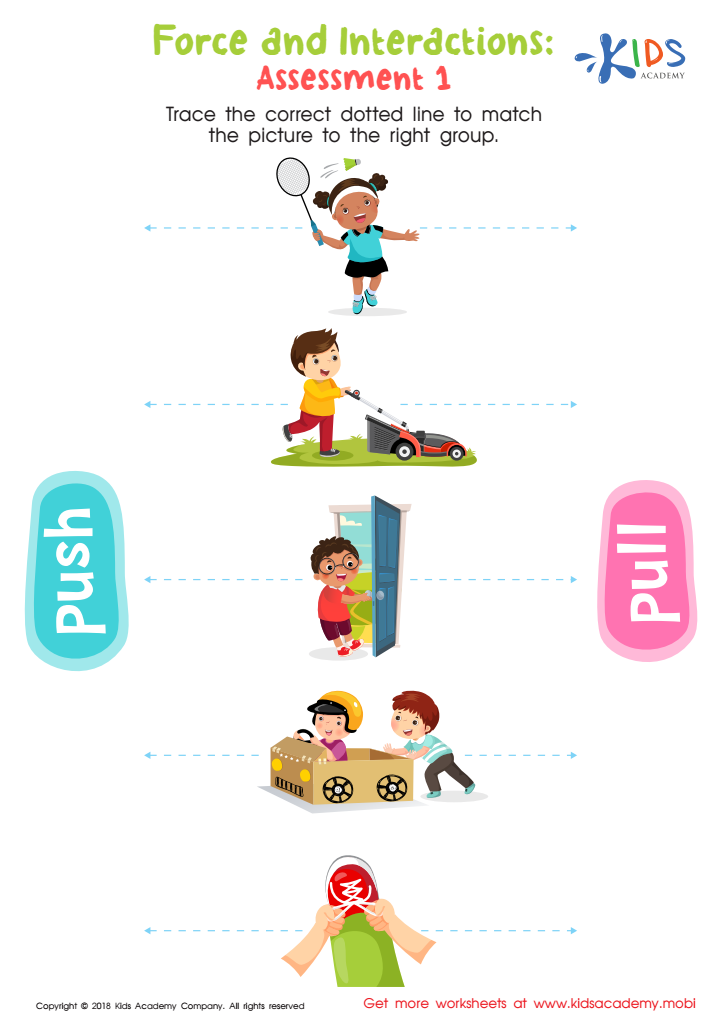
Force and Interactions: Assessment 2 Worksheet
Help your child see the difference between push and pull with this fun worksheet. Ask them to match each picture to the right group. The "push" is on the left and the "pull" is on the right. Assist them in tracing the activities and explain what it is the people are doing.
Force and Interactions: Assessment 2 Worksheet
Worksheet
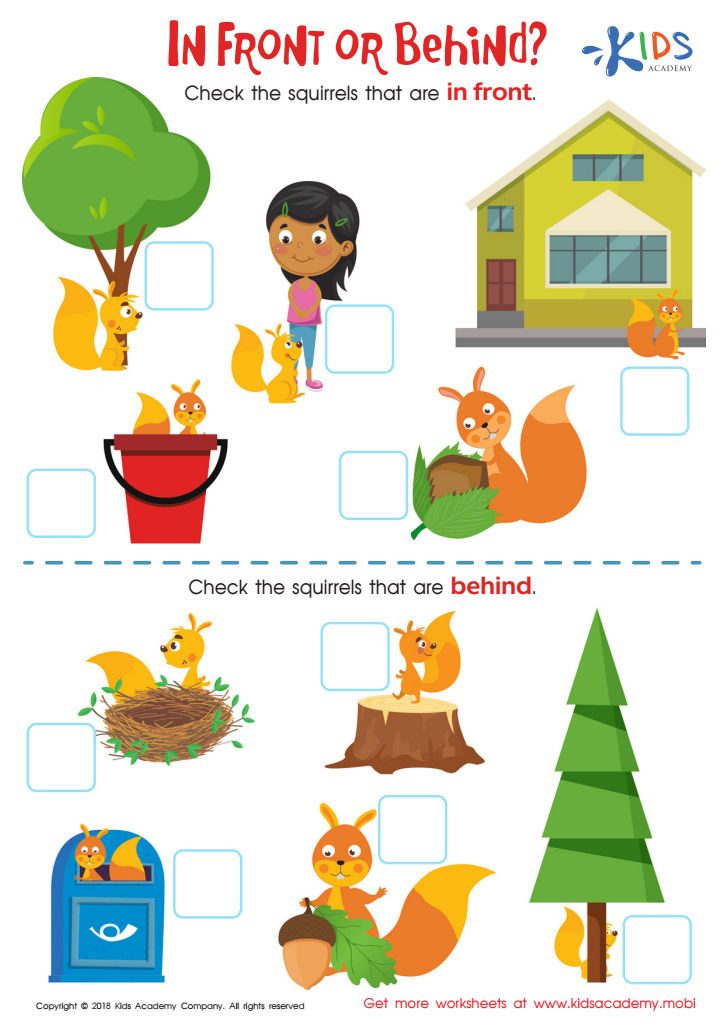
In Front or Behind: Part 2 Worksheet
Teach positional words "front" and "behind" with this fun worksheet! Students identify where the squirrel is in relation to the object - in front or behind. It's a great exercise to practice early geometry skills and understanding object movement.
In Front or Behind: Part 2 Worksheet
Worksheet
Join Kids Academy for Free
Who is primarily going to use this learning content?






Spatial awareness is a fundamental skill for young children that forms the basis for important cognitive and physical developmental milestones. For children aged 4-5, developing spatial awareness is crucial as it directly impacts their ability to understand and interact with the world around them. This skill influences numerous areas of early learning, including mathematics, reading, and physical coordination.
In mathematics, spatial awareness helps children understand concepts like size, shape, distance, and position. Recognizing how shapes fit together, judging distances, and understanding spatial relationships are foundational skills that underpin geometry and problem solving. For reading, spatial skills support letter and word recognition, understanding of texts, and help children follow directions on a page.
Physically, children with strong spatial awareness have better coordination and can navigate their environments more effectively. They can estimate distances, understand directions, and improve their fine and gross motor skills, which are essential for tasks like writing and participating in sports.
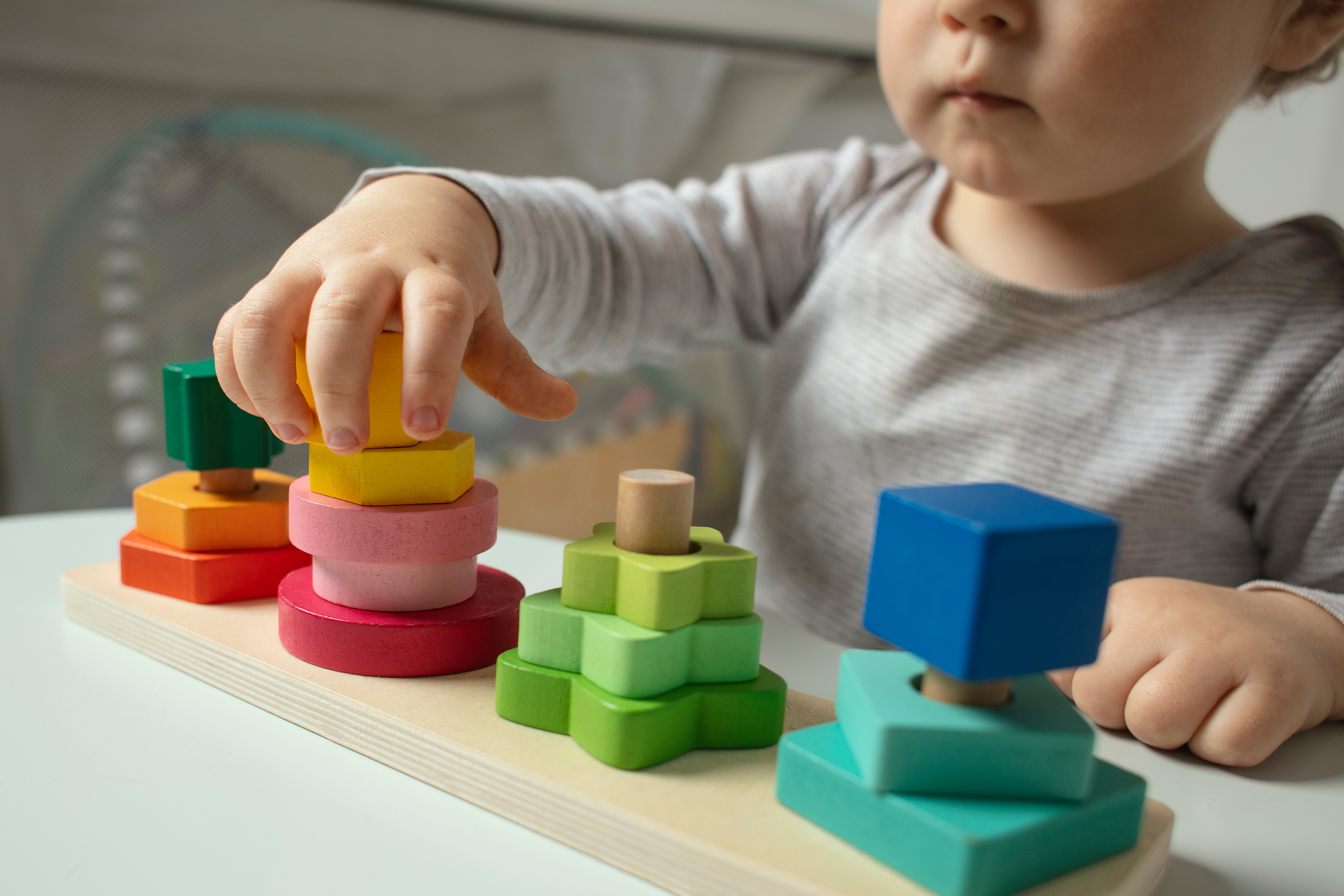
Moreover, spatial awareness also contributes to safety as children become more adept at noticing and avoiding potential hazards. Encouraging activities that promote spatial skills, such as puzzles, building blocks, and interactive play, not only accelerates academic growth but also builds a child's confidence and ability to explore the world. For these reasons, parents and teachers should prioritize the cultivation of spatial awareness in early childhood education.







